
>

>

ChatGPT prompts for turning notes into flashcards to master any subject fast.

Chatgpt prompts for turning notes into flashcards [Free Guide]

Discover the best ChatGPT prompts for turning notes into flashcards. Learn how to automate your study deck, improve retention, and use AI for active recall.

Use Study AI Free
ChatGPT Prompts for Turning Notes Into Flashcards

Students often struggle with the tedious process of manual flashcard creation, spending hours typing out definitions instead of actually studying them. These prompts unlock a faster way to transform messy lecture notes into high-quality active recall tools, saving you time and ensuring you focus on the most critical information. Simply copy and paste the prompts below to build your study deck in seconds.

Quick Start Guide

The most effective way to use this page is to copy the prompt that fits your current material, paste your notes directly into the chat, and specify your desired output format. The #1 Rule: Always provide your source text or PDF content; never ask ChatGPT to generate cards from memory, as it may include information your professor never covered or hallucinate facts.

How to Use These Prompts

  • Step 1: Paste Your Material: Copy your lecture slides, textbook highlights, or handwritten notes into the chat.

  • Step 2: Set Constraints: Define the complexity (e.g., medical student level or introductory high school) and the format (e.g., Anki-ready CSV or simple Q&A).

  • Step 3: Ask for Output + Self-Check: Review the generated cards to ensure they accurately reflect your notes and spot any gaps in logic.

  • Step 4: Convert into Spaced Repetition: Move these cards into a system like Duetoday or Anki to start your retention cycle.

Bucket A: Understand & Structure

The Definition Deep-Dive

Use this when you have a list of technical terms that need clear, concise explanations.

I am going to provide my notes. Please extract all bolded or key terms and create a flashcard for each. Front: The Term. Back: A 1-sentence definition based ONLY on the provided text, followed by a simple analogy to help me remember it

A good answer provides a clear distinction between the concept and the analogy, making the card easy to read at a glance.

The Concept Relationship Card

Use this when you need to understand how two different ideas in your notes interact with each other.

Based on these notes, create 5 'Compare and Contrast' flashcards. Front: How does [Concept A] differ from [Concept B]? Back: List 2-3 primary differences or similarities mentioned in the text

A good answer focuses on the specific nuances found in your source material rather than general internet knowledge.

The 'Why It Matters' Prompt

Use this to move beyond rote memorization and understand the significance of a topic.

Review these notes and create flashcards that focus on causality. Front: What is the primary cause/significance of [Topic]? Back: The explanation provided in the notes, formatted in a bulleted list

A good answer helps you prepare for essay-style questions by linking facts to their broader context.
Bucket B: Remember & Retain

The Simple Q&A Generator

Use this for general study sessions where you need a comprehensive review of the material.

Act as an expert tutor. Read these notes and generate 10 flashcards in a Q&A format. Ensure the questions are challenging and require active recall, not just simple 'yes/no' answers

A good answer forces you to describe processes or explain 'how' things work based on your lecture content.

Cloze Deletion (Fill-in-the-blank)

Use this for memorizing specific formulas, dates, or sequences of events.

Turn these notes into 8 'Cloze Deletion' flashcards. Replace the most critical keyword in a sentence with [...] and provide the answer for the back of the card

A good answer selects the most 'high-yield' information to hide, ensuring you are testing your core knowledge.

The Mnemonic Creator

Use this for lists or categories that are notoriously difficult to keep straight.

Identify the 3 most complex lists in these notes and create a flashcard for each. Front: List the components of [Topic]. Back: The list, plus a creative mnemonic or acronym to remember them

A good answer provides a memorable and catchy phrase that directly corresponds to the list items.

Bucket C: Practice & Master

The Scenario-Based Card

Use this for subjects like law, business, or medicine where you must apply knowledge to a situation.

Based on the attached notes, create 5 scenario-based flashcards. Front: A brief 2-sentence problem or situation. Back: The correct solution or diagnosis according to the principles mentioned in the notes

A good answer mimics the style of exam questions, helping you practice application rather than just recognition.

The Mistake-Avoidance Card

Use this to highlight common pitfalls or 'tricky' parts of a subject.

According to these notes, what are the most common misconceptions or errors students make about [Topic]? Create 3 flashcards where the Front asks 'Why is [Common Error] incorrect?' and the Back explains the right concept

A good answer helps you bulletproof your knowledge against common exam 'distractors.'

Common Mistakes to Avoid

  • Asking without providing source text: This leads to generic cards that might not match what you'll be tested on.

  • Ignoring formatting: If you don't specify 'Question and Answer format,' you might get long paragraphs that are hard to study.

  • Focusing on quantity over quality: 100 bad cards are worse than 20 high-yield ones. Use prompts that target 'key concepts.'

  • Only summarizing: A summary is passive; a flashcard must be a question that triggers a specific memory.

Supercharge Your Study Flow with Duetoday

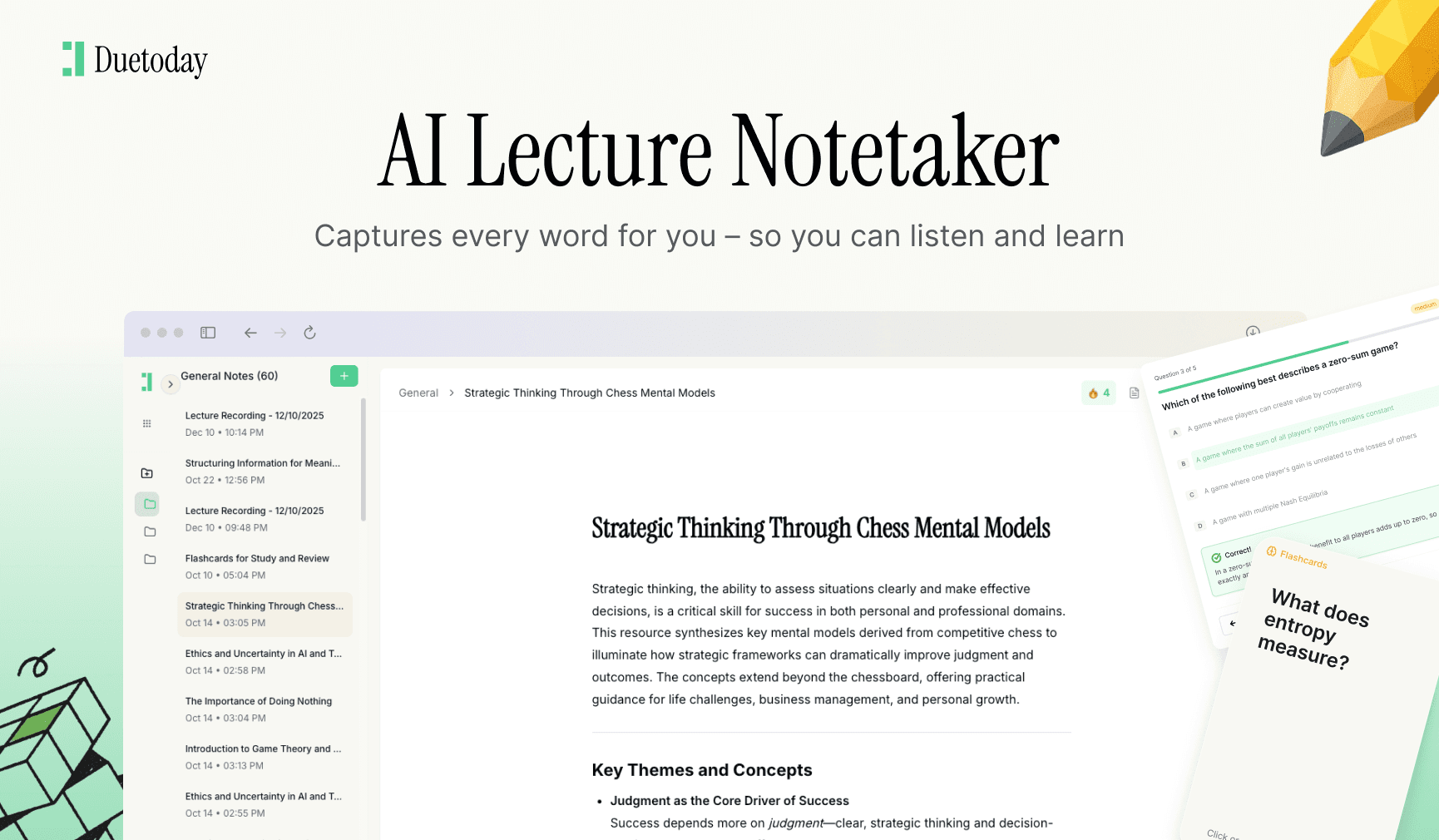
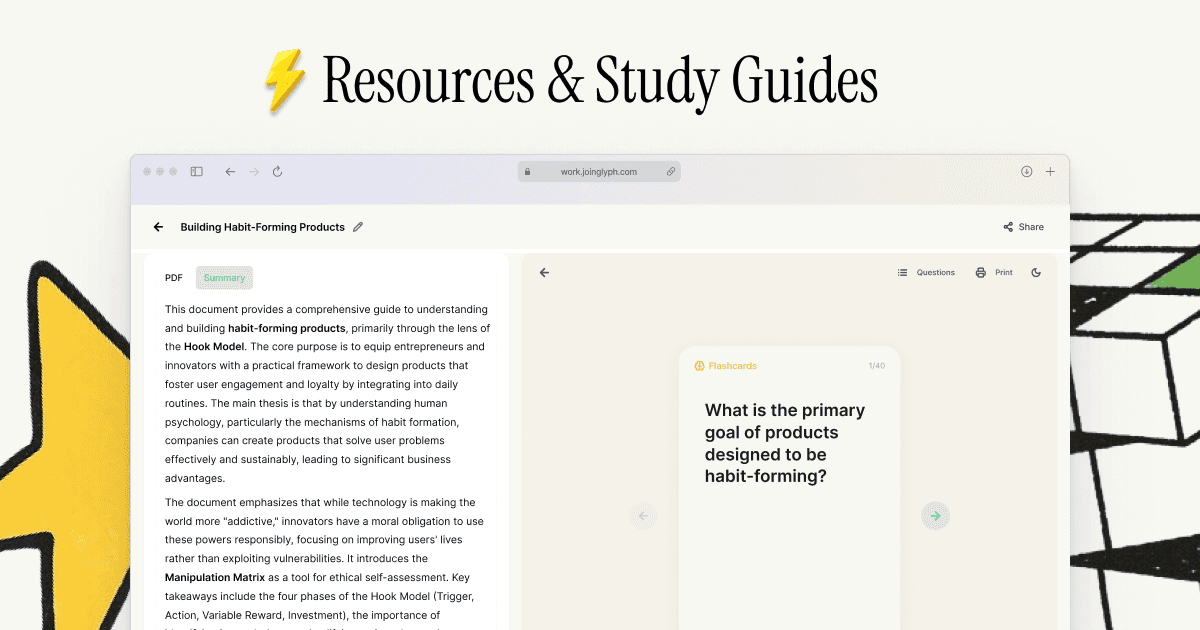
Manual prompting still takes work. If you want this entire process automated, Duetoday is the answer. Simply upload your PDFs, YouTube links, or Notion pages, and Duetoday's AI Brain will automatically extract the most important concepts and turn them into flashcards, quizzes, and spaced-repetition schedules.

  • Upload Material & Sync Notion

  • Generate Instant Active Recall Tools

  • Track Your Retention Progress

Stop copy-pasting and start learning. Pick two prompts from above to try today, or let Duetoday do the heavy lifting for you.

Duetoday is an AI-powered learning OS that turns your study materials into personalised, bite-sized study guides, cheat sheets, and active learning flows.

More Chatgpt Prompts
GET STARTED

Most Powerful Study Tool
for Students and Educators

Try Out Free. No Credit Card Required.
