
>

>

ChatGPT prompts for sustainable studying: Study smarter, not longer.

Chatgpt prompts for sustainable studying [Free Guide]

Discover the best ChatGPT prompts for sustainable studying. Learn to build eco-friendly study habits, manage burnout, and retain information efficiently.

Use Study AI Free
ChatGPT Prompts for Sustainable Studying

Many students struggle with academic burnout and inefficient study habits that lead to exhaustion rather than long-term mastery. These ChatGPT prompts for sustainable studying unlock a marathon-mindset, allowing you to maintain high performance without sacrificing your mental well-being or time. Below, you will find copy-paste prompts designed to help you organize, simplify, and retain knowledge for the long haul.

Quick Answer: The Best Way to Use This Page

To get the most out of these sustainable studying prompts, follow this quick framework: Paste your source text -> Define your goal -> Ask for a retrieval-based output. Instead of asking ChatGPT to 'summarize' (which is passive), ask it to 'structure' or 'challenge' you. Always provide your own lecture notes or PDFs as the primary source to prevent the AI from hallucinating facts outside your curriculum.

How to Use These Prompts

  • Step 1: Feed the AI: Paste your specific study material (lecture transcripts, PDFs, or Notion notes) into the chat.

  • Step 2: Set Constraints: Specify your current level (e.g., undergraduate) and the desired format (e.g., a 15-minute study block).

  • Step 3: Interactive Output: Ask the AI to identify gaps in your knowledge or create a practice quiz to verify your understanding.

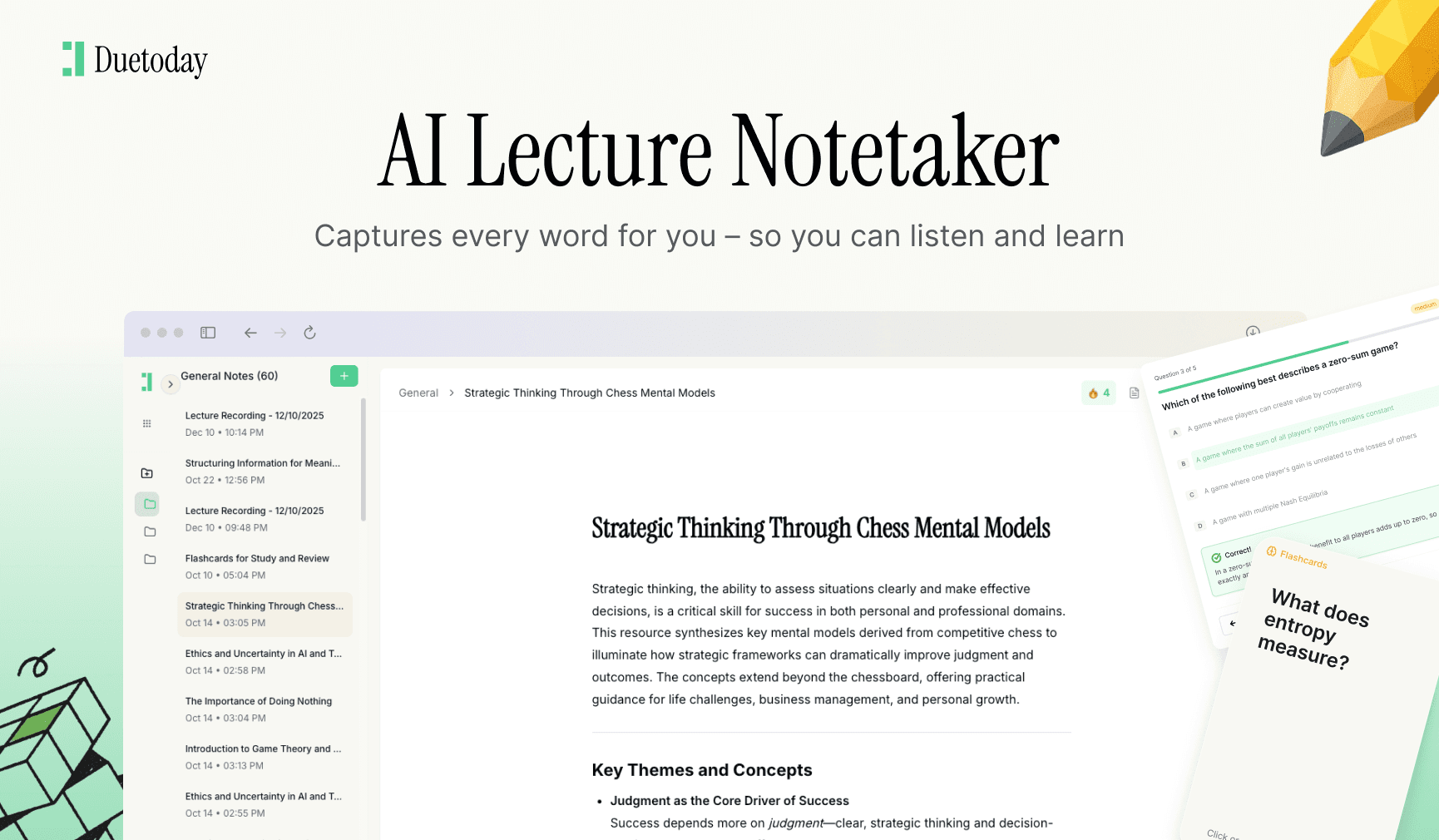
  • Step 4: Automate Retention: Move the generated insights into a tool like Duetoday to create a permanent, AI-powered study brain.

Bucket A: Understand (Sustainable Comprehension)

The Core Concept Simplifier

Use this when you are facing a complex topic that feels overwhelming and you need a high-level overview that sticks.

"I am uploading my notes on [Topic]. Please explain the most difficult core concept here as if I am a beginner, then gradually increase the technical detail. Use a sustainable analogy to help me remember the logic behind it."

A good answer: Connectes a difficult academic theory to a real-world system you already understand.

The Socratic Tutor Mode

Use this to build deep understanding through dialogue rather than passive reading.

"Act as a Socratic tutor. Based on the attached text about [Topic], do not give me a summary. Instead, ask me a series of probing questions one by one to help me derive the main conclusions myself."

A good answer: Challenges your assumptions and forces you to articulate the material in your own words.

The Connection Engine

Use this to link new information to what you already know, reducing the cognitive load of memorization.

"Here are my notes on [New Topic] and a brief summary of [Previous Topic]. Explain the relationship between these two subjects so I can integrate them into a single mental model."

A good answer: Maps out the intersections of different modules to create a holistic view of your course.
Bucket B: Remember (Long-term Retention)

The Spaced Repetition Scheduler

Use this to transform a heavy workload into a manageable, long-term review plan.

"Based on the exam date of [Date] and the complexity of these notes on [Topic], create a 4-week sustainable study schedule using spaced repetition intervals (1, 3, 7, and 14 days)."

A good answer: A realistic calendar that prevents last-minute cramming and reduces stress.

Notes-to-Q&A Converter

Use this to prepare for active recall sessions without spending hours writing your own questions.

"Extract 10 high-impact questions and answers from the attached lecture. Format them as 'Q:' and 'A:' so I can use them for self-testing and active recall."

A good answer: Specific, challenging questions that target the 'why' and 'how' rather than just 'what'.

The 'Teach it Back' Drill

Use this to find holes in your knowledge by explaining the topic back to the AI.

"I will explain [Concept] to you in my own words. Please listen and then identify any inaccuracies, missing details, or parts of my explanation that are unclear based on the source text."

A good answer: Provides constructive feedback that highlights exactly where your understanding is weak.

Bucket C: Practice (Application)

Practice Question & Answer Key

Use this to simulate exam conditions in a low-stakes, sustainable environment.

"Generate 5 multiple-choice questions and 2 short-answer questions based on these notes. After I provide my answers, give me a detailed answer key with explanations for why each answer is correct."

A good answer: Questions that vary in difficulty and test both rote memory and conceptual application.

The Error-Log Analyst

Use this to learn from your mistakes so you don't repeat them in the future.

"I got these questions wrong during my practice session: [Paste Questions/Answers]. Analyze these errors and explain the underlying principle I am missing, and suggest a way to remember it."

A good answer: A diagnostic report that turns failures into specific learning opportunities.

Common Mistakes to Avoid

  • Asking for summaries only: Research shows that reading summaries is one of the least effective ways to learn. Focus on practice questions instead.

  • Ignoring the source text: Without your specific notes, ChatGPT will give generic answers that may not align with your professor's requirements.

  • Over-automating: Don't let the AI do the thinking. Use it to facilitate *your* engagement with the material.

If you want this automated...

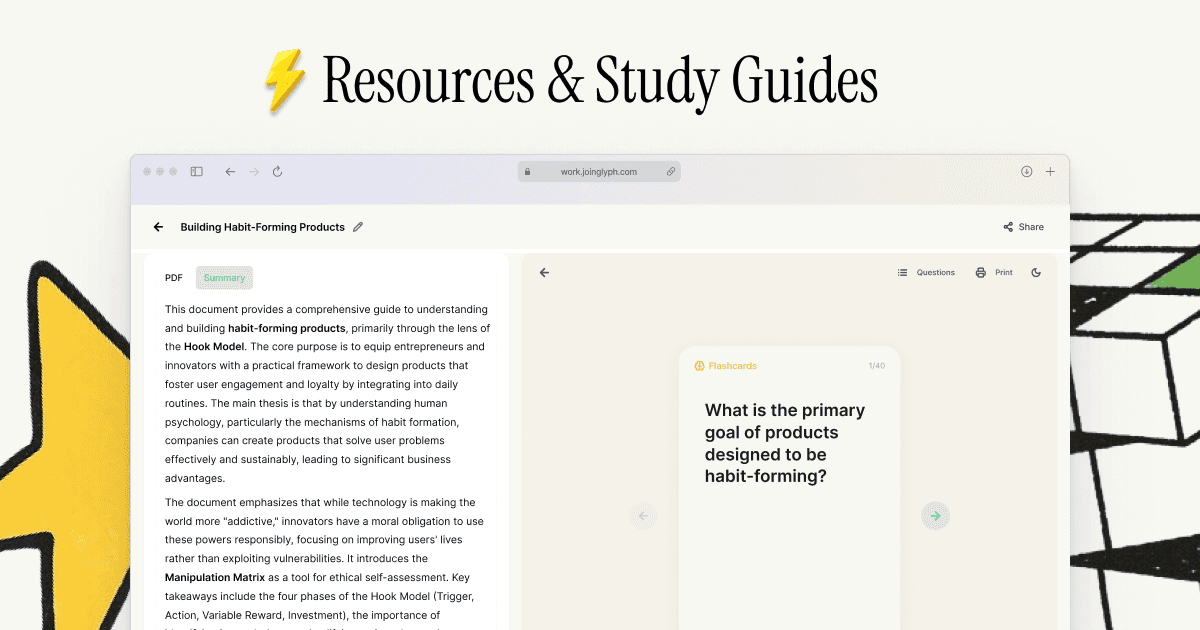
While ChatGPT is powerful, it requires constant manual input and context switching. Duetoday simplifies sustainable studying by serving as your retention-first workspace. Simply upload your materials—from YouTube links to PDFs—and Duetoday will automatically generate flashcards, quizzes, and a structured AI brain that knows exactly what you've learned.

Start building your AI learning brain at Duetoday.

Duetoday is an AI-powered learning OS that turns your study materials into personalised, bite-sized study guides, cheat sheets, and active learning flows.

More Chatgpt Prompts
GET STARTED

Most Powerful Study Tool
for Students and Educators

Try Out Free. No Credit Card Required.