
Chatgpt prompts for studying with past papers [Free Guide]
Maximize your exam prep with these ChatGPT prompts for studying with past papers. Learn how to analyze trends, simulate exams, and master complex topics fast.
Use Study AI Free
ChatGPT Prompts for Studying With Past Papers
Students often struggle to move beyond just 'doing' a past paper; the real challenge is identifying patterns, understanding where marks are lost, and fixing knowledge gaps before exam day. These ChatGPT prompts unlock a faster way to analyze your performance, simulate exam conditions, and turn old questions into active learning tools. Simply copy and paste the prompts below to transform your study sessions into high-yield exam preparation.
The Quick Start Guide to Past Paper Analysis
The most effective way to use this page is to feed ChatGPT your specific syllabus and previous exam questions. Here is the golden rule: Never let ChatGPT guess the content. Always upload the PDF of the past paper or paste the specific question text along with your answer for the most accurate feedback. To start, replace the [bracketed] variables in the prompts with your specific subject, exam board, and grade level.
How to Use These Prompts Effectively
Step 1: Feed the Context: Paste the past paper question and the official marking scheme into the chat.
Step 2: Set Your Constraints: Tell ChatGPT your current level (e.g., AP, A-Level, University) and ask it to grade you strictly based on the provided rubric.
Step 3: Analyze and Iterate: Don't just look at the score. Ask the AI to explain the logic behind the correct answer and identify which sub-topics you need to revisit.
Step 4: Automate the Retention: Use the output to create flashcards or a spaced repetition schedule to ensure you don't make the same mistake twice.
Bucket A: Deep Understanding & Concept Mapping
H3: The Marking Scheme Decoder
Use this prompt when you have the mark scheme but don't understand why a specific point earned the mark. It helps bridge the gap between knowing the facts and hitting the examiner's requirements.
"I am providing a past paper question and the official mark scheme. I wrote [Your Answer]. Please analyze why the mark scheme requires [Specific Requirement] and explain the logic behind it so I can apply this thinking to similar questions in the future."
A good answer will break down the 'examiner's mindset' and explain the specific vocabulary or logic needed for full marks.
H3: Topic Trend Finder
Use this when you have access to multiple years of past papers and want to identify high-yield topics.
"Based on these [Number] past paper questions from [Subject], identify the top 3 recurring themes or concepts that appear most frequently. Explain how the questions vary each year and what core principles I must master to answer any variation of this topic."
A good response provides a prioritized list of topics to study, saving you hours of manual cross-referencing.
H3: Socratic Error Analysis
Instead of giving you the answer, this prompt forces you to think through your mistakes like a tutor would.
"I got this past paper question wrong. Here is the question and my incorrect answer. Don't give me the right answer immediately. Instead, ask me a series of Socratic questions to lead me to discover where my reasoning failed and help me find the correct solution myself."
A good answer will be a dialogue that guides you to a 'lightbulb moment' rather than just handing you a solution.
Bucket B: Memory & Knowledge Retention
H3: The 'Reverse Engineering' Flashcard Generator
Use this to turn past paper mistakes into long-term memory using spaced repetition.
"Based on this past paper question and the correct answer, create 5 high-yield Anki-style flashcards. Each card should focus on a different conceptual layer of the question (e.g., definitions, processes, application, and common 'distractor' errors)."
A good answer provides clear Front/Back card formats that test your actual understanding, not just rote memorization.
H3: The Spaced Repetition Mastery Schedule
Use this to plan your final countdown to the exam based on your performance on past papers.
"I have [Number] days until my exam. Here is a list of topics I struggled with in my last 3 past papers: [List Topics]. Create a daily study schedule that incorporates spaced repetition, focusing heavily on my weak areas while briefly reviewing strong areas."
A good output is a structured, realistic calendar that balances new learning with constant review.
Bucket C: Active Practice & Simulation
H3: The 'Variation' Question Generator
Use this to ensure you haven't just memorized one specific question's answer.
"Here is a past paper question about [Topic]. Create 3 new variations of this question that test the same concept but use different scenarios, data points, or wording. Provide an answer key and marking criteria for each."
A good response gives you fresh practice material that feels like it could be on the real exam.
H3: The High-Pressure Exam Simulator
Use this to practice your timing and focus under simulated conditions.
"Act as a strict examiner. Give me one question from the attached past paper at a time. I have [Number] minutes per question. After I submit my answer, do not give feedback yet. Move to the next question. Only after I finish the full set, provide a detailed grade and critique."
This helps you build the 'exam stamina' needed for the actual day.
Common Mistakes to Avoid
Asking without source text: AI works best as a processor, not a search engine. Feed it the paper.
Ignoring the 'Why': Don't just check if you're right. Use AI to understand why the wrong answers are wrong.
Over-reliance on Summaries: Summarizing is passive. Use these prompts for active retrieval and practice questions instead.
Ignoring Citations: If you are in a subject that requires specific citations, verify the AI's suggestions against your actual syllabus.
Optimize Your Study Workflow
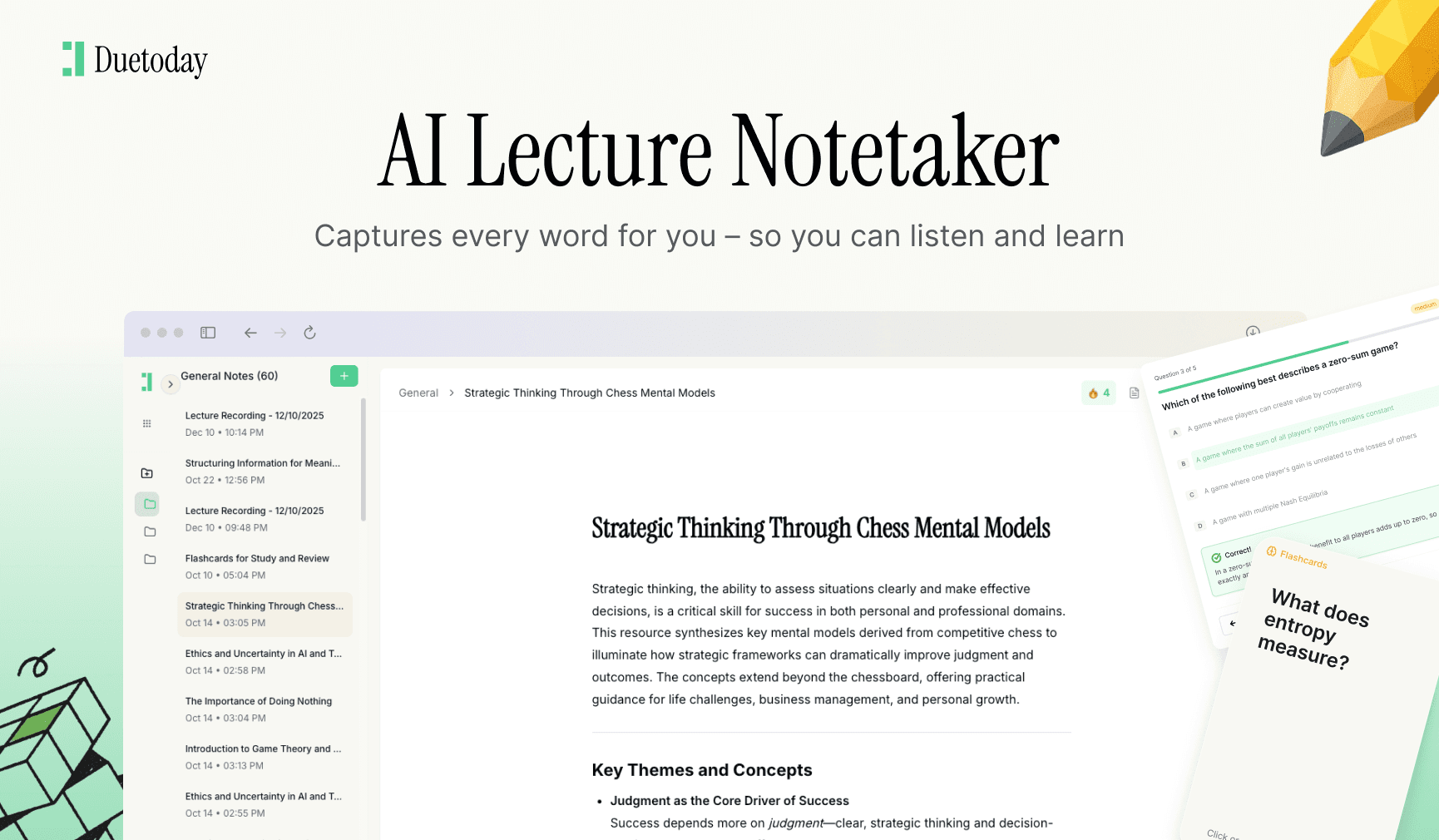
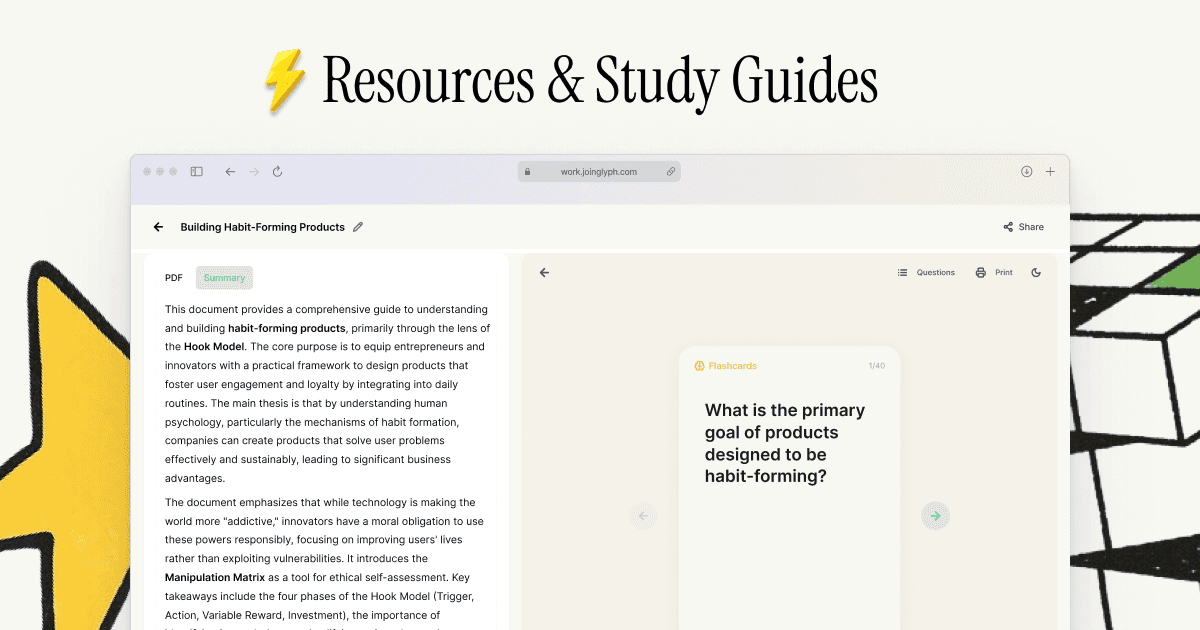
If you want this entire process automated, Duetoday is the ultimate retention-first workspace. Instead of manually prompting, you can upload your past papers, lecture notes, and YouTube tutorials into one 'AI Brain.' Duetoday connects the context across all your materials, instantly generates flashcards, and helps you recall everything when it matters most. Pick two prompts from this list and start today—or let Duetoday handle the heavy lifting for you.

Duetoday is an AI-powered learning OS that turns your study materials into personalised, bite-sized study guides, cheat sheets, and active learning flows.
More Chatgpt Prompts
GET STARTED
Most Powerful Study Tool
for Students and Educators
Try Out Free. No Credit Card Required.
