
>

>

ChatGPT prompts for deep work studying to master focus and retention.

Chatgpt prompts for Deep Work Studying [Free Guide]

Discover the best ChatGPT prompts for studying in deep work blocks. Learn how to structure intense focus sessions and automate your study notes with AI.

Use Study AI Free
ChatGPT Prompts for Studying in Deep Work Blocks

Many students struggle to maintain high-intensity focus, often falling victim to shallow work and constant distractions that hinder long-term retention. These prompts unlock a systematic approach to learning, allowing you to achieve faster understanding, better memory recall, and disciplined practice during your focus windows. Copy and paste the prompts below to transform your study sessions into high-output deep work blocks.

Quick Start: Using ChatGPT for Deep Work

To get the most out of these prompts, follow this quick framework:

  • What to paste: Copy your lecture transcripts, PDF text, or reading materials into the chat.

  • What to replace: Adjust the [Topic], [Difficulty Level], and [Time Block Duration] to match your specific session.

  • The Golden Rule: Always provide your source material first so ChatGPT acts as a tutor for your content rather than guessing from the web.

How to Use These Prompts Effectively

Maximizing deep work requires a repeatable system. Follow these four steps to integrate AI into your focus blocks:

  • Step 1: Feed the Context: Paste your slides, notes, or textbook chapters into ChatGPT.

  • Step 2: Define Constraints: Explicitly state your goals, such as "summarize for a senior-level exam" or "create a 90-minute study plan."

  • Step 3: Interactive Output: Don't just read the response; ask the AI to quiz you or identify your weak points.

  • Step 4: Bridge to Retention: Take the outputs and move them into a system like Duetoday for long-term spaced repetition.

Bucket A: Deep Understanding & Synthesis

The Conceptual Deep Dive

Use this when you need to understand a complex topic from scratch during a focus block.

I am starting a 90-minute deep work block on [Topic]. Based on the text I provided, explain the core principles simply, then gradually increase the complexity to a graduate level. Highlight the most difficult nuances I need to master

A good answer provides a tiered explanation that builds confidence before tackling advanced technicalities.

The Socratic Tutor Mode

Use this to stress-test your understanding through guided questioning.

Don't give me the answers directly. Based on these notes, act as a Socratic tutor and ask me a series of probing questions about [Topic] to help me derive the conclusions myself during this focus session.

A good answer will challenge your assumptions and force you to retrieve information from memory.

The Mental Model Linker

Use this to connect new information to concepts you already know.

Analyze these notes on [Topic]. Identify three mental models or analogies from other fields (like biology, physics, or sports) that explain how this system works to help it stick in my long-term memory

A good answer provides vivid, memorable analogies that make abstract data feel concrete.
Bucket B: Memory & Optimization

The Spaced Repetition Architect

Use this to plan your follow-up sessions immediately after a deep work block.

Based on the materials I just studied, create a 7-day spaced repetition schedule. Tell me exactly which sub-topics I should review on Day 1, 3, and 7 to ensure maximum retention

A good answer provides a clear, actionable calendar view of your upcoming review sessions.

Active Recall Flashcard Builder

Use this to turn your focus session into a long-term study asset.

Extract the most important facts and relationships from these notes. Format them as Q&A pairs suitable for flashcards. Focus on 'why' and 'how' rather than just 'what'

A good answer avoids one-word facts and focuses on conceptual understanding.

The Summarization Filter

Use this to distill massive amounts of text into high-density cheat sheets.

I have 30 minutes left in my deep work block. Condense these 20 pages into a one-page summary focusing on the 5 'must-know' concepts and their formulas/definitions

A good answer eliminates fluff and highlights the 'high-yield' information for exams.

Bucket C: Focused Practice

The Error-Log Analysis

Use this to learn from your past mistakes during a practice session.

Here is a list of questions I got wrong. Based on the source material, explain the underlying logic I missed for each one and give me a similar practice problem to prove I've learned it.

A good answer identifies the pattern in your mistakes rather than just correcting the fact.

The 'Teach it Back' Drill

Use this to verify you have actually mastered the topic before ending your block.

I will now explain [Topic] to you as if you are a beginner. Listen to my explanation, point out any gaps in my logic based on the provided notes, and ask two follow-up questions to test my depth

A good answer provides constructive feedback and ensures you aren't just memorizing definitions.

Common Mistakes to Avoid

  • No Source Text: Asking ChatGPT to explain topics without giving it your specific notes leads to generic and sometimes incorrect answers.

  • Ignoring Difficulty: Failing to specify your level (e.g., 'Freshman' vs. 'PhD') results in answers that are either too simple or overly complex.

  • Passive Consumption: Only asking for summaries instead of asking for quizzes or 'Teach it Back' drills significantly lowers your retention rate.

Optimize Your Learning with Duetoday

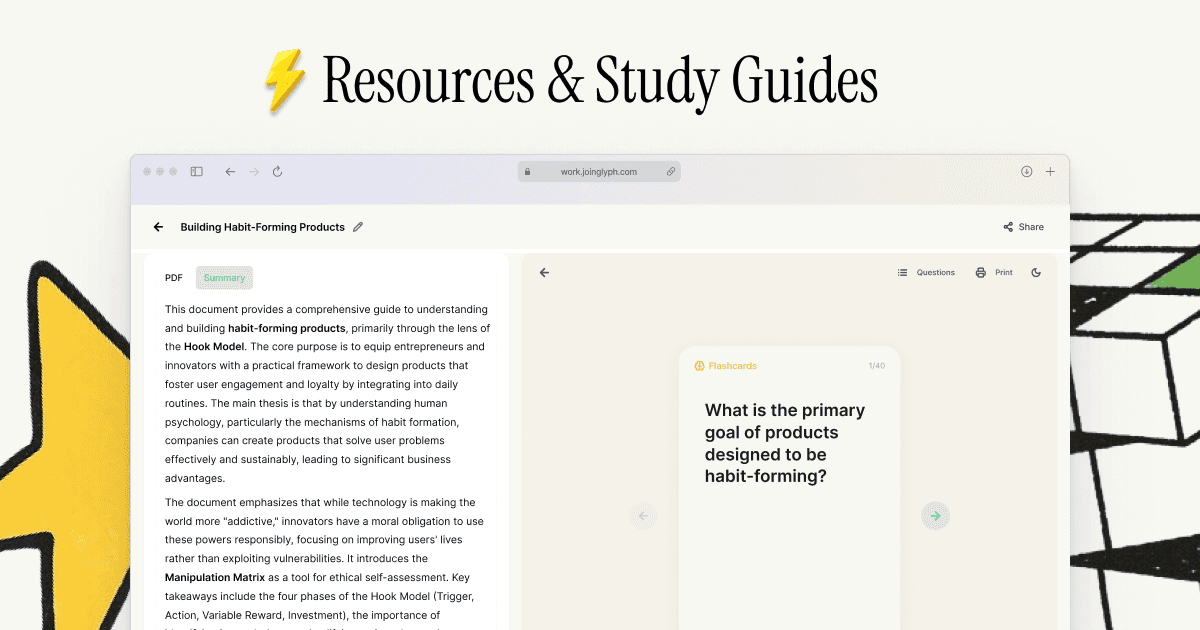
If you want to automate this entire process, Duetoday is the ultimate workspace for deep work. Simply upload your PDFs, YouTube links, or Notion notes, and let Duetoday’s AI Brain do the heavy lifting.

  • Instant Study Sets: Automatically generate flashcards and quizzes from your deep work materials.

  • Unified Context: Chat with all your uploads at once—no more copying and pasting into ChatGPT.

  • Retention Layer: Turn your focus blocks into a structured action list with our AI task manager.

Stop jumping between tabs. Get started with Duetoday AI today and turn your notes into permanent knowledge.

Duetoday is an AI-powered learning OS that turns your study materials into personalised, bite-sized study guides, cheat sheets, and active learning flows.

More Chatgpt Prompts
GET STARTED

Most Powerful Study Tool
for Students and Educators

Try Out Free. No Credit Card Required.
