ChatGPT Prompts for Study Reflection
Students often struggle to identify exactly why they aren't retaining information, often repeating the same ineffective study habits week after week. These prompts unlock a deeper level of metacognition, helping you analyze your learning process to find faster ways to understand and remember complex material. Copy and paste the prompts below to turn your past study sessions into a roadmap for future success.
Quick Start Guide
To get the most out of these reflection prompts, follow this simple framework: Paste your source text + describe your recent study session + apply the prompt. Always provide your own notes or lecture transcripts to ensure ChatGPT analyzes your actual work rather than providing generic advice. Specify your academic level and any specific exam dates to help the AI prioritize what matters most for your upcoming deadlines.
How to Use These Prompts Effectively
Step 1: Feed the Context: Paste your recent notes, a graded assignment, or a summary of what you studied today.
Step 2: Set the Parameters: Tell ChatGPT your goal (e.g., "I want to find out why I got the practice questions wrong" or "I need a more efficient way to read these papers").
Step 3: Analyze and Adjust: Use the output to spot knowledge gaps and ask the AI to suggest a specific corrective action.
Step 4: Automate the Future: Convert your reflections into a structured study plan or spaced repetition schedule.
Bucket A: Deepen Understanding
The Knowledge Shadow Finder
Use this prompt when you feel like you understand a topic but struggle to explain it to others.
I am going to provide my notes on [Topic]. Please analyze them and identify three 'shadow areas' where my explanation is vague or lacks depth. Ask me three targeted questions that force me to connect these concepts to [Related Concept] to ensure I truly understand the underlying logic
I am going to provide my notes on [Topic]. Please analyze them and identify three 'shadow areas' where my explanation is vague or lacks depth. Ask me three targeted questions that force me to connect these concepts to [Related Concept] to ensure I truly understand the underlying logic
I am going to provide my notes on [Topic]. Please analyze them and identify three 'shadow areas' where my explanation is vague or lacks depth. Ask me three targeted questions that force me to connect these concepts to [Related Concept] to ensure I truly understand the underlying logic
A good answer will point out specific logical leaps in your notes and challenge you with high-level conceptual questions.
The Analogy Stress Test
Use this when you want to ensure your mental models are accurate and durable.
Based on the attached materials about [Concept], I believe it works like [Your Analogy]. Critique this analogy. Where does it hold up, and where does it fail to represent the academic reality? Suggest a more precise analogy if this one is flawed
Based on the attached materials about [Concept], I believe it works like [Your Analogy]. Critique this analogy. Where does it hold up, and where does it fail to represent the academic reality? Suggest a more precise analogy if this one is flawed
Based on the attached materials about [Concept], I believe it works like [Your Analogy]. Critique this analogy. Where does it hold up, and where does it fail to represent the academic reality? Suggest a more precise analogy if this one is flawed
This ensures you aren't oversimplifying complex topics to the point of inaccuracy.
Bucket B: Remember and Retain
The Connection Mapper
Use this to stop studying topics in isolation and start building a 'mental web.'
I have studied [Current Topic] and [Previous Topic]. Based on my notes, explain 3 non-obvious ways these two topics intersect. How does understanding [Previous Topic] make learning [Current Topic] easier? Generate a summary that bridges both
I have studied [Current Topic] and [Previous Topic]. Based on my notes, explain 3 non-obvious ways these two topics intersect. How does understanding [Previous Topic] make learning [Current Topic] easier? Generate a summary that bridges both
I have studied [Current Topic] and [Previous Topic]. Based on my notes, explain 3 non-obvious ways these two topics intersect. How does understanding [Previous Topic] make learning [Current Topic] easier? Generate a summary that bridges both
A good answer creates a 'bridge' between old and new knowledge, which is the key to long-term retention.
The Spaced Repetition Architect
Use this to turn a one-time study session into a long-term memory plan.
I just finished a 2-hour study session on [Topic]. Based on the complexity of these notes, create a 2-4-7-14 day review schedule. For each review day, give me one specific 'active recall' prompt I should answer to test my memory without looking at the notes
I just finished a 2-hour study session on [Topic]. Based on the complexity of these notes, create a 2-4-7-14 day review schedule. For each review day, give me one specific 'active recall' prompt I should answer to test my memory without looking at the notes
I just finished a 2-hour study session on [Topic]. Based on the complexity of these notes, create a 2-4-7-14 day review schedule. For each review day, give me one specific 'active recall' prompt I should answer to test my memory without looking at the notes
The Summarization Audit
Use this to check if your summaries are actually capturing the core 'why' of the material.
Here is my summary of [Lecture/Chapter]. Compare this to the 'First Principles' of [Subject]. Did I focus too much on 'what' happened and too little on 'why' it happened? Rewrite my summary to be 50% shorter but 100% more focused on the core mechanisms
Here is my summary of [Lecture/Chapter]. Compare this to the 'First Principles' of [Subject]. Did I focus too much on 'what' happened and too little on 'why' it happened? Rewrite my summary to be 50% shorter but 100% more focused on the core mechanisms
Here is my summary of [Lecture/Chapter]. Compare this to the 'First Principles' of [Subject]. Did I focus too much on 'what' happened and too little on 'why' it happened? Rewrite my summary to be 50% shorter but 100% more focused on the core mechanisms
Bucket C: Practice and Perform
The Socratic Tutor Mode
Use this to transition from reading to being tested.
I want to reflect on my understanding of [Topic]. Do not give me a summary. Instead, act as a Socratic tutor and ask me one difficult question at a time to probe my understanding. After I answer, provide feedback and ask the next question. Stop after 5 questions
I want to reflect on my understanding of [Topic]. Do not give me a summary. Instead, act as a Socratic tutor and ask me one difficult question at a time to probe my understanding. After I answer, provide feedback and ask the next question. Stop after 5 questions
I want to reflect on my understanding of [Topic]. Do not give me a summary. Instead, act as a Socratic tutor and ask me one difficult question at a time to probe my understanding. After I answer, provide feedback and ask the next question. Stop after 5 questions
The Error-Log Analyzer
Use this after a practice test to ensure you don't make the same mistakes twice.
I am pasting a list of questions I got wrong on my [Subject] quiz. Categorize these mistakes into: 1. Conceptual Gap, 2. Careless Error, or 3. Vocabulary Confusion. Suggest a specific 15-minute drill for the category I missed most
I am pasting a list of questions I got wrong on my [Subject] quiz. Categorize these mistakes into: 1. Conceptual Gap, 2. Careless Error, or 3. Vocabulary Confusion. Suggest a specific 15-minute drill for the category I missed most
I am pasting a list of questions I got wrong on my [Subject] quiz. Categorize these mistakes into: 1. Conceptual Gap, 2. Careless Error, or 3. Vocabulary Confusion. Suggest a specific 15-minute drill for the category I missed most
Common Mistakes to Avoid
Passive Reflection: Don't just ask ChatGPT to "summarize my notes." This is passive. Ask it to "challenge my notes."
Lack of Constraints: Always define the difficulty. If you don't specify "Medical School level," you might get a middle-school level explanation.
Ignoring the Hallucination Risk: If ChatGPT quotes a study or date you don't recognize, double-check it against your primary sources.
Skipping the 'Teach Back': Reflection works best when you process the AI's feedback and try to explain the concept back in your own words.
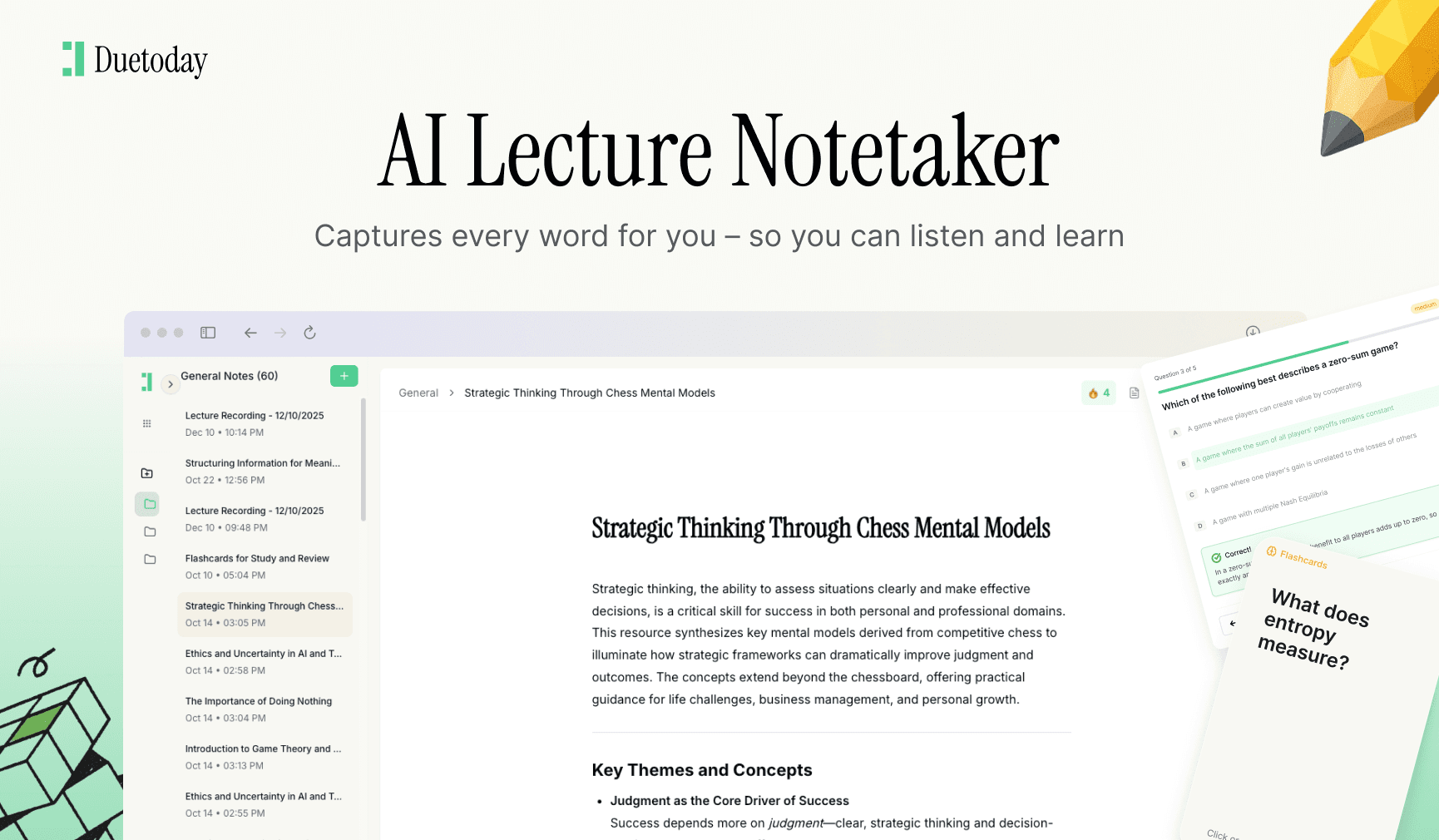
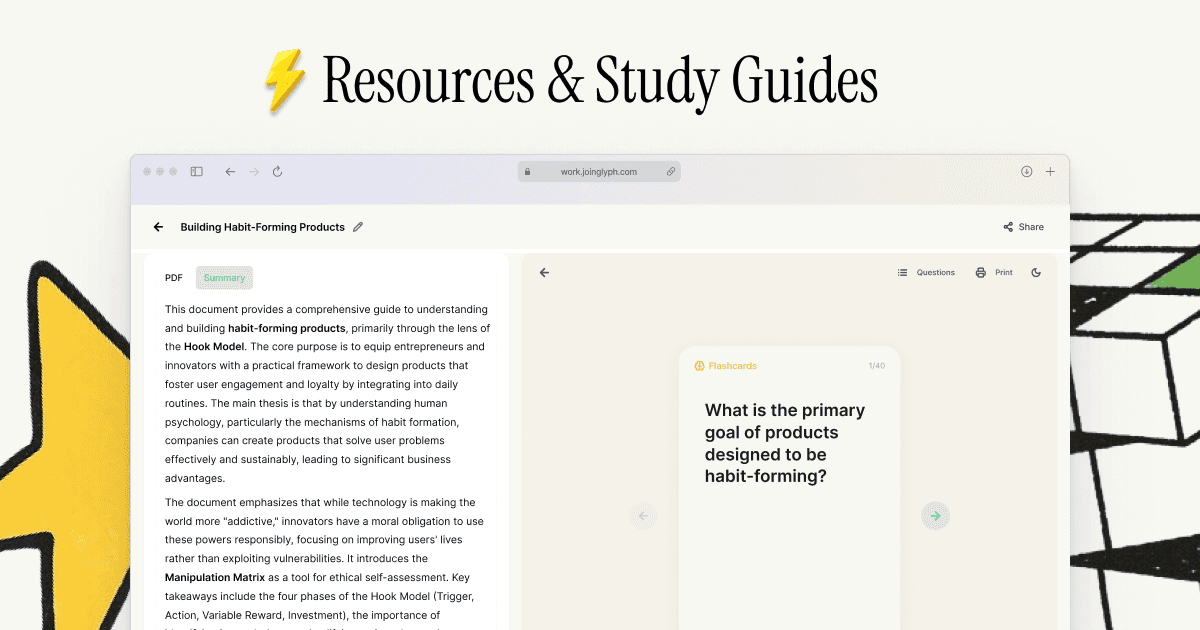
Start by picking just two prompts from the 'Understand' bucket to audit your latest lecture notes. If you want this process to be automated—where your PDFs, YouTube videos, and notes are instantly turned into quizzes and reflection guides—try Duetoday. It builds your 'AI Brain' so you can focus on learning, not just prompting.