
>

>

ChatGPT prompts for speed-reading textbooks for faster retention.

Chatgpt prompts for speed-reading [Free Guide}

Discover the best ChatGPT prompts for speed-reading textbooks. Learn how to extract key concepts, summarize chapters, and maximize retention in half the time.

Use Study AI Free
ChatGPT Prompts for Speed-Reading Textbooks

Many students struggle with massive reading assignments, often spending hours on a single chapter without actually retaining the core concepts. These prompts unlock a strategic way to digest academic material, allowing you to move from passive reading to active, high-speed comprehension and long-term retention. Copy and paste the prompts below to turn your textbook sessions from a chore into a streamlined learning workflow.

The Quick Start Guide

To get the most out of these prompts, follow this quick framework: focus on the structure first, the details second. Instead of reading every word, paste the table of contents or chapter summary into ChatGPT. The Golden Rule: Always provide the specific text or your personal lecture notes alongside the prompt to ensure the AI doesn't hallucinate facts that aren't in your specific curriculum.

How to Use These Prompts Effectively

  • Step 1: Select a chapter or section of your textbook and paste the text into the chat (or upload the PDF if using a tool like Duetoday).

  • Step 2: Define your constraints, such as your current knowledge level (e.g., "Beginner") and the specific output format you need (e.g., "Bulleted summary").

  • Step 3: Use the prompts to identify the 20% of information that accounts for 80% of the exam material.

  • Step 4: Ask ChatGPT to generate a "self-check" quiz based on the summary to move the information into your long-term memory.

Bucket A: Rapid Understanding

1. The Pareto Principle Filter

Use this when you have 30 minutes to learn a 50-page chapter.

"I am pasting a chapter from my textbook. Identify the 20% of the core concepts that explain 80% of the material. Summarize these concepts in simple terms for a student, focusing only on 'need-to-know' information for an exam."

A good answer will highlight 3-5 major theories or mechanisms without the fluff of secondary examples.

2. Structural Scaffolding

Use this to get a mental map of the chapter before you start reading details.

"Create a hierarchical outline of this text. Use H1 for main themes, H2 for sub-topics, and bullet points for supporting evidence. Explain how each section logically connects to the next."

A good answer provides a clear visual hierarchy that makes the dense text feel manageable.

3. The 'Explain Like I'm 10' Bridge

Use this for complex technical jargon that slows your reading speed down.

"Extract all the technical terms from this text and explain them using simple analogies. Then, rewrite the main argument of this section as if you were explaining it to a 10-year-old."

A good answer removes cognitive friction, allowing you to breeze through the actual text later.
Bucket B: Mental Retention

4. The Socratic Tutor Mode

Use this to ensure you aren't just scanning words but actually absorbing the logic.

"Don't summarize this text yet. Instead, ask me three probing questions about the core arguments in this chapter to see if I understood them. After I answer, provide the correct summary and point out any gaps in my logic."

A good answer challenges your assumptions and forces active engagement with the material.

5. Visual Mind-Map Generator

Use this to translate text into a format that is easier for your brain to scan visually.

"Based on the attached text, describe a mind map structure. Tell me what the central node is, what the first-level branches are, and which keywords should follow. Format this as a structured list I can draw out."

A good answer transforms a linear wall of text into a multi-dimensional map of ideas.

Bucket C: Practice and Execution

6. The Spaced Repetition Blueprint

Use this to turn your speed-reading session into a long-term study plan.

"Based on these textbook notes, create 10 high-quality flashcards in a Front/Back format. Ensure they cover the most difficult concepts. Then, suggest a schedule for when I should review these over the next 14 days."

A good answer provides specific Q&A pairs that are ready to be moved into a flashcard app.

7. Error-Logging the 'Hard Parts'

Use this when you hit a wall in a specific section and can't move forward.

"I am struggling with the section on [Topic]. Extract the most common misunderstandings or pitfalls related to this concept from the text and explain why they are wrong."

A good answer acts as a preemptive strike against common exam mistakes.

8. The 'Teach it Back' Drill

Use this as your final check before closing the book.

"I am going to explain the core concept of this chapter to you in my own words. Please act as a professor; critique my explanation for accuracy, and tell me which specific details from the textbook I missed."

A good answer provides constructive feedback that reinforces what you just read.

Common Mistakes to Avoid

  • Blind Trust: Asking ChatGPT to summarize a topic without providing the text (it may use a different edition or source).

  • Vague Constraints: Not specifying the level of detail, leading to summaries that are either too brief to use or too long to save time.

  • Neglecting Practice: Only reading the AI-generated summary without performing active recall or taking a quiz.

Automate Your Reading with Duetoday

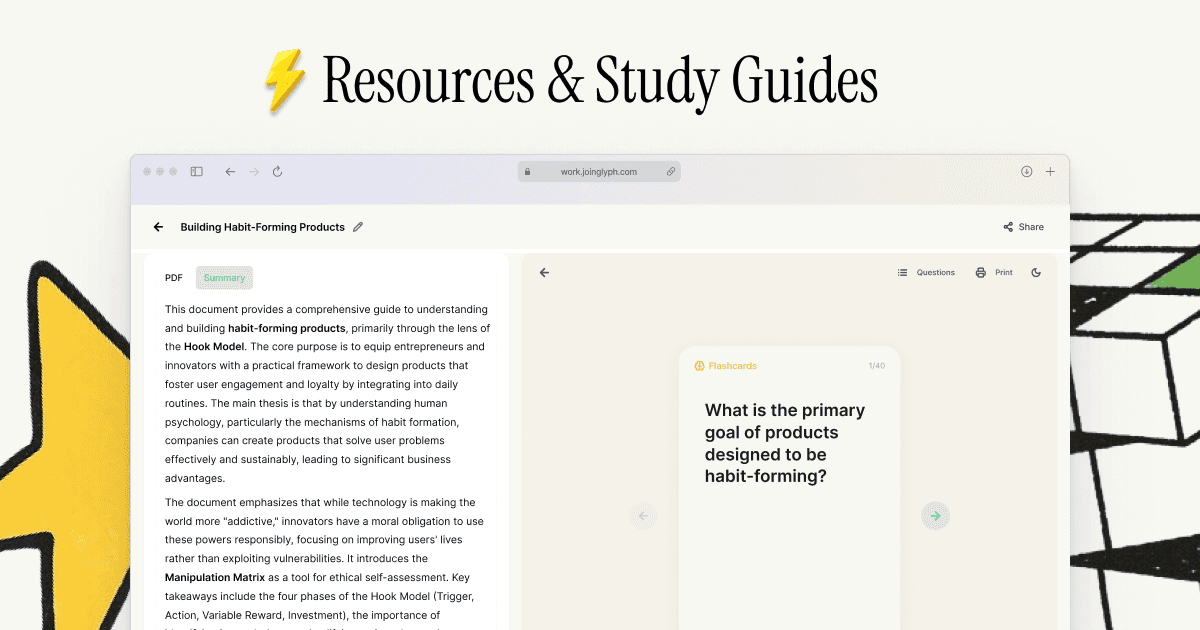
If you find yourself constantly copying and pasting text into ChatGPT, there’s a better way. Duetoday is a retention-first workspace that lets you upload your textbooks, PDFs, and YouTube lectures directly. It automatically generates study guides, flashcards, and quizzes from your materials, ensuring you never have to prompt the AI from scratch again.

Stop manually reading—start strategically learning. Pick 2 prompts above and try them out today!

Duetoday is an AI-powered learning OS that turns your study materials into personalised, bite-sized study guides, cheat sheets, and active learning flows.

More Chatgpt Prompts
GET STARTED

Most Powerful Study Tool
for Students and Educators

Try Out Free. No Credit Card Required.
