
Chatgpt prompts for "Remembering What You Study" [Free Guide]
Stop forgetting what you learn. Use these ChatGPT prompts to improve long-term retention, create flashcards, and master spaced repetition for better grades.
Use Study AI Free
ChatGPT Prompts for Remembering What You Study
Many students spend hours rereading notes only to forget everything the moment they close the book, leading to frustration and poor exam performance. These targeted prompts unlock the power of active recall and structured retention, helping you move information from short-term memory to long-term mastery instantly. Simply copy and paste the prompts below to transform your study material into a memory-friendly format.
Quick Start Guide
To get the best results from this guide, follow this simple framework: Paste your lecture notes or PDF text first, specify your current knowledge level (e.g., beginner or undergrad), and set a deadline for your exam. The golden rule for retention is to never let ChatGPT guess; always provide your specific source material so the AI builds its memory aids on accurate, relevant facts rather than hallucinations.
How to Use These Prompts for Maximum Retention
Using AI for memory isn't just about reading summaries; it's about engagement. Follow these steps for a repeatable success system:
Step 1: Import your primary source material (text from textbooks, transcripts, or personal notes).
Step 2: Set clear constraints, such as "Format this for a medical student" or "Keep definitions under 15 words."
Step 3: Ask the AI to identify gaps by quizzing you before it gives you the answers.
Step 4: Convert the final output into a spaced repetition schedule or flashcard deck.
Bucket A: Understand Deeply to Remember Longer
1. The Feynman Technique Drill
Use this when you want to ensure you actually understand a concept before trying to memorize it.
A good answer simplifies complex jargon into analogies without losing the core scientific or academic truth.
2. The 'Mental Peg' System Creator
Use this to create vivid associations for hard-to-remember lists or sequences.
A good answer provides a narrative that is easy to visualize and hard to forget.
3. Socratic Tutor Mode
Use this to build neural pathways by forcing your brain to retrieve information through guided questioning.
A good answer keeps you in a state of 'desirable difficulty,' which is essential for encoding memory.
Bucket B: Practice for Active Recall
4. The Flashcard Generator (Anki Style)
Use this to prepare for long-term retention via spaced repetition software.
A good answer follows the 'minimum information principle' to make reviewing fast and effective.
5. The 'Error-Log' Analysis
Use this after a practice test to figure out why you are forgetting specific details.
A good answer identifies the root cause of the misunderstanding, not just the correct fact.
Common Mistakes to Avoid
Passive Summarization: Just asking for a summary is the weakest way to remember. Always ask for questions or 'teach-it-back' exercises.
Ignoring Context: Without providing your specific course material, ChatGPT might give you information that won't be on your specific exam.
Hallucination Risks: Never trust dates or specific formulas from the AI without cross-referencing your primary source.
One-and-Done: Memory requires repetition. Don't just use the prompt once; revisit the generated outputs over several days.
Master Retention with Duetoday
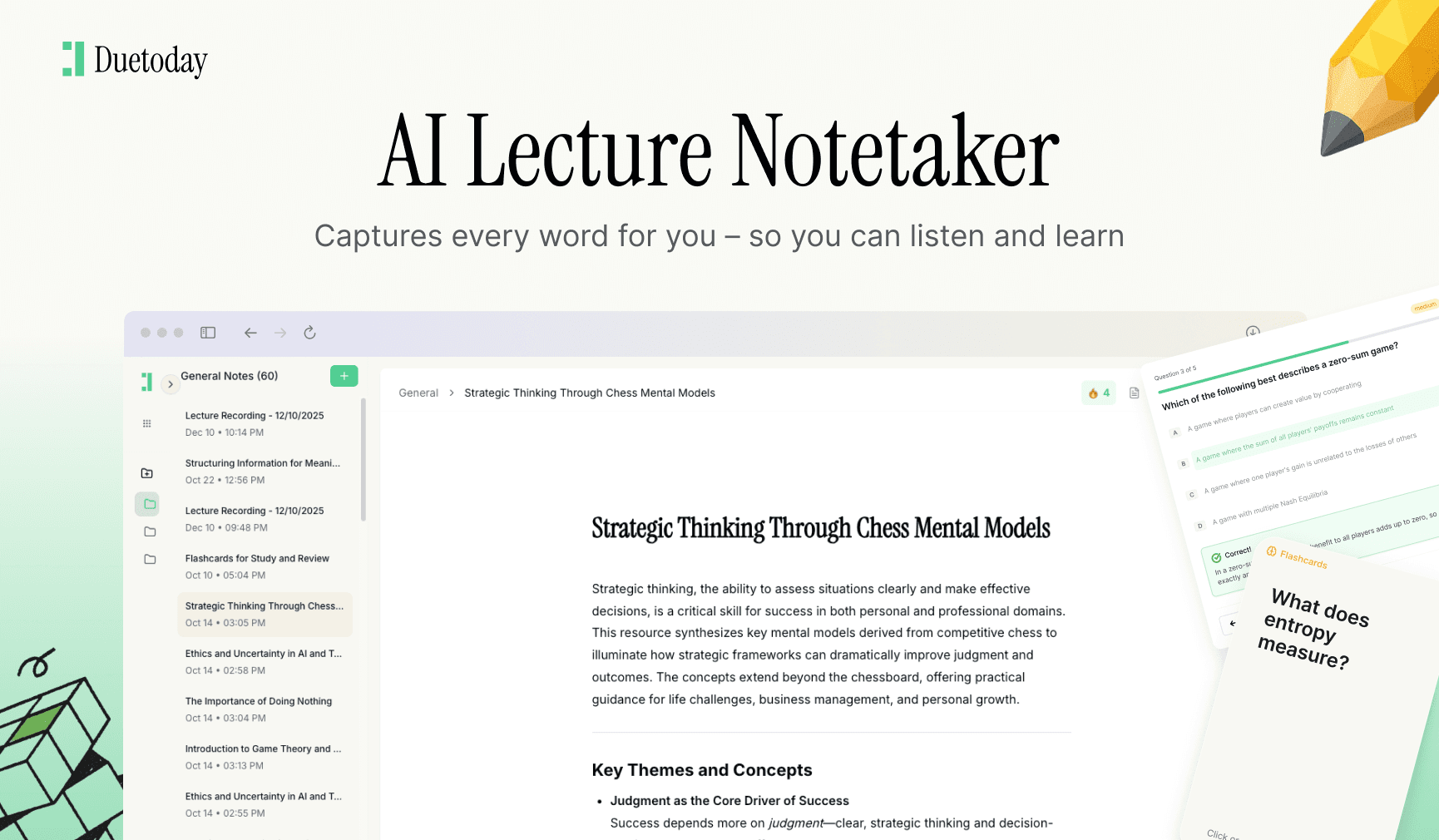
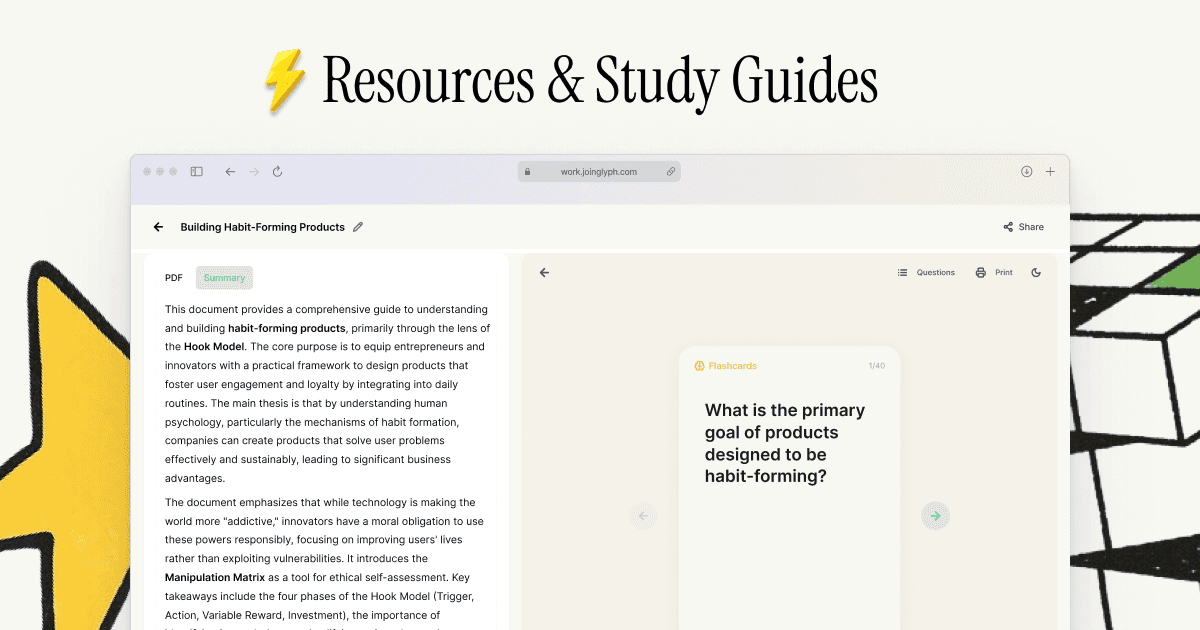
If you find manual prompting and copy-pasting tedious, Duetoday is built to handle the heavy lifting for you. Simply upload your lecture recordings, PDFs, or YouTube links, and Duetoday’s AI Brain automatically organizes your content into a unified learning library. Specifically designed for retention, it generates flashcards, quizzes, and bite-sized lessons based directly on your materials, ensuring you never forget a detail again. Supercharge your memory—try Duetoday AI today.
Closing
Pick two prompts from the 'Practice' bucket today and apply them to your hardest subject. If you want to automate this entire workflow and sync it with your calendar, Duetoday is your ultimate retention partner.

Duetoday is an AI-powered learning OS that turns your study materials into personalised, bite-sized study guides, cheat sheets, and active learning flows.
More Chatgpt Prompts
GET STARTED
Most Powerful Study Tool
for Students and Educators
Try Out Free. No Credit Card Required.
