
Chatgpt prompts for Proof Practice [Free Guide]
Master mathematical and logical proofs with these curated ChatGPT prompts. Learn to break down theorems, generate practice exercises, and verify logic.
Use Study AI Free
ChatGPT Prompts for Proof Practice
Mastering mathematical or logical proofs often feels like hitting a brick wall when you don't know the next step or the underlying structure. These prompts unlock a deeper understanding of deductive reasoning, helping you bridge the gap between reading a theorem and actually proving it yourself. Simply copy and paste the prompts below to transform ChatGPT into your personalized logic tutor.
The Quick Start Guide
To get the most out of these proof-oriented prompts, follow this simple framework:
Provide Your Source: Paste the specific theorem, axiom, or textbook excerpt you are working on.
Define Your Level: Specify if you are in introductory geometry, discrete math, or advanced real analysis.
Set the Mode: Ask for a hint, a step-by-step breakdown, or a practice problem similar to your current one.
The Golden Rule: Always provide your course notes or specific definitions to ensure ChatGPT uses the exact terminology and methods required by your instructor.
How to Use These Prompts Effectively
To maximize your retention and logical rigor, follow this four-step system:
Feed the Context: Start by uploading your lecture slides or pasting the text of the theorem you need to master.
Establish Constraints: Tell ChatGPT which proof methods are allowed (e.g., "Direct proof only," "Proof by contradiction," or "Mathematical induction").
Engage in Socratic Dialogue: Instead of asking for the full answer, ask the AI to guide you through the first logical leap.
Convert to Long-term Memory: Once you understand a proof, use the output to create flashcards or a retrieval practice schedule in your learning workspace.
Bucket A: Understand the Logic
The Structural Breakdown
Use this when you see a completed proof but don't understand how the author got from point A to point B.
A good answer will map out the flow of the argument without getting lost in calculation details.
The Axiom Explainer
Use this when a proof relies on a definition or axiom you haven't fully grasped yet.
A good answer connects the abstract definition to its practical application in a proof.
Bucket B: Practice and Apply
The Hint Generator
Use this when you are stuck on a homework problem and want to avoid looking at the solutions manual.
A good answer provides a conceptual clue that allows you to finish the work yourself.
The Scaffolding Exercise
Use this to build muscle memory for specific proof types like induction.
A good answer provides specific problems followed by a structured outline for you to complete.
Bucket C: Remember and Review
The Logic Peer Review
Use this to sharpen your critical thinking by finding errors in 'bad' proofs.
This 'error-logging' drill is one of the most effective ways to master rigorous logic.
Flashcard Extraction
Use this to turn a complex proof into bite-sized pieces for active recall.
Common Mistakes to Avoid
Starting with a Blank Slate: Never ask ChatGPT to "prove X" without giving it your class's specific definitions; mathematical terminology can vary by textbook.
Ignoring Notation: ChatGPT sometimes uses non-standard notation. Always tell it: "Use LaTeX formatting and standard [Subject] notation."
The 'Passive Reading' Trap: Don't just read the proof it generates. Force yourself to rewrite it from memory locally to ensure the logic has actually clicked.
Master Proofs with Duetoday
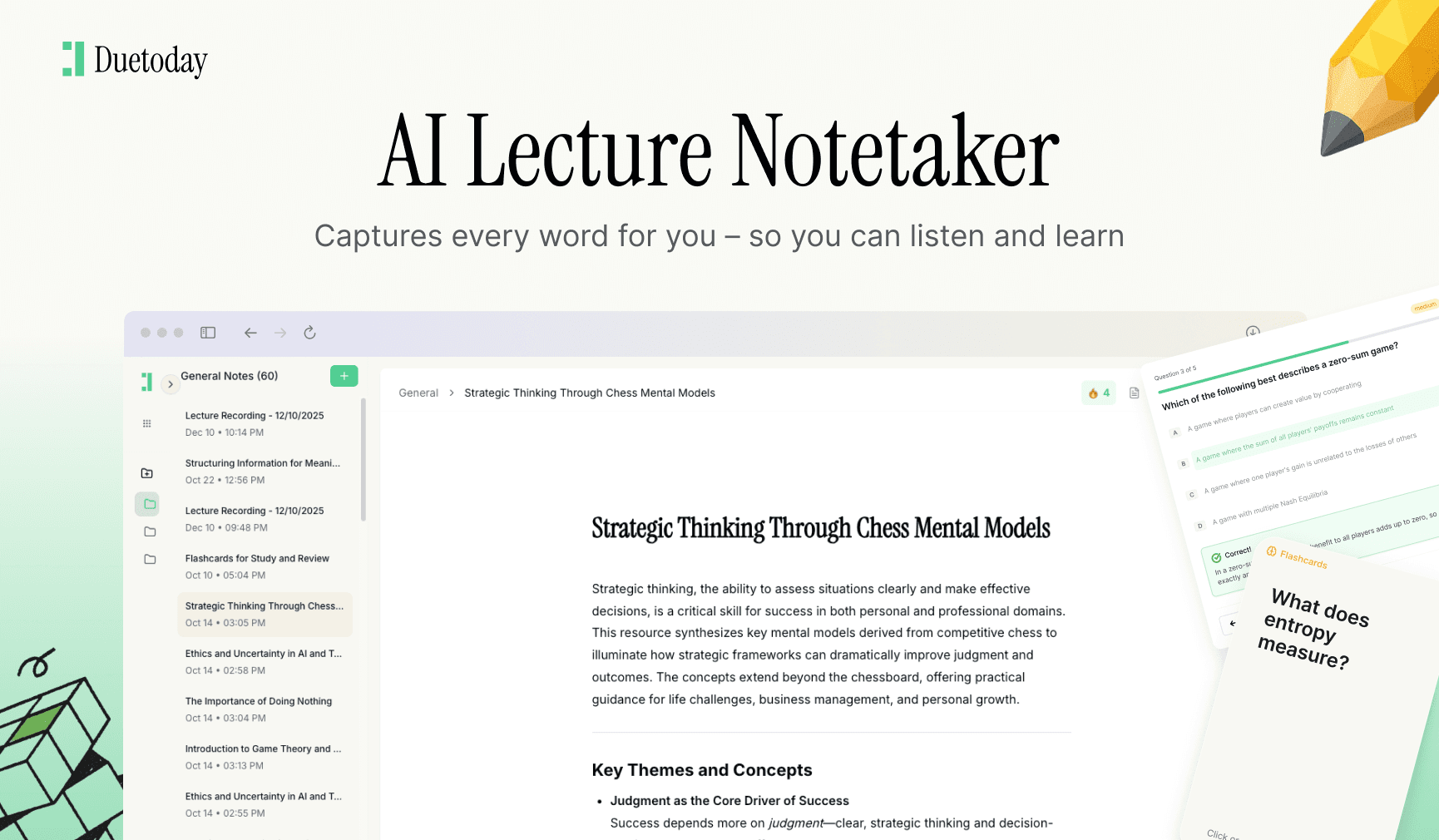
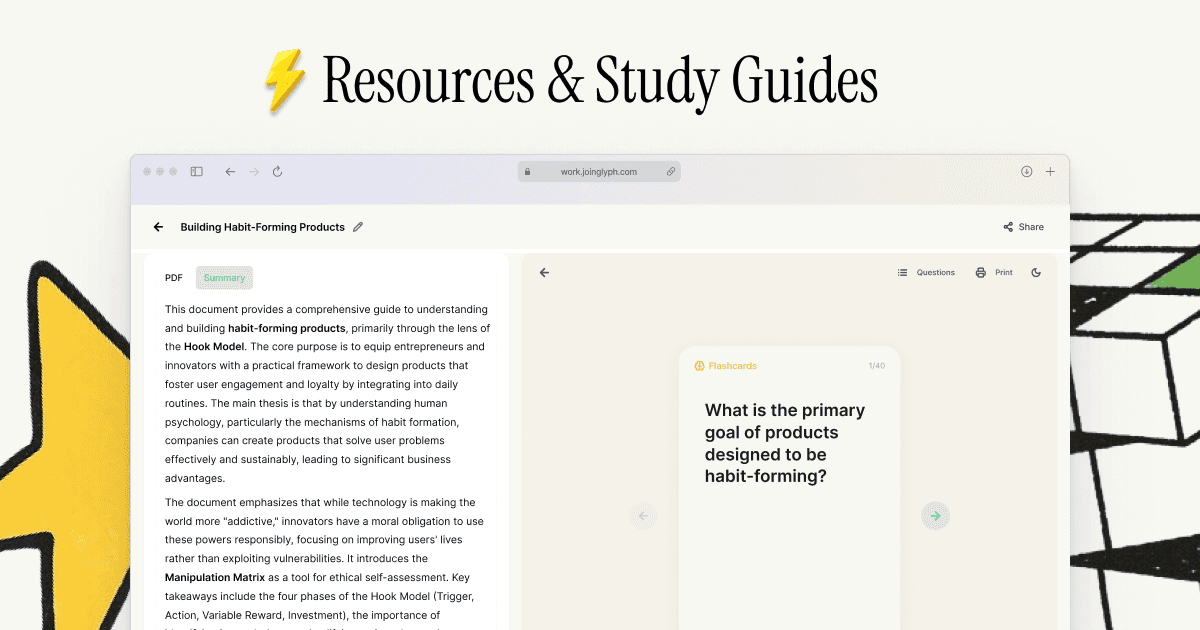
If you want to move beyond manual prompting, Duetoday can automate your entire proof-heavy course. By uploading your lecture recordings or research papers, Duetoday's AI Brain connects the dots between different theorems, generates structured Q&A sets, and builds a personalized retention plan for your exams. Start building your study brain on Duetoday today.
Pick two of the prompts above and try them with your current homework. If you want a faster way to organize all those logic notes, let Duetoday do the heavy lifting for you.

Duetoday is an AI-powered learning OS that turns your study materials into personalised, bite-sized study guides, cheat sheets, and active learning flows.
More Chatgpt Prompts
GET STARTED
Most Powerful Study Tool
for Students and Educators
Try Out Free. No Credit Card Required.
