ChatGPT Prompts for Problem-Solving Practice
Students often struggle to move beyond theory, finding it difficult to apply textbook knowledge to messy, real-world scenarios or complex exam problems. These prompts unlock a deeper level of cognitive processing, forcing you to bridge the gap between knowing a formula and executing a solution under pressure. Copy and paste these prompts below to transform your study sessions into high-intensity logic drills.
The Quick Start Guide
To get the most out of these problem-solving prompts, follow this quick framework:
Provide Context: Paste your specific textbook chapter, lecture notes, or a sample problem you're stuck on.
Set the Difficulty: Tell ChatGPT your current level (e.g., Undergraduate Engineering, MBA Case Study).
The Golden Rule: Never ask for just the answer; always ask for the reasoning process and a chance to attempt it yourself first.
How to Use These Prompts Effectively
Using AI for problem-solving is most effective when it acts as a coach, not a calculator. Start by pasting your study material to give the AI a source of truth. Next, set constraints regarding the format—ask for step-by-step hints rather than a full solution to keep your brain engaged. Finally, convert the output into active recall exercises. Once you solve a problem, ask the AI to generate a variation of it with different variables to ensure you've mastered the underlying principle, not just memorized the specific answer.
Bucket A: Deep Understanding & Frameworks
The First Principles Breakdown
Use this when you understand the 'what' but not the 'how' of a complex problem-solving methodology.
I am studying [Topic/Subject]. Break down the fundamental principles behind solving [Type of Problem] using first principles thinking. Explain the 'why' behind each step so I can apply this logic to any variation of the problem. Use a logical, step-by-step format
I am studying [Topic/Subject]. Break down the fundamental principles behind solving [Type of Problem] using first principles thinking. Explain the 'why' behind each step so I can apply this logic to any variation of the problem. Use a logical, step-by-step format
I am studying [Topic/Subject]. Break down the fundamental principles behind solving [Type of Problem] using first principles thinking. Explain the 'why' behind each step so I can apply this logic to any variation of the problem. Use a logical, step-by-step format
A good answer will identify the core axioms of the subject and show how they build into a solution.
The Socratic Problem-Solving Tutor
Use this to simulate a 1-on-1 tutoring session where you are forced to think.
I want to practice solving problems in [Subject]. Do not give me the answer. Instead, present me with one challenging problem based on [Inserted Text]. If I get stuck, ask me a leading question to help me find the next step myself. Start by giving me the first problem
I want to practice solving problems in [Subject]. Do not give me the answer. Instead, present me with one challenging problem based on [Inserted Text]. If I get stuck, ask me a leading question to help me find the next step myself. Start by giving me the first problem
I want to practice solving problems in [Subject]. Do not give me the answer. Instead, present me with one challenging problem based on [Inserted Text]. If I get stuck, ask me a leading question to help me find the next step myself. Start by giving me the first problem
A good answer keeps the user in the 'driver's seat' of the cognitive work.
The Analogy Bridge
Use this when a problem-solving step feels too abstract or technical to grasp.
Explain the logic used to solve [Specific Problem Type] by using a real-world analogy that has nothing to do with academia. Once I understand the analogy, map those steps back to the technical process found in my notes: [Paste Notes]
Explain the logic used to solve [Specific Problem Type] by using a real-world analogy that has nothing to do with academia. Once I understand the analogy, map those steps back to the technical process found in my notes: [Paste Notes]
Explain the logic used to solve [Specific Problem Type] by using a real-world analogy that has nothing to do with academia. Once I understand the analogy, map those steps back to the technical process found in my notes: [Paste Notes]
A good answer simplifies complex logic into relatable, everyday scenarios.
Bucket B: Practice & Application
The Edge-Case Generator
Use this to prepare for the 'trick questions' that often appear on exams.
Based on the logic in [Paste Notes], generate 3 'edge-case' problems. These should be scenarios where the standard formula might be tricky to apply or where a common misconception might lead to the wrong answer. Provide the problems first, then the solutions separately
Based on the logic in [Paste Notes], generate 3 'edge-case' problems. These should be scenarios where the standard formula might be tricky to apply or where a common misconception might lead to the wrong answer. Provide the problems first, then the solutions separately
Based on the logic in [Paste Notes], generate 3 'edge-case' problems. These should be scenarios where the standard formula might be tricky to apply or where a common misconception might lead to the wrong answer. Provide the problems first, then the solutions separately
A good answer identifies the nuances and exceptions within a topic.
The 'Teach it Back' Drill
Use this to prove you actually understand the solution path.
I am going to explain how to solve [Problem Description] to you. Act as a critical professor. Point out any logical leaps I make, any steps I skip, or any areas where my explanation is weak based on these notes: [Paste Notes]
I am going to explain how to solve [Problem Description] to you. Act as a critical professor. Point out any logical leaps I make, any steps I skip, or any areas where my explanation is weak based on these notes: [Paste Notes]
I am going to explain how to solve [Problem Description] to you. Act as a critical professor. Point out any logical leaps I make, any steps I skip, or any areas where my explanation is weak based on these notes: [Paste Notes]
A good answer provides constructive criticism on your cognitive flow.
Bucket C: Retention & Error Correction
The Error-Log Analyzer
Use this to identify patterns in why you keep getting things wrong.
Here is a problem I got wrong: [Problem]. Here was my incorrect work: [Paste Work]. Based on the correct principles in [Notes], analyze specifically where my logic failed. Was it a calculation error, a conceptual gap, or a procedural mistake
Here is a problem I got wrong: [Problem]. Here was my incorrect work: [Paste Work]. Based on the correct principles in [Notes], analyze specifically where my logic failed. Was it a calculation error, a conceptual gap, or a procedural mistake
Here is a problem I got wrong: [Problem]. Here was my incorrect work: [Paste Work]. Based on the correct principles in [Notes], analyze specifically where my logic failed. Was it a calculation error, a conceptual gap, or a procedural mistake
A good answer categorizes your mistake to prevent it from happening again.
Spaced Repetition Practice Schedule
Use this to ensure you don't forget how to solve these problems next week.
I have just learned how to solve [Problem Type]. Create a 2-week spaced repetition schedule for me to practice. Include 3 variations of the problem for each practice session: one easy, one medium, and one complex 'exam-style' challenge
I have just learned how to solve [Problem Type]. Create a 2-week spaced repetition schedule for me to practice. Include 3 variations of the problem for each practice session: one easy, one medium, and one complex 'exam-style' challenge
I have just learned how to solve [Problem Type]. Create a 2-week spaced repetition schedule for me to practice. Include 3 variations of the problem for each practice session: one easy, one medium, and one complex 'exam-style' challenge
A good answer provides a structured plan for long-term mastery.
Common Mistakes to Avoid
Asking for answers without source text: ChatGPT may use a different method than your professor, leading to confusion.
Ignoring the 'Step-by-Step': If you don't force the AI to show its work, you won't learn the underlying logic.
Accepting Hallucinations: Always cross-reference AI-generated solutions with your official textbook or Duetoday's verified source library.
Passive Reading: Simply reading a solved problem isn't practice. Always attempt the prompt-generated problem manually first.
Automate Your Learning with Duetoday
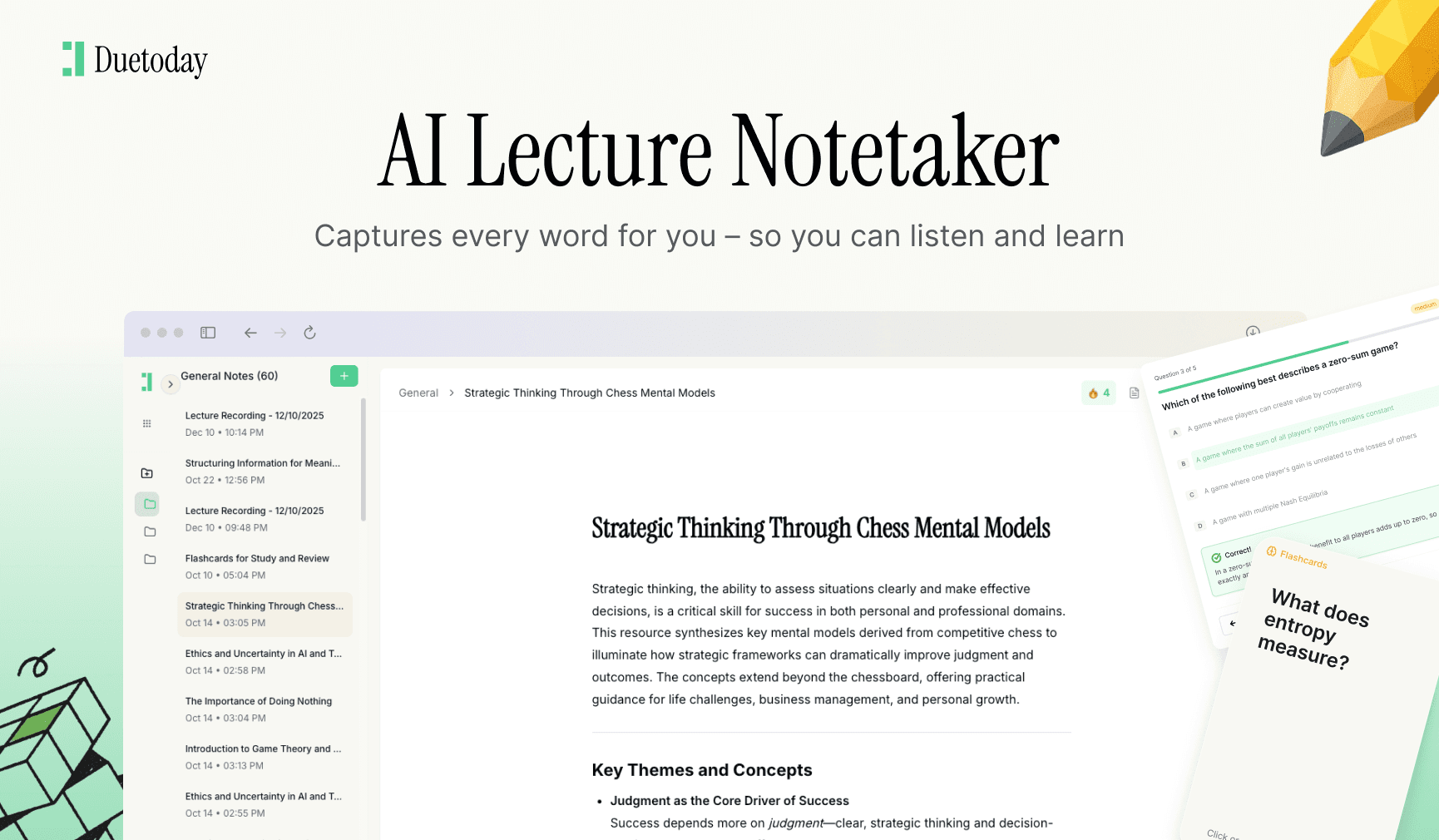
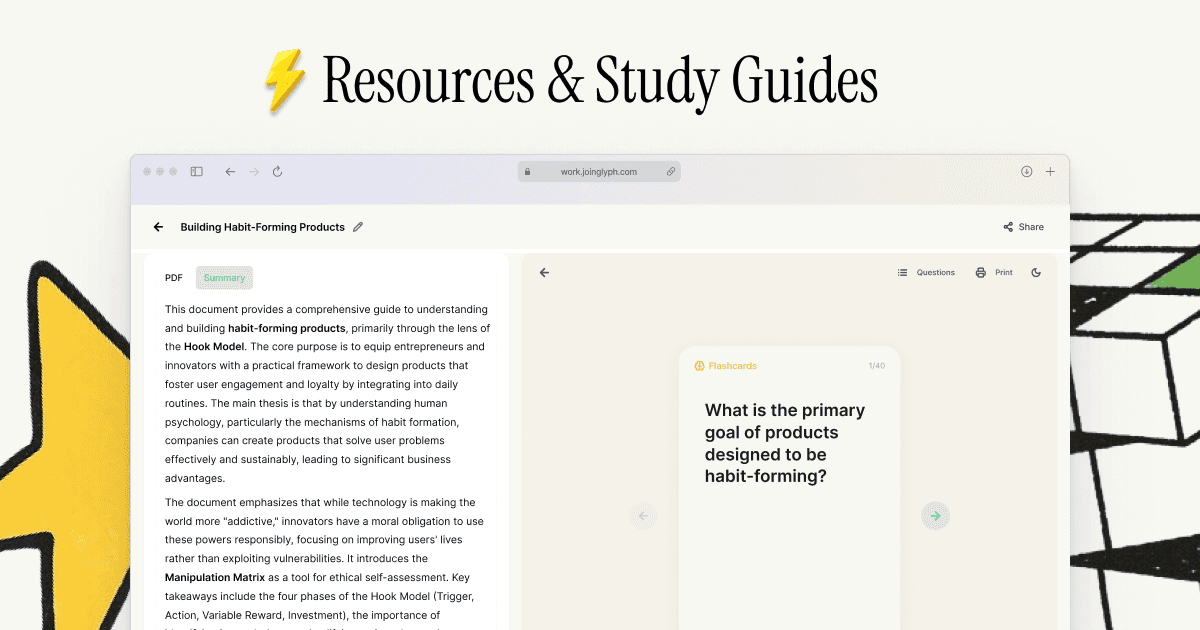
If you want to skip the manual prompting and get straight to the practice, Duetoday is your retention-first workspace. Simply upload your lecture recordings or PDFs, and Duetoday's AI Brain will automatically generate practice questions, logic drills, and flashcards tied directly to your course material. No more hallucinated dates or incorrect formulas—just your material, turned into an active learning experience.
Pick two prompts from this list and start your practice session today. For a more streamlined experience, let Duetoday handle the heavy lifting.