ChatGPT Prompts for Physics Studying
Students often struggle with physics because it requires bridging the gap between abstract mathematical formulas and tangible physical reality. These prompts unlock a deeper level of conceptual understanding and problem-solving speed, transforming dense textbook chapters into intuitive mental models you can actually apply. Copy/paste the prompts below to turn ChatGPT into your personal physics lab assistant and tutor.
The Instant Physics Success Protocol
To get the highest quality output for physics, follow this quick setup: paste your specific lecture notes or the text of a complex problem into the chat first. Tell ChatGPT your current level (e.g., AP Physics, Undergraduate, or Calculus-based) and your specific goal, such as 'deriving a formula' or 'visualizing a concept.' The golden rule for physics: never let the AI guess the constants or specific variables—always provide your source material to ensure mathematical accuracy and prevent hallucinations.
How to Use These Physics Prompts
Step 1: Feed the Data: Paste the specific physics laws, diagrams descriptions, or problem sets you are currently studying.
Step 2: Set Difficulty Constraints: Specify if you want a 'First Principles' explanation or a high-level mathematical derivation suitable for your grade level.
Step 3: Interactive Drill: Ask the AI to simulate a physics scenario and ask you 'what happens if X changes' to test your intuition.
Step 4: Bridge to Retention: Use the outputs to create structured flashcards or a spaced repetition schedule for constant review.
Bucket A: Understand Complex Concepts
The 'Explain Like I\'m Five' to Advanced Bridge
Use this when you understand the math but can't visualize the actual physical phenomenon.
I am studying [Topic, e.g., Quantum Entanglement]. First, explain the core concept using a simple real-world analogy. Then, transition into a technical explanation suitable for a [Your Level] student, highlighting the fundamental laws (like Newton's or Maxwell's) that govern it
I am studying [Topic, e.g., Quantum Entanglement]. First, explain the core concept using a simple real-world analogy. Then, transition into a technical explanation suitable for a [Your Level] student, highlighting the fundamental laws (like Newton's or Maxwell's) that govern it
I am studying [Topic, e.g., Quantum Entanglement]. First, explain the core concept using a simple real-world analogy. Then, transition into a technical explanation suitable for a [Your Level] student, highlighting the fundamental laws (like Newton's or Maxwell's) that govern it
A good answer starts with a relatable metaphor and ends with a rigorous definition of variables.
The Socratic Physics Tutor
Use this to build intuition rather than just getting the answer to a problem.
I want to solve a problem regarding [Topic]. Do not give me the answer. Instead, act as a Socratic tutor. Ask me one question at a time to lead me toward the correct free-body diagram and the necessary equations to solve for [Variable]
I want to solve a problem regarding [Topic]. Do not give me the answer. Instead, act as a Socratic tutor. Ask me one question at a time to lead me toward the correct free-body diagram and the necessary equations to solve for [Variable]
I want to solve a problem regarding [Topic]. Do not give me the answer. Instead, act as a Socratic tutor. Ask me one question at a time to lead me toward the correct free-body diagram and the necessary equations to solve for [Variable]
A good answer pushes you to identify forces or energy transfers yourself before moving to the next step.
The Visualizer Prompt
Use this for topics that are hard to see, like electromagnetism or thermodynamics.
Describe a mental experiment or a visual simulation that demonstrates [Concept]. Explain what I would see, feel, or measure if I changed [Variable A] while keeping [Variable B] constant. Use descriptive language to help me build a mental model
Describe a mental experiment or a visual simulation that demonstrates [Concept]. Explain what I would see, feel, or measure if I changed [Variable A] while keeping [Variable B] constant. Use descriptive language to help me build a mental model
Describe a mental experiment or a visual simulation that demonstrates [Concept]. Explain what I would see, feel, or measure if I changed [Variable A] while keeping [Variable B] constant. Use descriptive language to help me build a mental model
A good answer creates a vivid 'thought experiment' similar to those used by Einstein or Feynman.
Bucket B: Practice and Problem Solving
The Variable Stress Test
Use this to understand how different physical factors affect an outcome.
For the formula [Insert Formula], explain what happens to [Dependent Variable] if [Independent Variable] doubles, while all other factors stay the same. Provide three different scenarios where this relationship is critical in engineering or nature
For the formula [Insert Formula], explain what happens to [Dependent Variable] if [Independent Variable] doubles, while all other factors stay the same. Provide three different scenarios where this relationship is critical in engineering or nature
For the formula [Insert Formula], explain what happens to [Dependent Variable] if [Independent Variable] doubles, while all other factors stay the same. Provide three different scenarios where this relationship is critical in engineering or nature
A good answer demonstrates a proportional understanding of physics equations.
Error-Log My Physics Mistakes
Use this when you keep getting a specific type of problem wrong.
I thought the answer to this physics problem was [Your Answer], but the correct answer is [Correct Answer]. Analyze my logic in this attached work and identify the specific conceptual misunderstanding or mathematical error I made
I thought the answer to this physics problem was [Your Answer], but the correct answer is [Correct Answer]. Analyze my logic in this attached work and identify the specific conceptual misunderstanding or mathematical error I made
I thought the answer to this physics problem was [Your Answer], but the correct answer is [Correct Answer]. Analyze my logic in this attached work and identify the specific conceptual misunderstanding or mathematical error I made
A good answer identifies if your mistake was a 'unit conversion error' or a 'law application error.'
Practice Question Generator
Use this to prep for midterms or finals with fresh material.
Based on the following syllabus/notes: [Paste Notes], generate 5 practice problems. Include one conceptual, two calculation-based, and two 'challenge' problems that combine multiple topics. Provide a hidden answer key with step-by-step solutions
Based on the following syllabus/notes: [Paste Notes], generate 5 practice problems. Include one conceptual, two calculation-based, and two 'challenge' problems that combine multiple topics. Provide a hidden answer key with step-by-step solutions
Based on the following syllabus/notes: [Paste Notes], generate 5 practice problems. Include one conceptual, two calculation-based, and two 'challenge' problems that combine multiple topics. Provide a hidden answer key with step-by-step solutions
A good answer mimics the difficulty and tone of your specific physics course.
Bucket C: Remember and Review
Physics Flashcard Creator
Use this to prepare for active recall sessions.
Identify the 10 most important constants, laws, and formulas from these notes: [Paste Text]. Format them as Q&A pairs. On the 'Question' side, describe a physical situation; on the 'Answer' side, provide the law or formula that applies
Identify the 10 most important constants, laws, and formulas from these notes: [Paste Text]. Format them as Q&A pairs. On the 'Question' side, describe a physical situation; on the 'Answer' side, provide the law or formula that applies
Identify the 10 most important constants, laws, and formulas from these notes: [Paste Text]. Format them as Q&A pairs. On the 'Question' side, describe a physical situation; on the 'Answer' side, provide the law or formula that applies
A good answer focuses on application rather than just rote definition.
Spaced Repetition Schedule
Use this to organize your study plan leading up to an exam.
I have a physics exam on [Date] covering [List of Topics]. Create a 14-day study schedule using spaced repetition principles. Group topics by difficulty and tell me which days to review 'old' material vs. learning 'new' material
I have a physics exam on [Date] covering [List of Topics]. Create a 14-day study schedule using spaced repetition principles. Group topics by difficulty and tell me which days to review 'old' material vs. learning 'new' material
I have a physics exam on [Date] covering [List of Topics]. Create a 14-day study schedule using spaced repetition principles. Group topics by difficulty and tell me which days to review 'old' material vs. learning 'new' material
A good answer provides a clear, day-by-day roadmap that prevents last-minute cramming.
Common Mistakes to Avoid
Assuming Accuracy: Always double-check ChatGPT’s arithmetic; it is better at explaining logic than doing complex decimal multiplication.
No Context: Don't just ask 'What is gravity?'—ask 'Explain gravity in the context of General Relativity as per these lecture notes.'
Skipping the Units: If you don't specify units, the AI might mix metric and imperial, leading to disastrous results in physics problems.
Passive Reading: Don't just ask for a summary. Ask for a quiz to force your brain into active retrieval.
Master Physics Faster with Duetoday
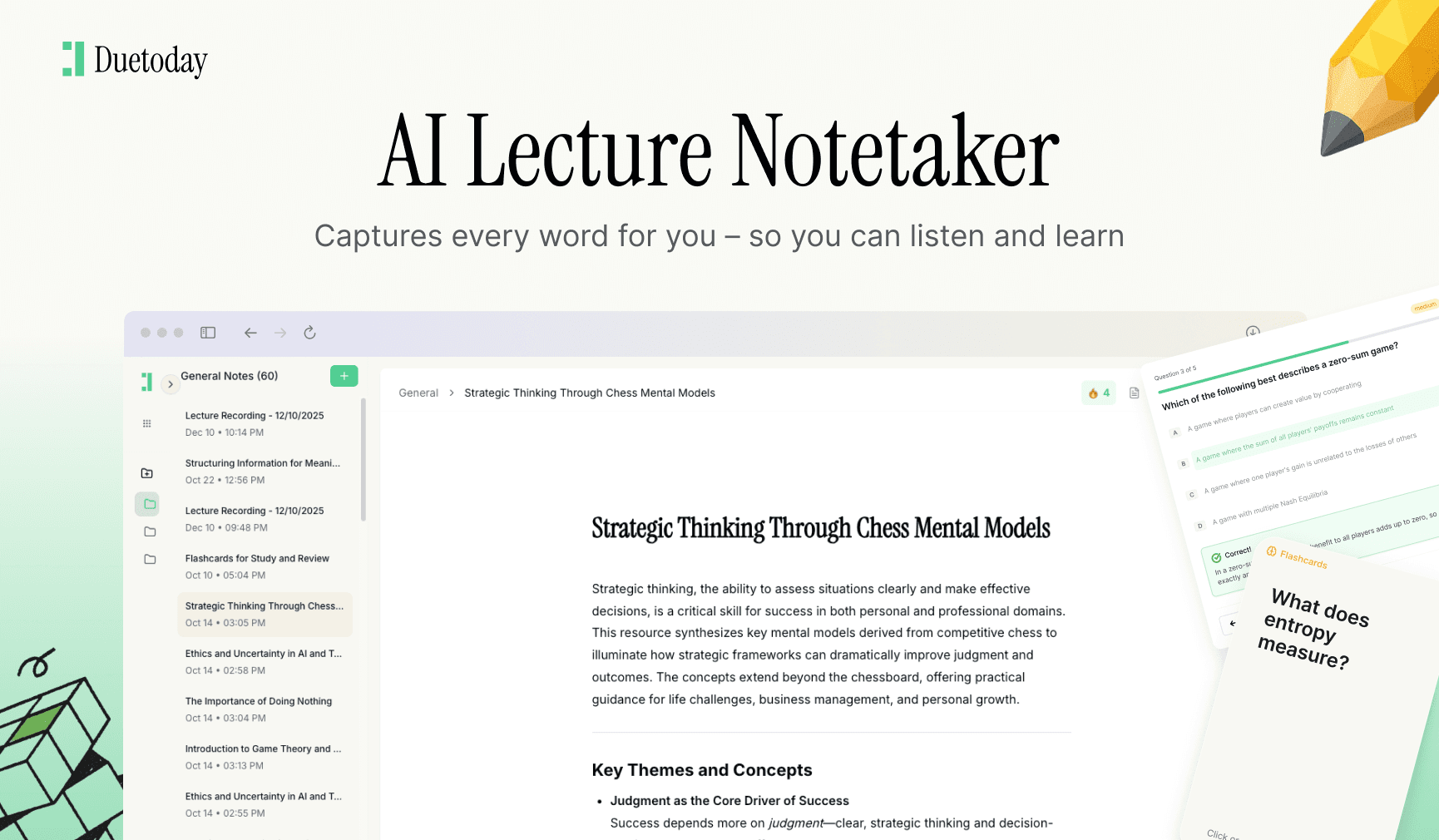
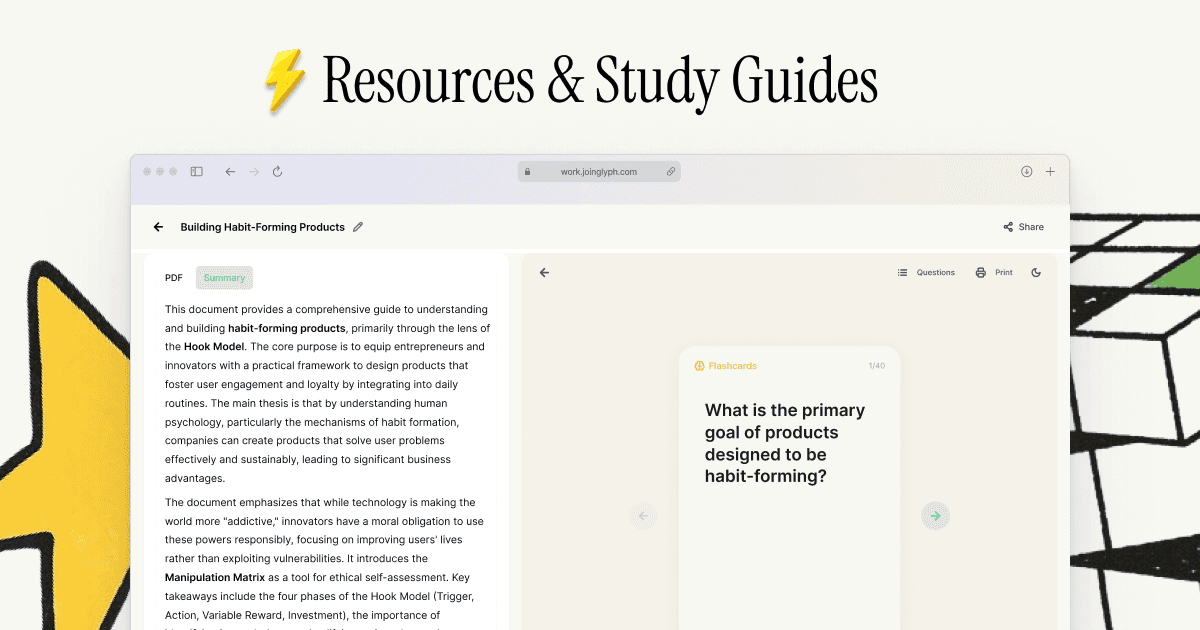
While these prompts are powerful, managing them manually across dozens of lectures is exhausting. Duetoday automates this entire workflow. By uploading your physics PDFs, lecture recordings, or YouTube tutorials, Duetoday’s AI 'Brain' learns your specific curriculum. It automatically generates flashcards, structured notes, and practice problems, then schedules them into a retention-first plan so you never forget a formula again.
Pick two of the prompts above and try them today. If you want the process to be seamless and automated, switch to Duetoday.