ChatGPT Prompts for Midterms
Students often struggle with the overwhelming volume of material that accumulates before midterm week, leading to burnout and ineffective cramming. These curated prompts unlock a streamlined study process, allowing you to synthesize months of lectures into actionable practice tests and clear summaries in seconds. Simply copy and paste the prompts below into ChatGPT to transform your study sessions.
The Quick Start Guide to Midterm Prompts
To get the most out of these prompts, follow this blueprint. Always paste your specific lecture notes, syllabus, or textbook excerpts first. Tell ChatGPT your goal: 'I am a sophomore college student preparing for a Chemistry midterm on [Date].' The golden rule for midterm success is to never let the AI guess; always provide the source text to ensure accuracy and prevent hallucinations about your specific curriculum.
How to Use These Prompts Effectively
Step 1: Feed the AI: Upload or paste your lecture slides, reading notes, or transcriptions to provide context.
Step 2: Set Difficulty: Specify your academic level (e.g., AP High School, Undergraduate, Graduate) and the exam format (Multiple Choice, Essay, Short Answer).
Step 3: Analyze & Iterate: Ask the AI to identify your weak spots or to explain a concept using a different analogy if the first one doesn't click.
Step 4: Bridge to Memory: Take the outputs and convert them into active recall tools like flashcards or timed practice drills.
Bucket A: Understand Complex Concepts
1. The Feynman Technique Drill
Use this when you understand a concept vaguely but couldn't explain it to someone else during an exam.
"I will provide a topic from my midterm material. Explain it to me as if I am 10 years old. Once I understand the basics, explain the more advanced nuances suitable for a college level, highlighting the connection between the two."
"I will provide a topic from my midterm material. Explain it to me as if I am 10 years old. Once I understand the basics, explain the more advanced nuances suitable for a college level, highlighting the connection between the two."
"I will provide a topic from my midterm material. Explain it to me as if I am 10 years old. Once I understand the basics, explain the more advanced nuances suitable for a college level, highlighting the connection between the two."
A good answer will start with a simple analogy and transition into technical terminology found in your syllabus.
2. The Socratic Tutor Mode
Use this to test your depth of knowledge rather than just reading your notes passively.
"Act as a Socratic tutor for [Topic]. Do not give me the answers. Instead, ask me a series of leading questions to help me arrive at a deep understanding of the core principles on my own. Start with one question."
"Act as a Socratic tutor for [Topic]. Do not give me the answers. Instead, ask me a series of leading questions to help me arrive at a deep understanding of the core principles on my own. Start with one question."
"Act as a Socratic tutor for [Topic]. Do not give me the answers. Instead, ask me a series of leading questions to help me arrive at a deep understanding of the core principles on my own. Start with one question."
A good answer will be a single, thought-provoking question that forces you to retrieve information from your memory.
3. The Relationship Mapper
Use this when you have many disconnected facts and need to see the 'big picture' for the exam.
"Based on these notes, create a structured outline that shows the relationships between [Concept A] and [Concept B]. Focus on cause-and-effect and how these ideas integrate into the overall theme of the course."
"Based on these notes, create a structured outline that shows the relationships between [Concept A] and [Concept B]. Focus on cause-and-effect and how these ideas integrate into the overall theme of the course."
"Based on these notes, create a structured outline that shows the relationships between [Concept A] and [Concept B]. Focus on cause-and-effect and how these ideas integrate into the overall theme of the course."
A good answer will provide a hierarchical list or a mental map description showing how topics intersect.
Bucket B: Remember & Retain
4. Flashcard Generator (Table Format)
Use this to prep for Anki or Quizlet quickly without manual typing.
"Analyze my notes and extract the top 15 most important terms and concepts. Present them in a two-column table with the term on the left and a concise, one-sentence definition for active recall on the right."
"Analyze my notes and extract the top 15 most important terms and concepts. Present them in a two-column table with the term on the left and a concise, one-sentence definition for active recall on the right."
"Analyze my notes and extract the top 15 most important terms and concepts. Present them in a two-column table with the term on the left and a concise, one-sentence definition for active recall on the right."
A good answer is a clean table ready for copy-pasting into your favorite flashcard app.
5. The Spaced Repetition Planner
Use this when you are 7 days out and don't know how to allocate your time.
"I have a midterm in [Subject] on [Date]. Based on the following list of topics and my self-assessed difficulty (High/Medium/Low), create a daily study schedule that utilizes spaced repetition to maximize my memory retention."
"I have a midterm in [Subject] on [Date]. Based on the following list of topics and my self-assessed difficulty (High/Medium/Low), create a daily study schedule that utilizes spaced repetition to maximize my memory retention."
"I have a midterm in [Subject] on [Date]. Based on the following list of topics and my self-assessed difficulty (High/Medium/Low), create a daily study schedule that utilizes spaced repetition to maximize my memory retention."
A good answer will be a day-by-day plan focusing more heavily on your 'High' difficulty areas.
6. The Cheat Sheet Condenser
Use this to find the most high-yield information for final review sessions.
"I am allowed one page of notes for my exam. Extract the most critical formulas, dates, and definitions from these materials and organize them into a dense, categorized 'cheat sheet' format."
"I am allowed one page of notes for my exam. Extract the most critical formulas, dates, and definitions from these materials and organize them into a dense, categorized 'cheat sheet' format."
"I am allowed one page of notes for my exam. Extract the most critical formulas, dates, and definitions from these materials and organize them into a dense, categorized 'cheat sheet' format."
A good answer is a high-density list of essential facts, grouped logically by chapter or theme.
Bucket C: Practice & Apply
7. The Simulated Mock Exam
Use this to overcome 'test anxiety' by practicing in a timed environment.
"Generate 5 multiple-choice questions and 2 short-answer questions based on the attached text. The difficulty should be at a [Junior/Senior] college level. Provide the questions first, then wait for my response before providing the answer key."
"Generate 5 multiple-choice questions and 2 short-answer questions based on the attached text. The difficulty should be at a [Junior/Senior] college level. Provide the questions first, then wait for my response before providing the answer key."
"Generate 5 multiple-choice questions and 2 short-answer questions based on the attached text. The difficulty should be at a [Junior/Senior] college level. Provide the questions first, then wait for my response before providing the answer key."
A good answer will present only the questions, allowing you to simulate a real testing environment.
8. The Error-Log Analysis
Use this after taking a practice test to identify logical flaws in your thinking.
"I got this question wrong: [Paste Question]. Here was my logic: [Paste Your Logic]. Tell me why my reasoning was incorrect and explain the underlying principle I missed so I don't repeat the mistake on the midterm."
"I got this question wrong: [Paste Question]. Here was my logic: [Paste Your Logic]. Tell me why my reasoning was incorrect and explain the underlying principle I missed so I don't repeat the mistake on the midterm."
"I got this question wrong: [Paste Question]. Here was my logic: [Paste Your Logic]. Tell me why my reasoning was incorrect and explain the underlying principle I missed so I don't repeat the mistake on the midterm."
A good answer identifies the specific gap in your understanding rather than just giving the correct answer.
Common Mistakes to Avoid
Asking without context: ChatGPT doesn't know what your specific professor emphasizes. Always provide your notes.
Broad difficulty: Failing to define if it's an Intro or Advanced course results in answers that are too simple or too complex.
Hallucination checks: Always verify dates and specific formulas against your textbook.
Passive consumption: Don't just read the summaries the AI generates; turn them into practice tests to ensure the info sticks.
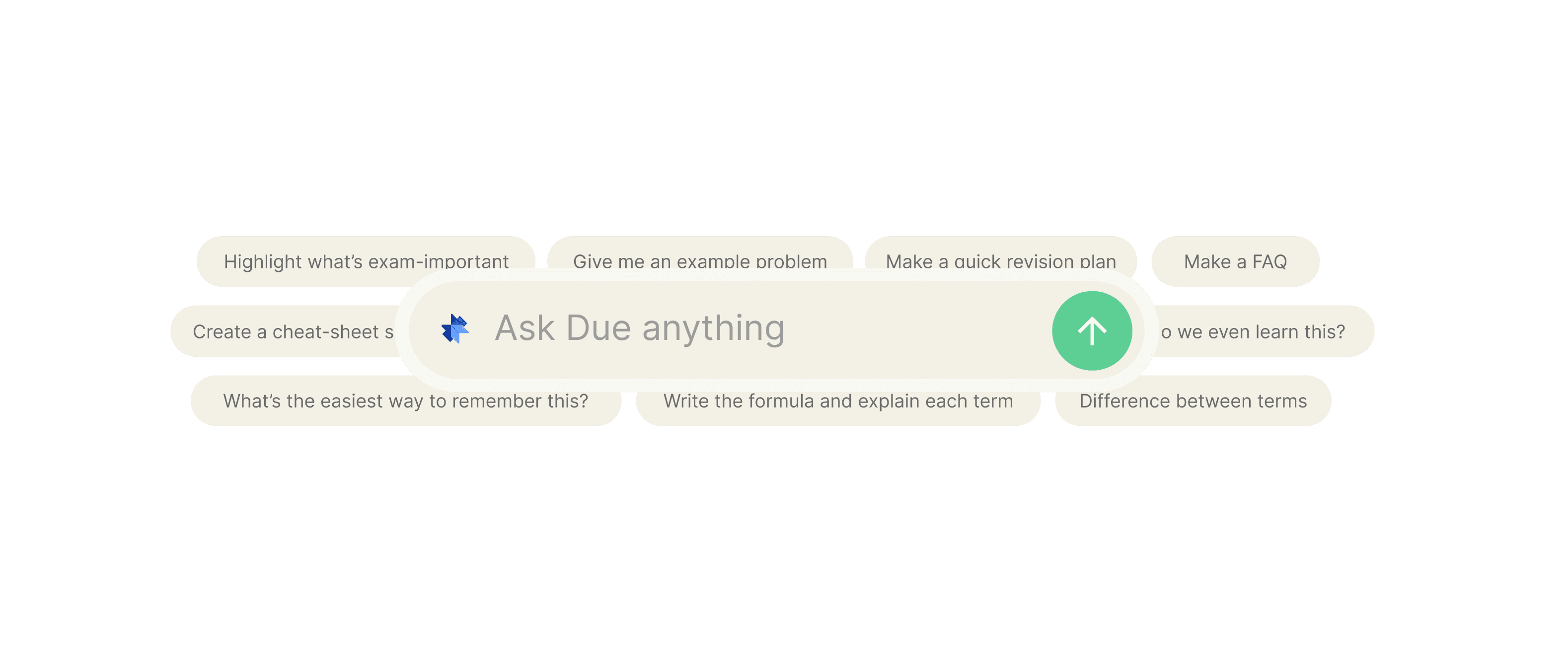
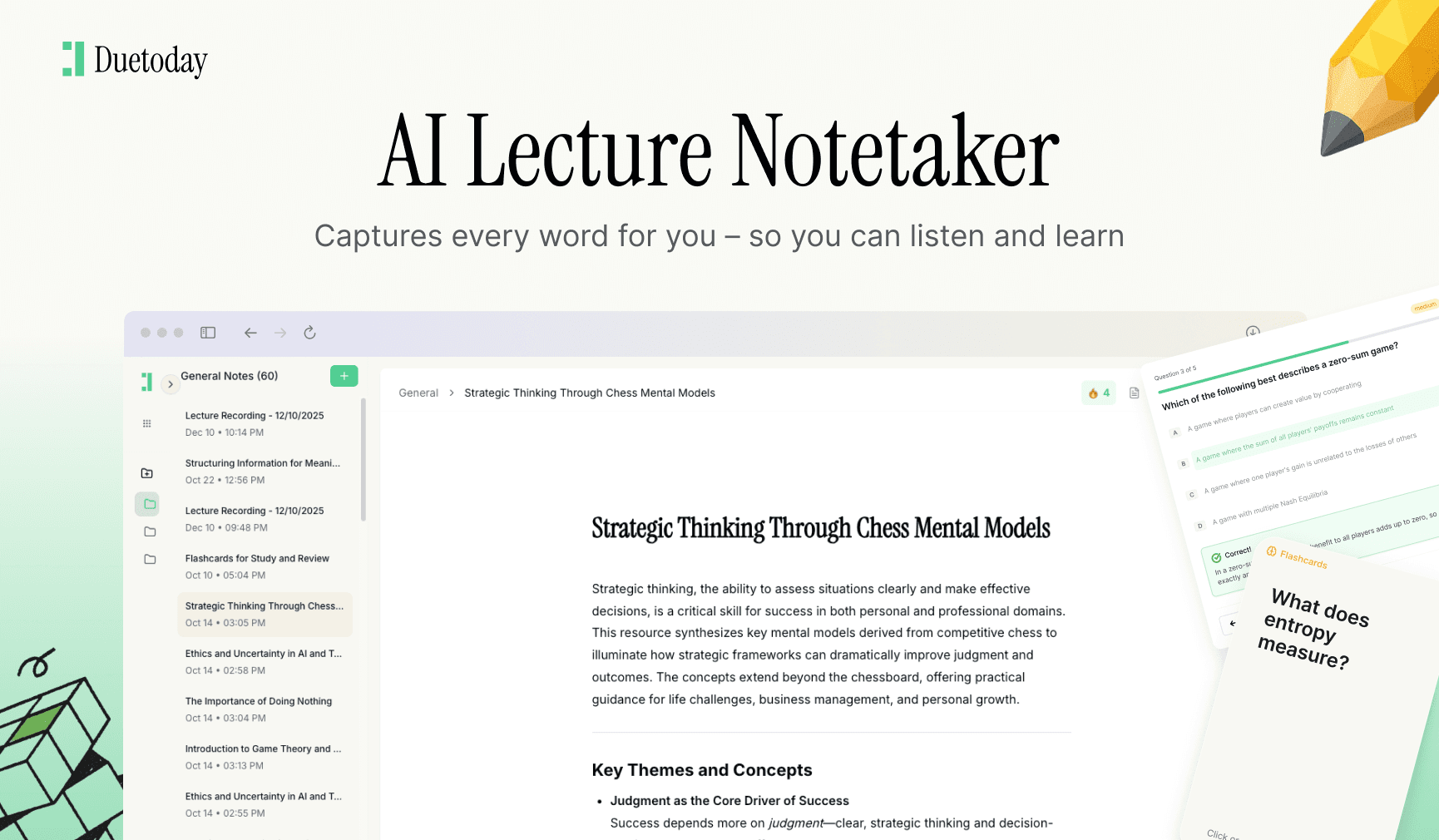
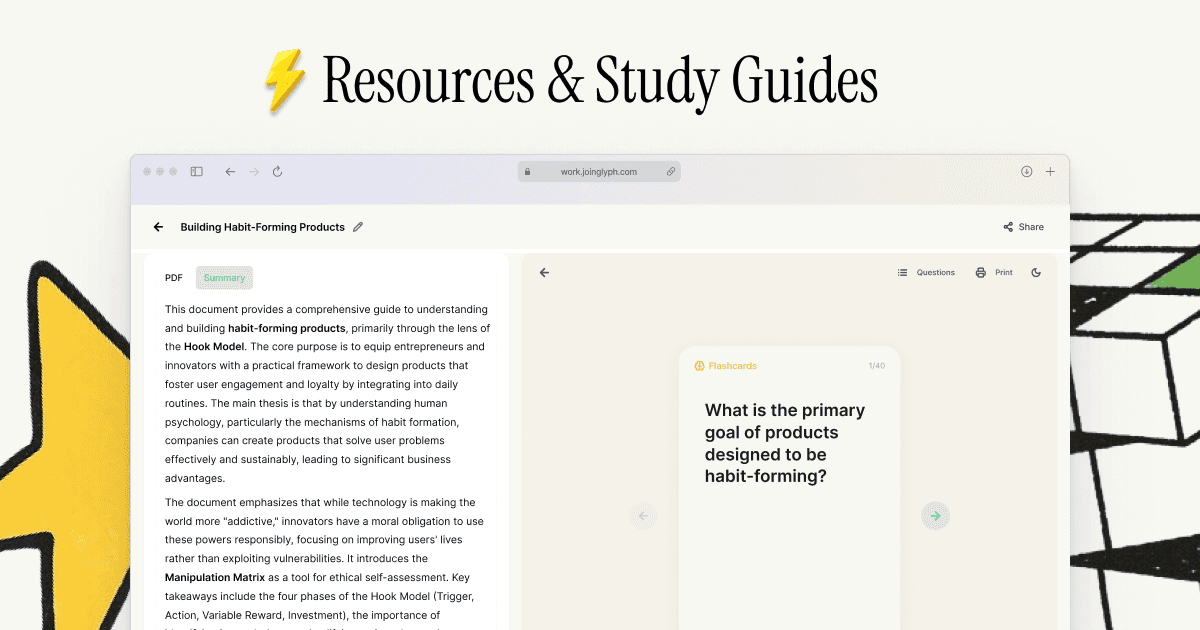
Pick two of these prompts today and apply them to your hardest subject. If you want to skip the manual prompting and have an AI that already knows all your course materials, Duetoday can automate this entire workflow for you.