
ChatGPT Prompts for Learning Concepts Visually [Free Guide]
Master complex topics with these ChatGPT prompts for learning concepts visually. Generate mental models, diagrams, and metaphors to boost retention instantly.
Use Study AI Free
ChatGPT Prompts for Learning Concepts Visually
Many students struggle to grasp abstract theories or complex systems when they are buried in walls of text. These visual learning prompts unlock a world of mental models, spatial analogies, and structured diagrams that transform dense information into clear, memorable images. Copy and paste the prompts below to start seeing your subjects instead of just reading them.
Quick Start Guide
To get the best results for visual learning, follow this simple framework: paste your textbook chapter or lecture notes into ChatGPT and ask it to 'translate' the logic into a spatial or structural layout. Always specify the level of complexity you need and provide a specific source text to prevent the AI from hallucinating details that aren't in your curriculum.
How to Use These Visual Learning Prompts
Step 1: Feed the Source: Paste your PDF, website link, or notes so ChatGPT has the exact context.
Step 2: Define the Visual Format: Choose between a flowchart, a mind map, a physical analogy, or a spatial map.
Step 3: Analyze and Verify: Ask the AI to explain the visual relationship between nodes to ensure logic is sound.
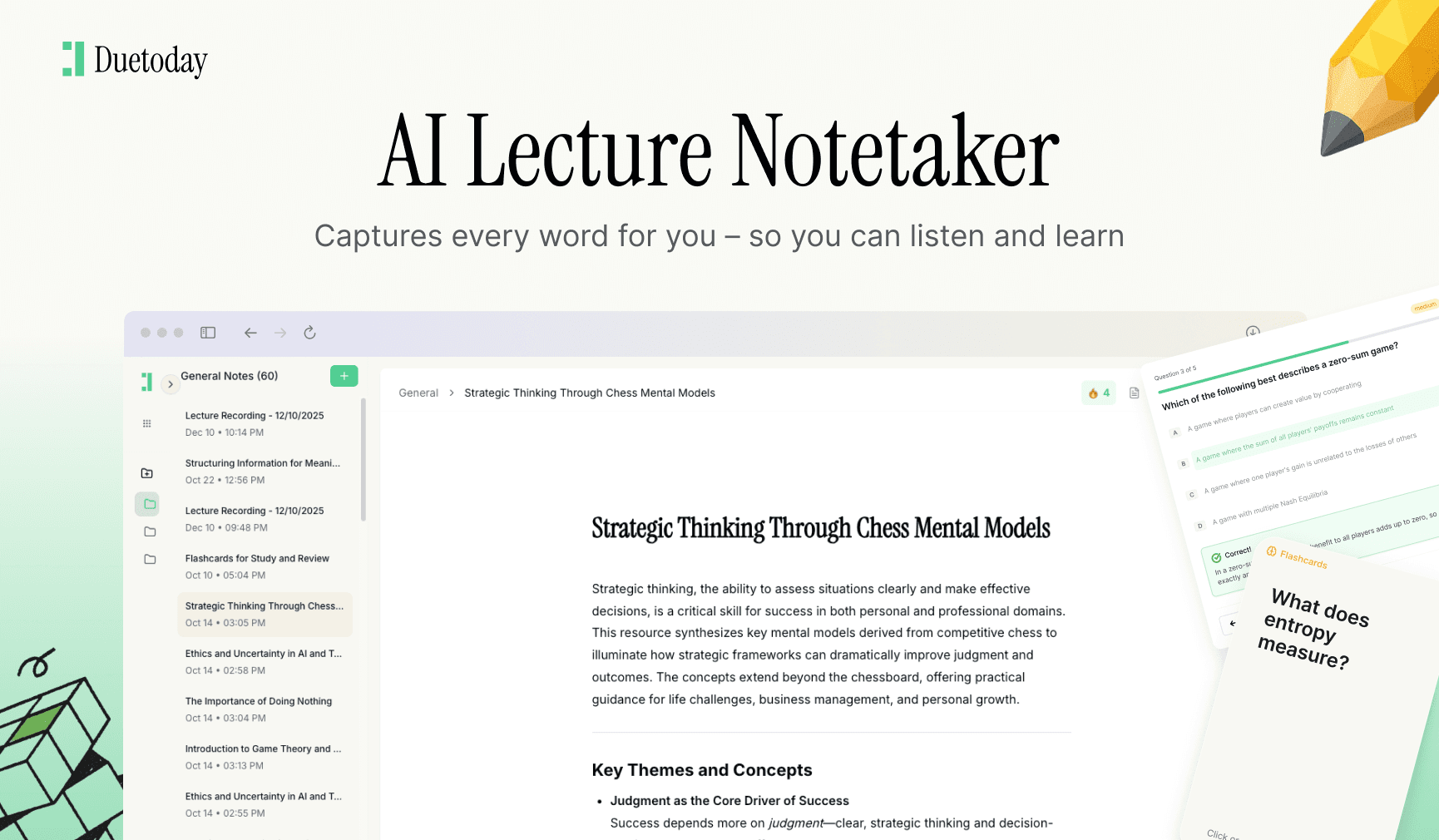
Step 4: Bridge to Duetoday: Import these visual structures into your Duetoday AI Brain to keep them as permanent study guides.
Bucket A: Understand through Imagery
1. The Mechanical Analogy Prompt
Use this when you need to understand how a complex system (like a cell or an engine) works by comparing it to something everyday.
What a good answer looks like: A detailed breakdown where, for example, the Mitochondria is explained as the 'City Power Plant' with specific visual descriptions of energy flow.
2. The Mermaid.js Flowchart Creator
Use this to get code that you can paste into a diagram editor to see a literal process map.
What a good answer looks like: A block of code that represents a logical flow, which can be visualized in any markdown editor or Duetoday's canvas.
3. The Infographic Outline
Use this to break down a topic into visual 'sections' as if you were designing a poster.
What a good answer looks like: A structured plan that tells you exactly how to organize information on a page for maximum visual impact.
Bucket B: Remember with Spatial Memory
4. The Memory Palace Builder
Use this to apply the ancient 'Method of Loci' to your current study materials.
What a good answer looks like: A walkthrough of a house where bizarre imagery (e.g., a giant gold balancing scale in the kitchen) helps you recall legal or economic principles.
5. The Comparison Venn Diagram
Use this when you are confused between two similar-sounding concepts.
What a good answer looks like: A clear differentiation of facts that highlights exactly where two theories differ and where they align.
Bucket C: Practice and Recall
6. The 'Spot the Error' Diagram
Use this to test your deep understanding by finding what's wrong.
What a good answer looks like: A challenging list of steps that forces you to visualize the correct process to find the 'glitch' in the AI's description.
7. The Sketch-to-Learn Prompt
Use this to transform your text into a physical drawing exercise.
What a good answer looks like: Practical instructions like 'Draw a bridge where the cables represent the force of tension... if the cables are thin, it shows...'
8. The Concept Map Generator
Use this to find the hidden links between different chapters of your work.
What a good answer looks like: A hierarchical web of information that shows how the 'big picture' connects to the tiny details.
Common Mistakes When Learning Visually
No Source Text: If you don't provide the text, ChatGPT might use a different version of a theory than your professor.
Over-complicating: Don't ask for a '100-node mind map.' Start small with 5-10 core nodes to avoid visual clutter.
Passive Viewing: Don't just look at the output. Try to redraw the AI's description from memory to engage active recall.
Master Your Learning with Duetoday
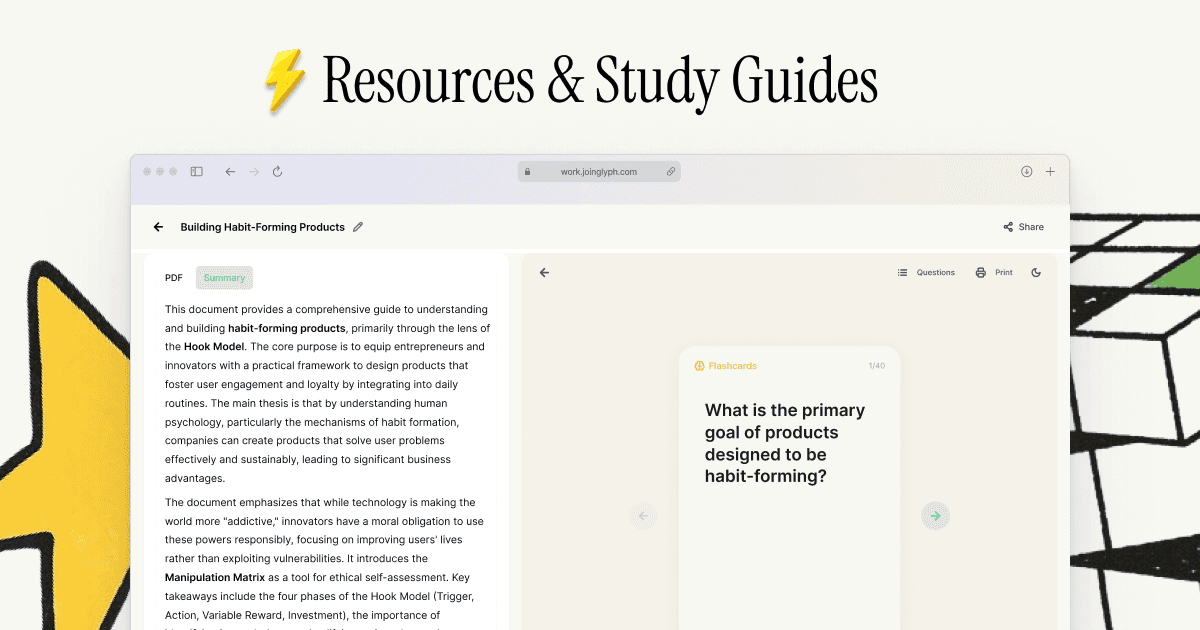
While ChatGPT prompts are powerful, they require a lot of manual copying and pasting. Duetoday simplifies this by connecting your lectures, PDFs, and YouTube videos into one AI-powered workspace. Instead of writing prompts, you can simply upload your materials and let Duetoday's AI Brain generate your mind maps, flashcards, and study guides automatically. Ready to see your notes in a whole new way?
Pick two prompts from the list above and try them on your hardest subject today. If you want to skip the manual work, let Duetoday handle it for you.

Duetoday is an AI-powered learning OS that turns your study materials into personalised, bite-sized study guides, cheat sheets, and active learning flows.
More Chatgpt Prompts
GET STARTED
Most Powerful Study Tool
for Students and Educators
Try Out Free. No Credit Card Required.
