
>

>

ChatGPT prompts for learning a new topic from scratch: master any subject fast.

Chatgpt prompts for Learning a New Topic From Scratch [Free Guide]

Discover the best ChatGPT prompts for learning a new topic from scratch. From structured roadmaps to deep dives, master any subject with these proven prompts.

Use Study AI Free
ChatGPT Prompts for Learning a New Topic From Scratch

Starting a new subject often feels like staring at a mountain of information without a map. These prompts unlock a structured path to mastery, helping you move from confusion to deep retention and practical application faster than traditional reading. Copy/paste the prompts below to build your custom learning roadmap.

The Quick Start Guide to Learning With AI

To get the most out of these prompts, follow this blueprint. Instead of asking one-off questions, treat ChatGPT as a personal mentor that needs context. Copy the text from your research papers, YouTube transcripts, or textbook chapters and paste them into the chat before running these commands.

Replacement Guide: Replace [Topic] with your subject (e.g., Quantum Physics), [Level] with your current knowledge (e.g., Beginner), and [Format] with your goal (e.g., Exam Prep or Skill Building).

How to Use These Prompts Effectively

  • Step 1: Paste Your Source Material: Don't let the AI guess; provide the PDF, notes, or website link info first.

  • Step 2: Set Constraints: Define your grade level and the specific format you want the output in (e.g., "Explain this like I'm 10").

  • Step 3: Ask for Active Output: Move beyond reading. Ask for a quiz or a teaching drill to spot your knowledge gaps.

  • Step 4: Convert into Spaced Repetition: Take the key facts and move them into a system like Duetoday to ensure you don't forget them next week.

Bucket A: Understand (The Foundation)

The 80/20 Rule Analysis

Use this when you want to identify the most important concepts of a new topic without wasting time on fluff.

I want to learn [Topic] from scratch. Apply the Pareto Principle (80/20 rule) to identify the 20% of concepts that will help me understand 80% of the subject. Create a structured learning roadmap based on these core principles for a [Level] learner

A good answer will provide a prioritized list of high-impact concepts rather than an alphabetical list of definitions.

The Feynman Technique Explanation

Use this to break down complex jargon into simple, relatable language to ensure you actually grasp the logic.

Explain the fundamental concepts of [Topic] to me as if I am a beginner with no prior background. Use analogies, avoid jargon, and conclude with a 3-sentence summary that explains why this topic matters in the real world

A good answer uses a story or simple analogy (like comparing an atom to a solar system) to make the concept stick.

Socratic Tutor Mode

Use this when you want to move beyond passive reading and start thinking critically about the material.

I want to learn [Topic]. Do not give me a lecture. Instead, act as a Socratic tutor. Ask me a series of questions, one by one, to help me derive the core principles of [Topic] on my own through logic

A good answer starts with a broad opening question and adapts based on your specific responses.
Bucket B: Remember (Encoding Information)

Mental Model Integration

Use this to connect the new topic to things you already know, making it easier for your brain to store the data.

I am an expert in [Subject You Know]. Explain the core principles of [New Topic] by using mental models and concepts from [Subject You Know] as metaphors. Point out the similarities and differences

A good answer bridges the gap between old and new knowledge, creating strong neural hooks for better memory.

Turn Notes into Active Recall Flashcards

Use this to prepare for long-term retention using a Q&A format.

I will paste my notes on [Topic] below. Extract the 10 most important facts and turn them into a 'Question and Answer' format for flashcards. Ensure the questions are specific and the answers are concise

A good answer follows the 'Minimum Information Principle'—short questions and punchy, single-concept answers.

Bucket C: Practice (The Testing Phase)

The 'Teach it Back' Drill

Use this to stress-test your understanding by trying to explain the topic back to the AI.

I have been studying [Topic]. I will now explain it to you in my own words. Please listen, identify any gaps in my logic, correct my misconceptions, and ask me 2 follow-up questions to test my depth of understanding

A good answer provides constructive feedback and challenges you with 'What if' scenarios to check for deeper comprehension.

Generate High-Stakes Practice Questions

Use this to simulate an exam or real-world application of the knowledge.

Create 5 multiple-choice questions and 2 long-form scenario questions about [Topic] at an [Advanced/Beginner] level. Include an answer key at the very end, but do not show it to me until I provide my answers

A good answer generates challenging 'distractor' options in multiple-choice questions to ensure you aren't just guessing.

Common Mistakes When Learning with AI

  • Asking broad questions: "Tell me about History" is too vague. Focus on specific eras or events for better results.

  • Ignoring Hallucinations: Statistics and citations are often made up by AI. Always verify specific dates and names against your original source material.

  • Passive Consumption: Don't just read the AI's explanation. If you aren't quizzing yourself or applying the info, you'll forget it in 24 hours.

Ready to master your next subject? Pick two prompts from the 'Understand' section and start your chat today. If you want a system that does the heavy lifting for you—transcribing your lectures and building your study guides automatically—Duetoday is waiting for you.

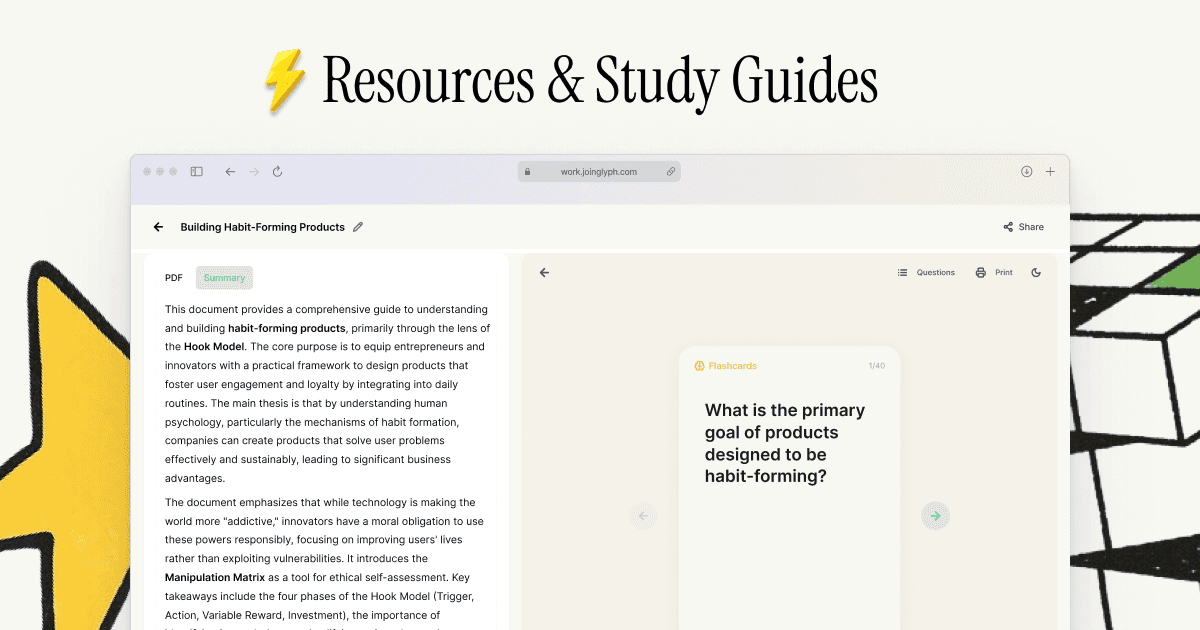
Duetoday is an AI-powered learning OS that turns your study materials into personalised, bite-sized study guides, cheat sheets, and active learning flows.

More Chatgpt Prompts
GET STARTED

Most Powerful Study Tool
for Students and Educators

Try Out Free. No Credit Card Required.
