
Chatgpt prompts for Last-Minute Studying [Free Guide]
Discover the best ChatGPT prompts for last-minute studying. Learn how to condense notes, generate quick quizzes, and master key concepts fast.
Use Study AI Free
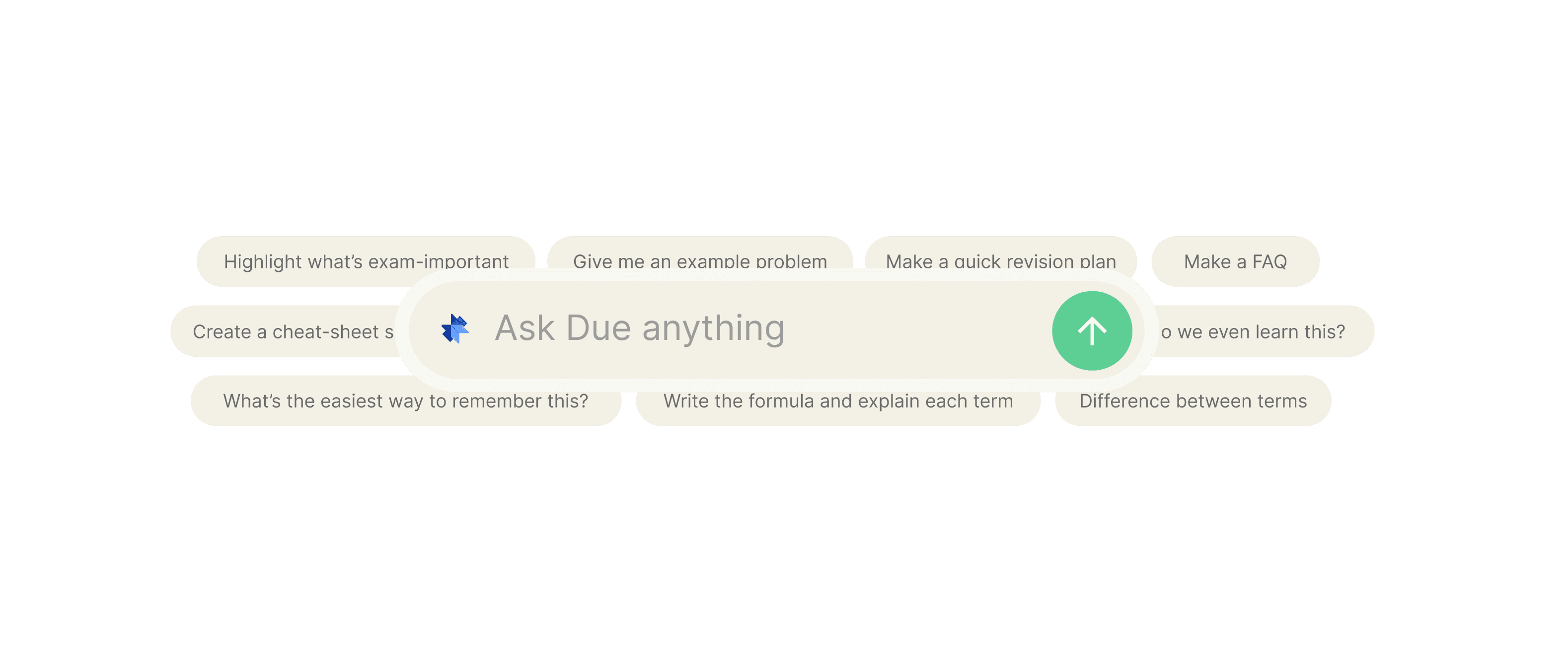
ChatGPT Prompts for Last-Minute Studying
When the clock is ticking and your exam is hours away, trying to read an entire textbook or re-watch weeks of lectures is a recipe for panic. Students often struggle with information overload and the inability to prioritize high-yield topics when time is short. These prompts unlock a strategic advantage by helping you filter out the noise, condense complex subjects into digestible summaries, and focus on active recall. Copy/paste the prompts below to turn your last-minute cram session into a productive study marathon.
The Quick Start Guide to Last-Minute Cramming
To get the most out of this page, follow these instructions for immediate results:
What to paste: Provide ChatGPT with your lecture transcripts, PDF highlights, or messy notes.
What to replace: Swap out [Topic] and [Exam Type] with your specific details (e.g., Organic Chemistry, Midterm).
The Golden Rule: Always provide your own source materials. ChatGPT is an expert at synthesizing your data, but it can hallucinate details if you ask it to generate facts from scratch without context.
How to Use These Prompts Effectively
Maximizing a short study window requires a systematic approach. Follow these four steps to ensure the AI helps you retain information rather than just skimming it:
Step 1: Feed the Brain: Paste your source material (notes, slides, or textbook snippets) into the chat first.
Step 2: Define the Constraints: Tell the AI your current knowledge level and the specific format you need (e.g., "Explain it like I'm 15" or "Technical summary for a senior-level exam").
Step 3: Test for Gaps: Ask the AI to quiz you on the most frequently tested concepts within that material.
Step 4: Convert to Action: Move the output into an active recall system like Duetoday to ensure you don't forget it the moment you close the tab.
Bucket A: Understand Complex Topics Fast
The 'Explain Like I'm 5' Deep Dive
Use this when you hit a concept that simply won't click and you don't have time for a 30-minute video explanation.
"I have 2 hours until my [Topic] exam. I am providing my notes below. Explain the core mechanism of [Specific Concept] using a simple analogy that is impossible to forget. Then, give me a 3-sentence technical summary for the exam."
A good answer provides a relatable metaphor followed by the precise academic language you need for the test.
High-Yield Content Identifier
Use this when you have 100 pages of notes and only 1 hour to study.
"Based on the following lecture notes for [Subject], identify the top 5 most important concepts that are likely to appear on a multiple-choice exam. For each concept, provide a one-sentence summary and one 'must-know' fact."
A good answer acts as a curator, highlighting the biological or historical 'bottlenecks' of the information provided.
Bucket B: Remember and Retain
The Connection Map
Use this to see how different parts of your syllabus relate to each other, which is crucial for essay exams.
"Using the attached text, create a logical flow-chart description showing how [Concept A] leads to [Concept B]. Explain the 'Why' behind each connection in 10 words or less."
A good answer helps you visualize the hierarchy of information, making it easier to recall during the test.
The Mnemonic Device Generator
Use this when you need to memorize a list of terms or a sequence of events quickly.
"I need to memorize these 7 terms from my notes: [Target List]. Create a funny, memorable mnemonic acronym or sentence for them. Explain why the mnemonic relates to the definition of each term."
An effective response provides a catchy phrase that triggers the memory of the actual scientific or historical terms.
Bucket C: Practice and Test Yourself
The 'Spot the Error' Drill
Use this to sharpen your critical thinking and ensure you actually understand the nuances of the material.
"I am going to provide my notes on [Topic]. Write a summary of these notes that contains 3 deliberate factual errors. I will try to find them. After I guess, tell me which ones I missed and explain the correct facts."
This forces you to read carefully and engage with the material rather than just passively scanning it.
The Rapid-Fire Quizzer
Use this for the final 30 minutes of your study session to test your speed and recall.
"Based on the notes provided, ask me one challenging multiple-choice question at a time. After I answer, tell me if I am right or wrong, provide a brief explanation, and then move to the next question. Do 10 rounds total."
A good answer mimics the pressure of a real exam while providing instant feedback to bridge knowledge gaps.
Common Mistakes to Avoid
No Context: Asking ChatGPT questions without providing your lecture notes leads to generic and potentially irrelevant answers.
Ignoring Difficulty: Not specifying your grade level can result in answers that are either way too simple or unnecessarily complex.
The 'Lurker' Effect: Only reading the summaries ChatGPT gives you without testing yourself. Summaries feel like learning, but only testing creates retention.
Hallucination Risk: Blindly trust dates or names if the AI didn't get them from your uploaded documents.
Pick just two prompts from this list—one for understanding and one for practicing—and start your session. If you want this process handled automatically with flashcards and a built-in AI tutor that knows your specific PDFs and YouTube lectures, try Duetoday for your next study session.

Duetoday is an AI-powered learning OS that turns your study materials into personalised, bite-sized study guides, cheat sheets, and active learning flows.
More Chatgpt Prompts
GET STARTED
Most Powerful Study Tool
for Students and Educators
Try Out Free. No Credit Card Required.
