ChatGPT Prompts for Lab Report Writing
Students often struggle with translating raw data into a structured, formal scientific narrative that meets strict grading rubrics. These high-level prompts unlock faster drafting, clearer data interpretation, and deeper analysis of your experimental results. Copy and paste the prompts below to transform your lab notes into professional reports.
The Quick Start Guide
To get the best results, paste your raw experimental observations and data table directly into the chat. Tell the AI your specific academic level (e.g., Undergraduate Organic Chemistry) and the required citation style (APA, MLA, etc.). The One Rule: Never let the AI 'guess' your results; always provide your specific measurements to ensure scientific integrity.
How to Use These Prompts
Step 1: Upload or paste your raw data, hypothesis, and procedural notes.
Step 2: Set your constraints, such as 'use formal academic tone' and 'focus on the sources of error.'
Step 3: Request specific sections like the Abstract or Discussion, then check for chemical/mathematical accuracy.
Step 4: Use the output to build a study guide or flashcards for the upcoming lab exam.
Bucket A: Understand & Draft
The Abstract Architect
Use this prompt to condense your entire experiment into a concise summary.
I have conducted an experiment on [Topic]. Here are my objectives, methods, and key results: [Paste Notes]. Write a 200-word formal abstract that highlights the purpose, methodology, key findings, and conclusion. Use a passive voice and scientific tone
I have conducted an experiment on [Topic]. Here are my objectives, methods, and key results: [Paste Notes]. Write a 200-word formal abstract that highlights the purpose, methodology, key findings, and conclusion. Use a passive voice and scientific tone
I have conducted an experiment on [Topic]. Here are my objectives, methods, and key results: [Paste Notes]. Write a 200-word formal abstract that highlights the purpose, methodology, key findings, and conclusion. Use a passive voice and scientific tone
A good answer will be a single paragraph that captures the 'why' and 'how' without fluff.
Clear Procedure Formatter
Use this when your manual notes are too messy for the final report.
Convert these rough chronological notes into a professional 'Materials and Methods' section for a lab report: [Paste Notes]. Ensure it is written in the past tense and is detailed enough for another scientist to replicate the study
Convert these rough chronological notes into a professional 'Materials and Methods' section for a lab report: [Paste Notes]. Ensure it is written in the past tense and is detailed enough for another scientist to replicate the study
Convert these rough chronological notes into a professional 'Materials and Methods' section for a lab report: [Paste Notes]. Ensure it is written in the past tense and is detailed enough for another scientist to replicate the study
Expect a structured, easy-to-read sequence of steps using precise terminology.
Hypothesis Refiner
Use this to ensure your experimental direction is scientifically sound.
Based on the following experimental premise [Explain Concept], help me draft a formal 'If/Then' hypothesis. It must be testable, specific, and include the independent and dependent variables
Based on the following experimental premise [Explain Concept], help me draft a formal 'If/Then' hypothesis. It must be testable, specific, and include the independent and dependent variables
Based on the following experimental premise [Explain Concept], help me draft a formal 'If/Then' hypothesis. It must be testable, specific, and include the independent and dependent variables
This will provide a sharp, one-sentence statement that sets the foundation for your analysis.
Bucket B: Analyze & Remember
The Discussion Deep-Dive
Use this prompt to explain the 'why' behind your results.
My results were [Data], but the expected theoretical value was [Value]. Helping me write a 'Discussion' section that explores why this discrepancy exists. Mention potential sources of error such as [Error 1, Error 2] and the scientific principles of [Topic]
My results were [Data], but the expected theoretical value was [Value]. Helping me write a 'Discussion' section that explores why this discrepancy exists. Mention potential sources of error such as [Error 1, Error 2] and the scientific principles of [Topic]
My results were [Data], but the expected theoretical value was [Value]. Helping me write a 'Discussion' section that explores why this discrepancy exists. Mention potential sources of error such as [Error 1, Error 2] and the scientific principles of [Topic]
The output should connect your specific data to broader scientific laws and theories.
Error Log Analyst
Use this to identify what went wrong during your experiment.
Analyze these experimental errors: [List Errors]. Explain how each error specifically affected the precision and accuracy of the final calculation. Suggest one way to mitigate each error in future trials
Analyze these experimental errors: [List Errors]. Explain how each error specifically affected the precision and accuracy of the final calculation. Suggest one way to mitigate each error in future trials
Analyze these experimental errors: [List Errors]. Explain how each error specifically affected the precision and accuracy of the final calculation. Suggest one way to mitigate each error in future trials
This provides critical thinking depth that often earns the highest marks in lab reports.
Bucket C: Practice & Review
The Socratic Lab Tutor
Use this to test your understanding before the lab quiz.
I am studying for a lab exam on [Subject]. Based on my report [Paste Report], act as a professor and ask me 5 challenging questions that test my understanding of the underlying theory. Don't give me the answers until I respond.
I am studying for a lab exam on [Subject]. Based on my report [Paste Report], act as a professor and ask me 5 challenging questions that test my understanding of the underlying theory. Don't give me the answers until I respond.
I am studying for a lab exam on [Subject]. Based on my report [Paste Report], act as a professor and ask me 5 challenging questions that test my understanding of the underlying theory. Don't give me the answers until I respond.
This creates an active recall loop that ensures you aren't just copying but actually learning.
Formula to Flashcard
Use this to prep for technical lab evaluations.
Extract all the mathematical formulas and chemical equations from these lab notes: [Paste Notes]. Turn them into a Q&A format that I can use to quiz myself on which variables represent what
Extract all the mathematical formulas and chemical equations from these lab notes: [Paste Notes]. Turn them into a Q&A format that I can use to quiz myself on which variables represent what
Extract all the mathematical formulas and chemical equations from these lab notes: [Paste Notes]. Turn them into a Q&A format that I can use to quiz myself on which variables represent what
This produces a condensed study sheet focused purely on the technical requirements of the lab.
Common Mistakes to Avoid
Data Hallucination: Never ask ChatGPT to 'generate data' for a lab you missed; it will invent numbers that don't follow physical laws.
Ignoring Rubrics: ChatGPT doesn't know your professor's specific formatting rules unless you paste the rubric in.
Vague Context: Writing 'explain my chemistry lab' won't work. Specify the chemicals, concentrations, and equipment used.
Passive Reliance: Only using ChatGPT to summarize prevents you from understanding the logic required for the final exam.
Automate Your Science Studies
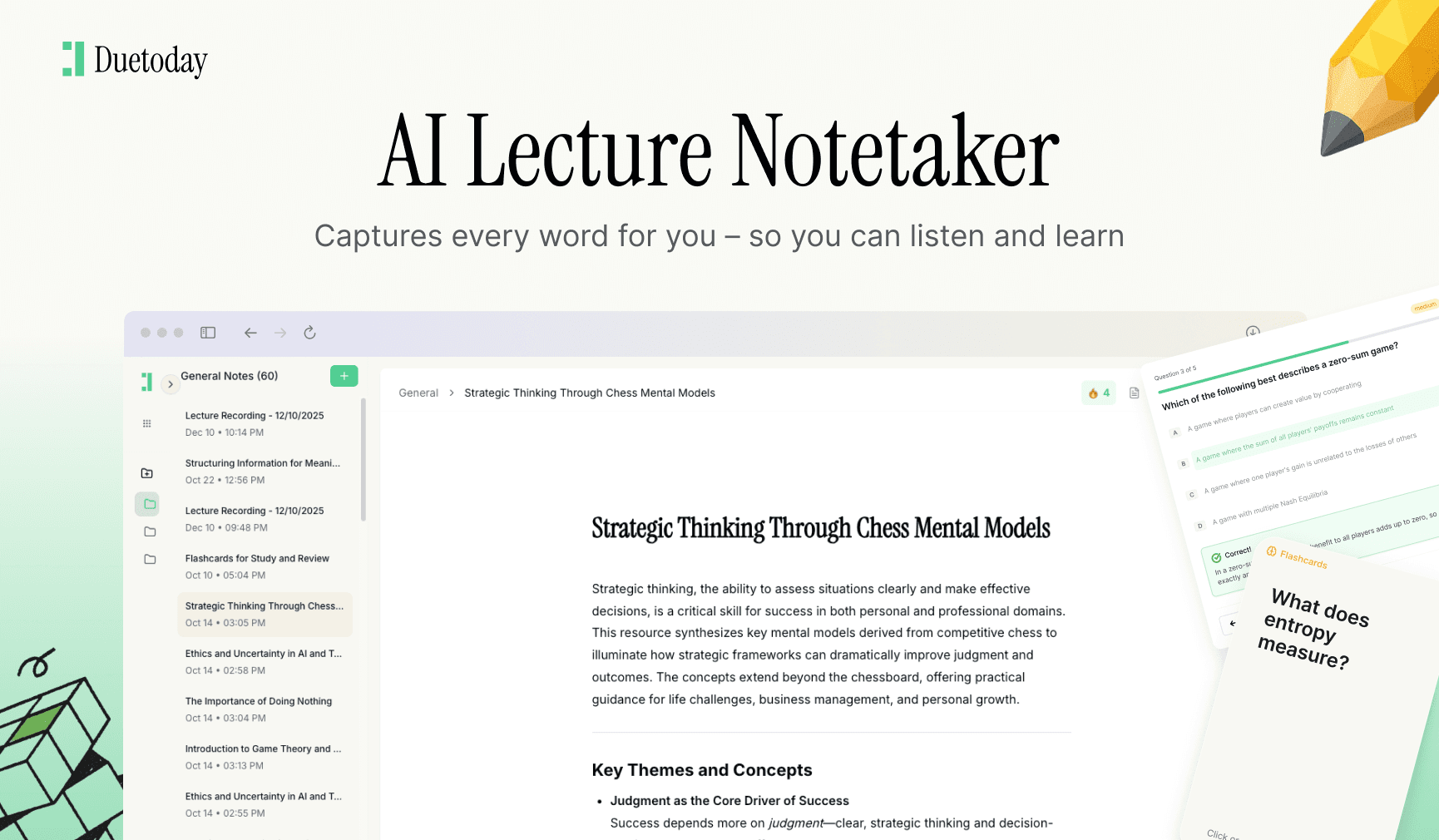
If you're tired of switching between your lab manual, your data sheet, and ChatGPT, Duetoday can help. Upload your lab PDFs and lecture recordings, and our AI Brain will automatically connect the dots, generating flashcards and summaries that help you actually retain the material. Stop drafting, start mastering.