Chatgpt prompts for Homework Help [Free Guide]
Discover the best ChatGPT prompts for homework help. Learn how to break down complex topics, solve problems, and boost retention with our expert guide.
Use Study AI Free
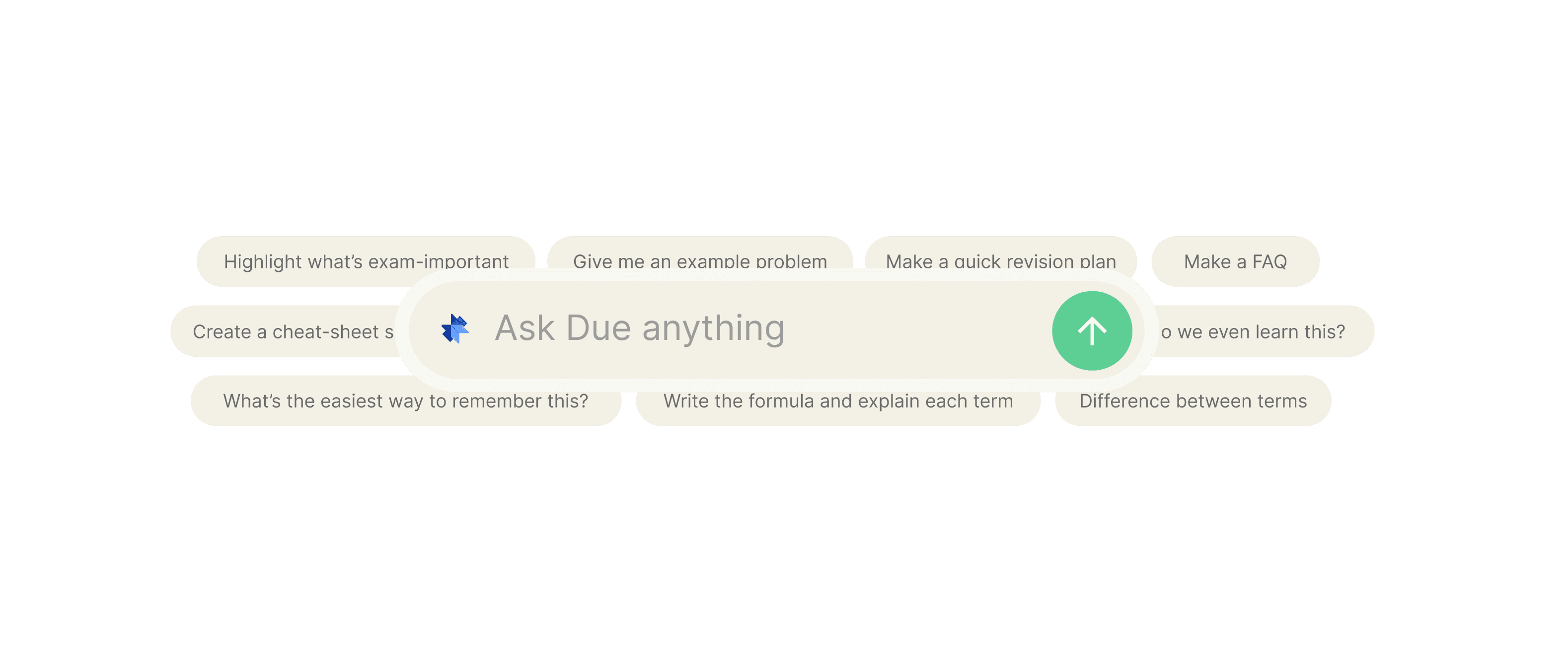
ChatGPT Prompts for Homework Help
Students often struggle with overwhelming assignments because they lack a clear breakdown of complex concepts or a structured way to approach problem-solving. These prompts unlock faster understanding, better retention, and targeted practice by acting as a personalized 24/7 tutor. Simply copy and paste the prompts below to transform your study sessions into high-efficiency learning blocks.
Quick Start Guide
To get the most accurate help from AI, always provide context. The best way to use this page is to paste your specific assignment instructions or textbook excerpts directly into the prompt. Replace the [bracketed text] with your specific topic, grade level, or deadline. Rule #1: Never let the AI guess; always provide your class notes or source text to ensure the output matches your curriculum.
How to Use These Prompts
Step 1: Paste your source material (class notes, lecture slides, or PDF text) into the chat first.
Step 2: Set your constraints, such as 'Explain this at a 10th-grade level' or 'Format this as a bulleted summary'.
Step 3: Ask for specific outputs like practice problems or a conceptual breakdown to self-check your understanding.
Step 4: Convert the results into active recall tools like flashcards or a study schedule to ensure the info sticks.
Bucket A: Understand Complex Concepts
1. The First Principles Breakdown
Use this when you are staring at a concept that makes no sense, like Quantum Physics or Macroeconomics.
"Explain [Concept] using first principles. Break it down into its most basic truths and then build it back up to a complex level. Use analogies that a high schooler would understand."
A good answer will avoid jargon and use relatable metaphors to build a foundation before moving to technical details.
2. The Socratic Tutor Mode
Use this when you want to learn how to solve a problem themselves rather than just getting the answer.
"I am working on [Topic/Problem]. Instead of giving me the answer, act as a Socratic tutor. Ask me a series of leading questions that will help me arrive at the solution on my own. Start with the first step."
A good answer will be a single, encouraging question that prompts you to think about the very first step of the problem.
3. The Summary Logic Map
Use this to see the 'big picture' of a long chapter or a set of complex lecture notes.
"I am pasting my notes below. Create a logical summary that connects the main ideas using 'if-then' statements or cause-and-effect relationships. Highlight the 3 most important takeaways."
A good answer will show how one concept leads to another, providing a mental map of the entire subject.
Bucket B: Remember and Organize
4. The Active Recall Machine
Use this to turn passive reading into an active study session immediately after finishing a chapter.
"Based on the text I provided, generate 5 challenging Q&A sets. Do not give me the answers immediately. Format it so I see the questions first, and provide the answers only when I ask for them."
A good answer will focus on 'Why' and 'How' questions rather than simple 'What' definitions.
5. Spaced Repetition Planner
Use this when you have a big exam coming up and need a structured plan to avoid cramming.
"I have an exam on [Link/Topic] on [Date]. Create a 7-day study schedule using spaced repetition. Tell me exactly which sub-topics to review each day and include 15-minute active recall sessions."
A good answer will balance new material with reviews of previous days to maximize long-term memory.
Bucket C: Practice and Refine
6. The Error-Log Analysis
Use this when you keep getting a specific type of problem wrong and don't understand your mistake.
"Here is a problem I solved and my incorrect answer: [Paste both]. Can you identify the exact step where I went wrong and explain the underlying concept I am misunderstanding?"
A good answer will pinpoint the logical or mathematical 'pivot point' where the error occurred and explain how to fix it.
7. The 'Teach it Back' Drill
Use this to test if you truly know the material by explaining it to the AI.
"I am going to explain [Concept] to you. Act as a professor and critique my explanation. Point out any gaps in my logic, missing key terms, or inaccuracies. Ask me one follow-up question to test my depth."
A good answer will be constructive, highlighting what you got right while challenging you on the nuances you missed.
8. Practice Question Generator
Use this to prepare for the actual format of your upcoming test or quiz.
"Create 3 multiple-choice, 2 short-answer, and 1 essay question based on these notes. Ensure they are at a [University/High School] difficulty level. Provide a rubric for the essay question."
A good answer will mimic the style of academic assessments, helping you get used to the phrasing of exam questions.
Common Mistakes to Avoid
Passive Asking: Simply asking for an answer without providing your class notes often results in 'generic' info that doesn't match your teacher's expectations.
Ignoring Difficulty: Failing to specify '8th grade' vs 'College level' can lead to explanations that are either too simple or way too technical.
Blind Trust: AI can occasionally halluncinate dates or formulas. Always cross-reference the output with your primary source.
Summarization Only: If you only ask for a summary, you aren't practicing retrieval. Always ask for questions or 'teach-back' drills.
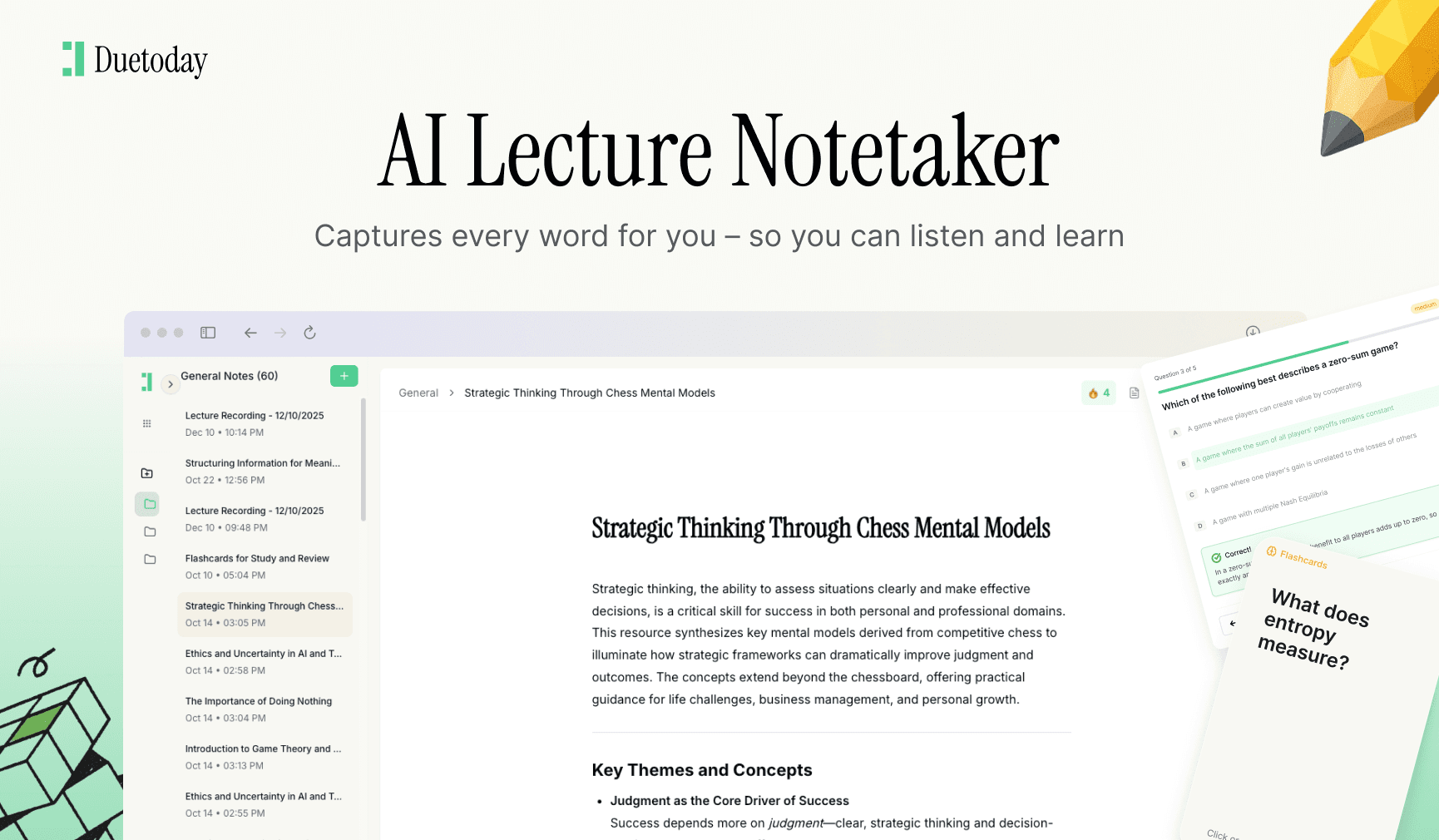
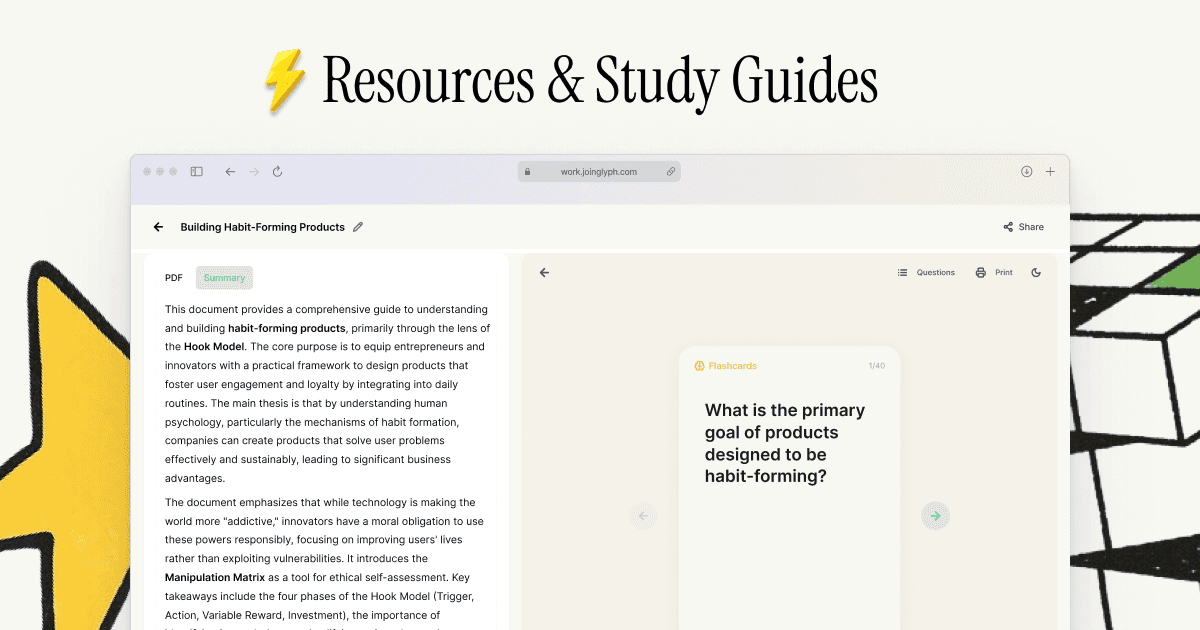
Pick two prompts from the list above and start your next assignment. If you want to automate this entire workflow—from uploading PDFs to generating retention-ready flashcards—Duetoday is ready to help you thrive.

Duetoday is an AI-powered learning OS that turns your study materials into personalised, bite-sized study guides, cheat sheets, and active learning flows.
More Chatgpt Prompts
GET STARTED
Most Powerful Study Tool
for Students and Educators
Try Out Free. No Credit Card Required.