
Chatgpt prompts for Getting 90+ in Exams [Free Guide]
Discover the best ChatGPT prompts to ace your exams with 90+ scores. Master study guides, flashcards, and active recall strategies with our free AI prompt library.
Use Study AI Free
ChatGPT Prompts for Getting 90+ in Exams
Students often struggle to filter massive amounts of information into the specific insights that actually appear on high-stakes exams. These prompts unlock a systematic approach to studying, allowing you to move from passive reading to active mastery and 90%+ retention. Simply copy and paste the prompts below to transform your notes into a high-performance study engine.
Quick Answer: The 90+ Score Strategy
To get the most out of these prompts, follow this protocol: Paste your specific lecture notes or textbook chapters directly into the chat before running a prompt. The Golden Rule: Never ask ChatGPT to explain a topic in a vacuum; always provide your source material so it doesn't guess or include irrelevant outside information. Replace [Topic] with your subject and [Exam Date] to help the AI prioritize the most critical information.
How to Use These Prompts
Step 1: Upload or paste your source material (PDF transcripts, lecture notes, or textbook passages).
Step 2: Set strict constraints, specifically defining your academic level (e.g., Undergraduate, AP, Medical Board).
Step 3: Request specific outputs like practice questions or gap analyses to find what you don't know.
Step 4: Export the results into a spaced repetition system like Duetoday to ensure you don't forget it by exam day.
Bucket A: Understand Complex Concepts
The First Principles Breakdown
Use this when you are facing a topic that feels too dense or complex to grasp."I am attaching my notes on [Topic]. Explain the core concepts using first principles, breaking the logic down into its simplest components. Avoid jargon and use an analogy for the most difficult part."
A good answer provides a 'ground-up' explanation that makes the logic feel intuitive rather than memorized.
Socratic Tutor Mode
Use this to test if you truly understand the 'why' behind the facts."Act as a Socratic tutor. Based on this text, ask me a series of probing questions one by one to see if I understand the underlying logic. Do not give me the answers; lead me to them."
A good answer engages you in a back-and-forth dialogue that exposes your conceptual blind spots.
The 'Explain Like I’m an Expert' Transition
Use this to move from basic understanding to the high-level nuance required for 90+ scores."First, explain [Topic] like I am 10. Then, explain it like I am a PhD candidate, focusing on the current research debates and technical complexities mentioned in these notes."
A good answer bridges the gap between simple intuition and the technical precision needed for top marks.
Bucket B: Remember and Organize
The High-Yield Summary
Use this to identify the most likely exam questions within a massive PDF."Analyze these notes and identify the top 10 most 'testable' concepts. For each, explain why a professor would likely include it on a high-stakes exam."
A good answer highlights specific themes and patterns rather than just summarizing the whole text.
The Spaced Repetition Logic Map
Use this to organize your study calendar leading up to the big day."Based on the complexity of these 5 topics [List Topics], create a 7-day study plan that uses spaced repetition. Prioritize the most difficult concepts for days 1, 3, and 6."
A good answer provides a clear, day-by-day checklist that prevents last-minute cramming.
Bucket C: Practice Like a Pro
The 'Hard' Practice Exam
Use this to simulate the highest difficulty level of your upcoming test."Generate 5 multiple-choice questions and 2 essay prompts based on this text. The difficulty should be 'hard,' focusing on application and synthesis, not just recall. Provide an answer key at the end."
A good answer forces you to apply information in new contexts, which is the hallmark of 90+ scoring students.
The Error-Log Analysis
Use this after you take a practice test to fix your mistakes."I got these questions wrong: [Paste Mistakes]. Based on my notes, explain exactly why the correct answer is right and what logical error I likely made."
A good answer identifies the 'why' behind your error, ensuring you don't repeat it on the actual exam.
The Teach-Back Drill
Use this to finalize your knowledge through retrieval practice."I am going to explain [Concept] to you. Please critique my explanation based on the attached notes. Tell me what I missed and what I described inaccurately."
A good answer provides specific feedback on your gaps, serving as a final quality check for your memory.
Common Mistakes to Avoid
No Source Text: Asking ChatGPT about a topic without giving it your specific class notes leads to generic and often irrelevant answers.
Surface Leveling: Only asking for summaries. To get a 90+, you need practice questions and application drills.
Ignoring Citations: Assuming the AI's dates or names are correct. Always cross-reference AI-generated study guides with your primary material.
Pick two prompts from the practice section and start testing yourself today. If you want to skip the prompt engineering and have your AI 'brain' handle this automatically, Duetoday can transform your materials into retention tools with one click.

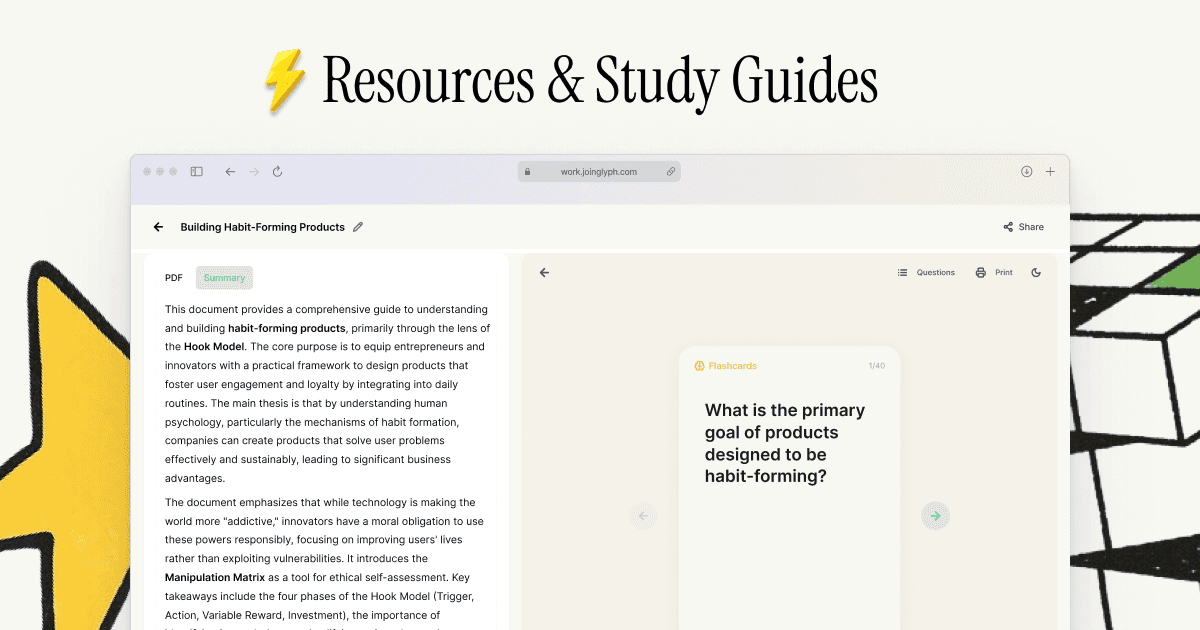
Duetoday is an AI-powered learning OS that turns your study materials into personalised, bite-sized study guides, cheat sheets, and active learning flows.
More Chatgpt Prompts
GET STARTED
Most Powerful Study Tool
for Students and Educators
Try Out Free. No Credit Card Required.
