
Chatgpt prompts for flashcards [Free Guide]
Discover the best ChatGPT prompts for generating flashcards. Learn how to turn notes, PDFs, and lectures into high-quality Anki-style cards for better retention.
Use Study AI Free
ChatGPT Prompts for Generating Flashcards
Students often struggle with the 'manual labor' of studying—spending hours copy-pasting text into flashcards instead of actually learning the material. These prompts unlock a faster way to transform dense notes into active recall tools, ensuring you spend your time practicing rather than formatting. Copy and paste the prompts below to turn your study materials into high-quality flashcards in seconds.
Quick Start: How to Generate Flashcards Fast
To get the best results, don't just ask ChatGPT to 'make cards.' Instead, paste your specific lecture notes or textbook chapters and use a structured command. Always include the target difficulty level and the specific format you need (like Front/Back or Q&A). The golden rule: provide the source text so the AI doesn't hallucinate facts that aren't in your curriculum.
How to Use These Prompts
Step 1: Paste your source material (PDF text, YouTube transcripts, or Notion notes) into the chat.
Step 2: Set constraints such as 'create 10 cards' and specify the 'Medical School' or 'High School' level.
Step 3: Request a specific output format, such as a table or CSV layout for easy importing.
Step 4: Review the cards for accuracy and move them into a system that supports spaced repetition.
Bucket A: Understand & Deconstruct
1. The Concept-Definition Split
Use this when you have a list of technical terms and need clear, concise definitions for the 'Back' of your card.
A good answer provides a clear distinction between the term and a relatable example to anchor the memory.
2. The 'Why' Behind the Fact
Perfect for subjects like History or Biology where understanding causation is more important than memorizing dates.
A good answer avoids one-word facts and instead explains the logic or 'reasoning' behind the concept.
3. The Analogy Generator
Use this for complex or abstract topics that are hard to visualize or remember through rote memorization.
A good answer connects a difficult concept (like Mitochondria) to a common object (like a Power Plant).
Bucket B: Practice & Recall
4. Cloze Deletion (Fill-in-the-Blanks)
Ideal for memorizing specific phrasing, formulas, or anatomical structures where context clues matter.
A good answer keeps the surrounding context clear while hiding the most critical piece of information.
5. The Socratic Study Drill
Use this to test your deep understanding rather than just recognition of a term.
A good result will force you to synthesize information from two different parts of your notes.
6. Reverse Engineering Concepts
This prompt helps you identify a concept when given a description, which is common in multiple-choice exams.
A good response provides a detailed scenario on the front that uniquely identifies only one possible answer.
Bucket C: Optimize & Refine
7. The Error-Log Flashcard
Use this when you keep getting a specific topic wrong in your practice tests.
A good answer uses a 'vs' format to clarify exactly where the distinction lies.
8. The Spaced Repetition Scheduler
Use this to organize your study flow over a long period leading up to an exam.
A good answer provides a structured calendar that ramps up frequency for difficult topics.
Common Mistakes to Avoid
Asking without source text: ChatGPT will use its general training data, which might contradict what your professor actually wants you to know.
Too much text on one card: Simple cards are better. If a card has more than two sentences on the back, ask the AI to break it into two separate cards.
Ignoring the 'Why': Don't just make cards for 'What.' Make sure you have cards that ask 'How' and 'Why.'
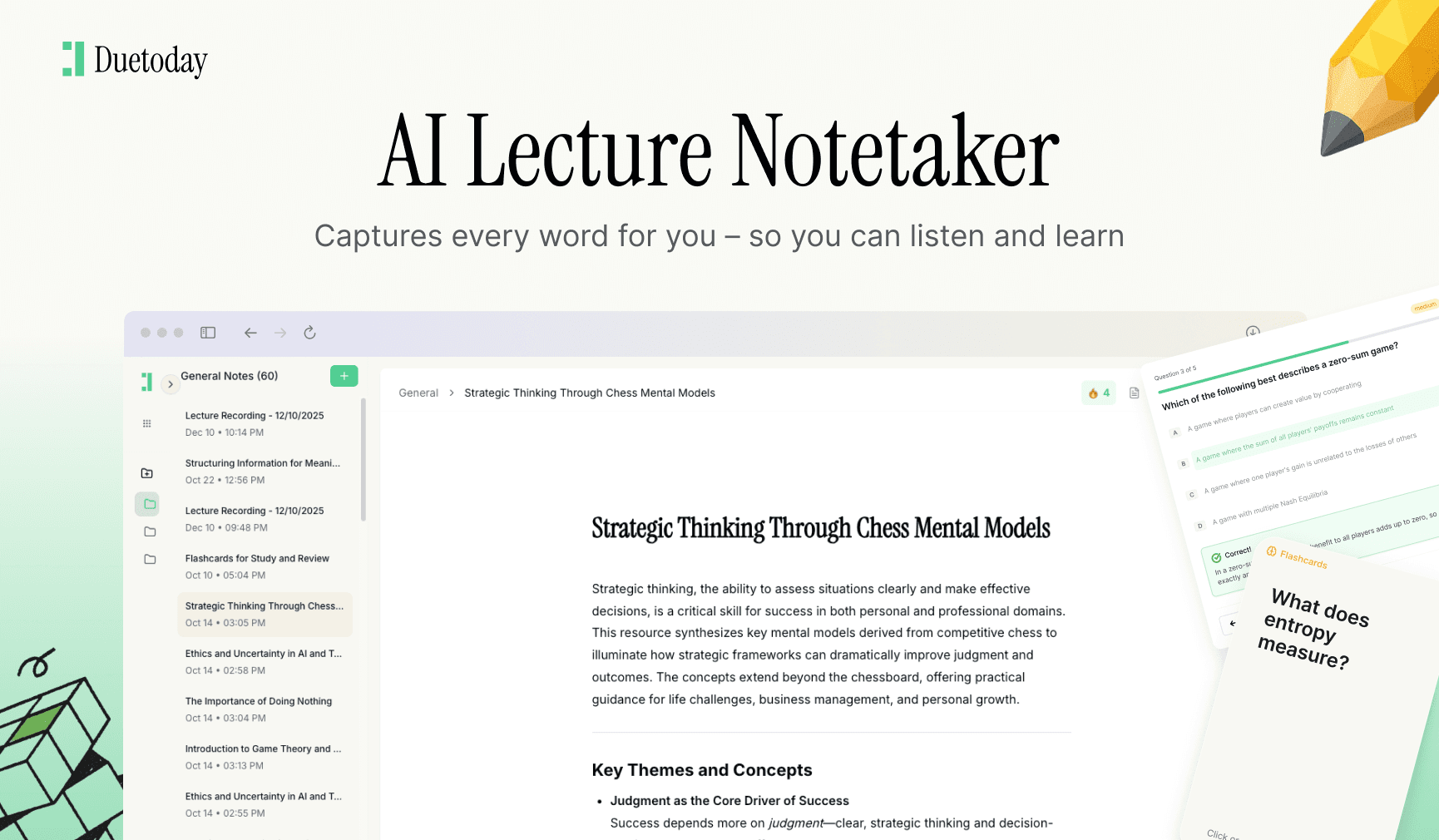
Pick two prompts from the list above and start transforming your notes today. If you want a system that does the heavy lifting for you—from transcribing lectures to generating flashcards automatically—check out Duetoday.

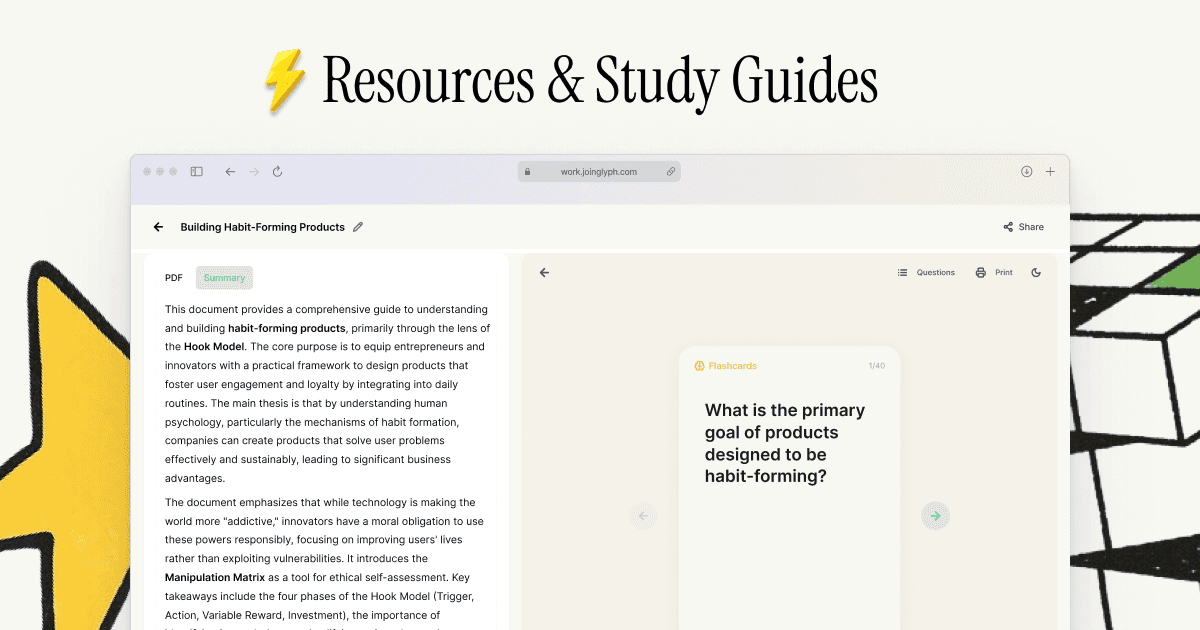
Duetoday is an AI-powered learning OS that turns your study materials into personalised, bite-sized study guides, cheat sheets, and active learning flows.
More Chatgpt Prompts
GET STARTED
Most Powerful Study Tool
for Students and Educators
Try Out Free. No Credit Card Required.
