ChatGPT Prompts for First-Principles Learning
Students often struggle to understand complex topics because they memorize formulas and definitions without grasping the underlying logic. These first-principles prompts unlock a deeper level of mastery by stripping away assumptions and rebuilding your knowledge from the ground up. Copy and paste the prompts below to transform how you study.
The Quick Start Guide
To get the most out of these prompts, follow this simple framework: Paste your specific textbook chapter or lecture notes into ChatGPT, define the core concept you want to deconstruct, and specify that you want to ignore analogies in favor of fundamental truths. The Golden Rule: Never let ChatGPT guess; always provide your source material to ensure the AI doesn't hallucinate 'facts' that aren't in your curriculum.
How to Use These Prompts Effectively
Step 1: Provide the Source: Upload your lecture transcript, PDF, or paste text notes directly into the chat.
Step 2: Set Constraints: Tell the AI to explain the topic as if you are a beginner but want to reach an expert level of logical depth.
Step 3: Deconstruct: Use the prompts below to find the 'atoms' of the information—the parts that cannot be further simplified.
Step 4: Bridge to Retention: Once the logic is clear, convert those insights into active recall questions or flashcards.
Bucket A: Understand (Deconstruction)
The 'Five Whys' Deconstruction
Use this when you have a complex theory and want to find its absolute foundation.
I am providing notes on [Topic]. Act as a logic expert and apply the 'Five Whys' technique to deconstruct this concept. Start with the main premise and keep asking 'why' until we reach the fundamental physical or logical truths that cannot be broken down further
I am providing notes on [Topic]. Act as a logic expert and apply the 'Five Whys' technique to deconstruct this concept. Start with the main premise and keep asking 'why' until we reach the fundamental physical or logical truths that cannot be broken down further
I am providing notes on [Topic]. Act as a logic expert and apply the 'Five Whys' technique to deconstruct this concept. Start with the main premise and keep asking 'why' until we reach the fundamental physical or logical truths that cannot be broken down further
A good answer will strip away jargon and leave you with a clear chain of causality.
The Axiom Finder
Use this to identify the 'non-negotiable' truths of a specific subject or chapter.
Based on this text: [Paste Text], identify the 3-5 fundamental axioms or first principles that this entire concept is built upon. Ignore analogies and historical context; focus only on the core logical requirements for this to be true
Based on this text: [Paste Text], identify the 3-5 fundamental axioms or first principles that this entire concept is built upon. Ignore analogies and historical context; focus only on the core logical requirements for this to be true
Based on this text: [Paste Text], identify the 3-5 fundamental axioms or first principles that this entire concept is built upon. Ignore analogies and historical context; focus only on the core logical requirements for this to be true
This helps you see the 'building blocks' of the subject rather than just the finished structure.
The Analogy Stripper
Use this when a teacher's analogy is more confusing than the actual science or math.
Explain [Concept] without using any analogies or metaphors. Describe it using only its fundamental components, physical laws, or logical proofs. Break down the system into its most basic parts
Explain [Concept] without using any analogies or metaphors. Describe it using only its fundamental components, physical laws, or logical proofs. Break down the system into its most basic parts
Explain [Concept] without using any analogies or metaphors. Describe it using only its fundamental components, physical laws, or logical proofs. Break down the system into its most basic parts
A strong response will explain the 'exactly how and why' without fluff.
Bucket B: Remember (Synthesis)
The Knowledge Tree Builder
Use this to organize your thoughts before an exam to ensure your mental map is logical.
Create a 'Knowledge Tree' for [Topic]. Start with the first-principles foundations as the roots, the core theories as the trunk, and the specific applications or formulas as the branches. Use the provided notes as the source
Create a 'Knowledge Tree' for [Topic]. Start with the first-principles foundations as the roots, the core theories as the trunk, and the specific applications or formulas as the branches. Use the provided notes as the source
Create a 'Knowledge Tree' for [Topic]. Start with the first-principles foundations as the roots, the core theories as the trunk, and the specific applications or formulas as the branches. Use the provided notes as the source
This provides a visual hierarchy that makes retrieval much easier during high-stakes testing.
The 'Teach a Six-Year-Old' Drill
Use this to find gaps in your own logic by forcing simplicity.
Explain the first principles of [Topic] to a 6-year-old. Then, gradually increase the complexity in three stages until you reach a university level. Ensure each stage builds logically on the previous first-principle foundational truth
Explain the first principles of [Topic] to a 6-year-old. Then, gradually increase the complexity in three stages until you reach a university level. Ensure each stage builds logically on the previous first-principle foundational truth
Explain the first principles of [Topic] to a 6-year-old. Then, gradually increase the complexity in three stages until you reach a university level. Ensure each stage builds logically on the previous first-principle foundational truth
A good answer highlights where your understanding of the 'basics' might be shaky.
Bucket C: Practice (Application)
The Socratic Tutor Mode
Use this to test your understanding through a guided dialogue.
I want to master [Topic] using first principles. Do not give me the answer. Instead, ask me a series of Socratic questions that will lead me to discover the fundamental truths of this topic on my own. Start with the most basic question
I want to master [Topic] using first principles. Do not give me the answer. Instead, ask me a series of Socratic questions that will lead me to discover the fundamental truths of this topic on my own. Start with the most basic question
I want to master [Topic] using first principles. Do not give me the answer. Instead, ask me a series of Socratic questions that will lead me to discover the fundamental truths of this topic on my own. Start with the most basic question
This forces active retrieval, which is the key to long-term retention.
The Zero-State Reconstruction
Use this to prepare for essay questions or complex problem-solving.
If the current formulas and methods for [Topic] didn't exist, how would I derive the solution starting only from [Fundamental Principle]? Walk me through the logical steps to rebuild the solution from scratch.
If the current formulas and methods for [Topic] didn't exist, how would I derive the solution starting only from [Fundamental Principle]? Walk me through the logical steps to rebuild the solution from scratch.
If the current formulas and methods for [Topic] didn't exist, how would I derive the solution starting only from [Fundamental Principle]? Walk me through the logical steps to rebuild the solution from scratch.
This ensures you aren't just memorizing steps, but actually understand why the steps exist.
The Error-Log Logic Check
Use this when you keep getting a specific type of problem wrong.
Here is a problem I got wrong and my notes on the topic. Identify which first principle I am misunderstanding or skipping that led to this error. Explain the logic I missed
Here is a problem I got wrong and my notes on the topic. Identify which first principle I am misunderstanding or skipping that led to this error. Explain the logic I missed
Here is a problem I got wrong and my notes on the topic. Identify which first principle I am misunderstanding or skipping that led to this error. Explain the logic I missed
This turns a mistake into a profound learning moment by fixing the root cause, not just the symptom.
Common Mistakes to Avoid
Ignoring the Source: Never ask ChatGPT to explain first principles in a vacuum; its training data might differ from your specific course requirements.
Stopping at the 'What': Don't settle for a summary. Always push the AI to explain the 'Why' behind every fact.
Over-Reliance on Analogies: While helpful for initial hooks, analogies are 'learning by comparison.' First principles require 'learning by deconstruction.'
Automate First-Principles Learning with Duetoday
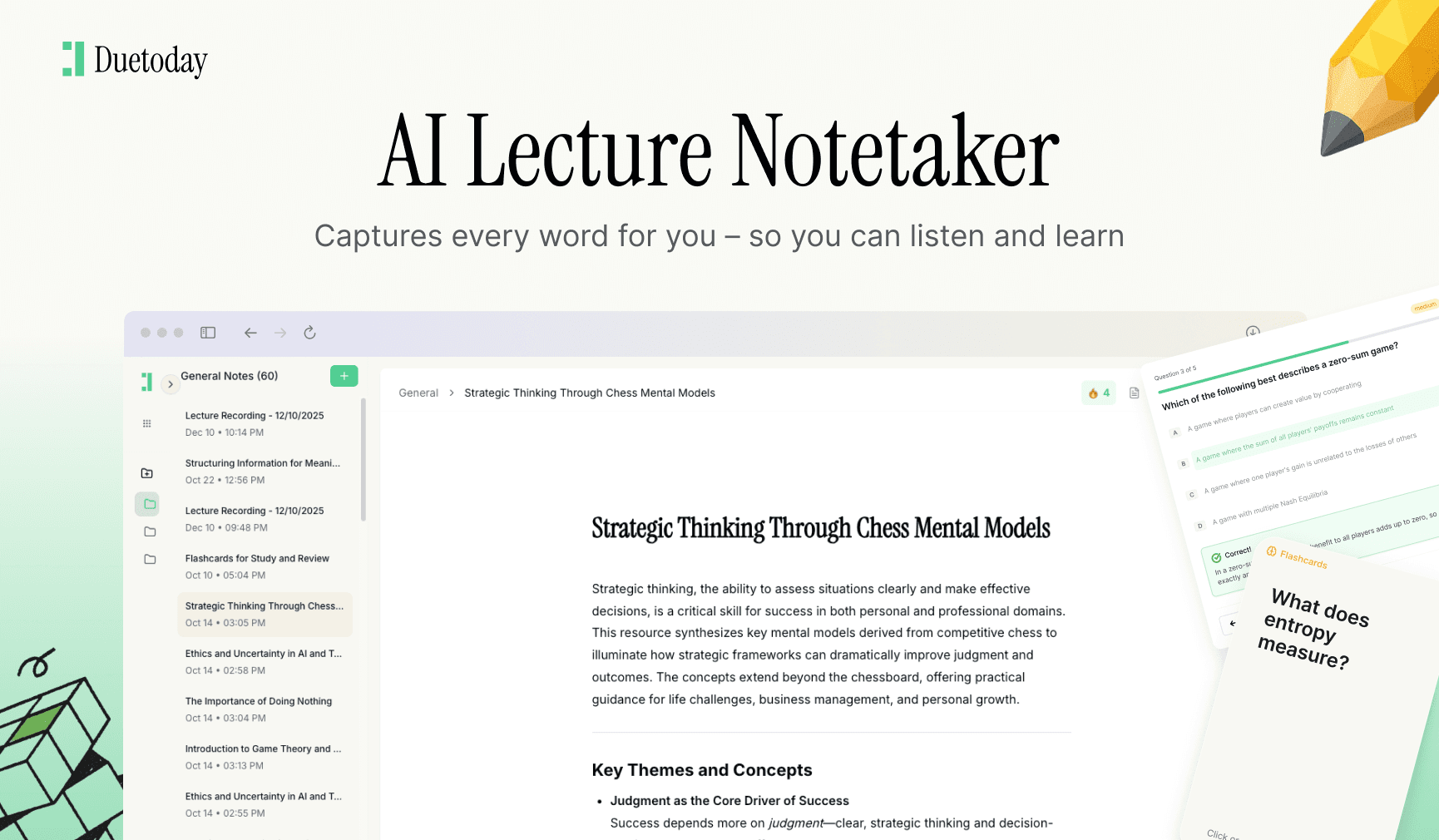
If you want this process automated without the manual prompting, Duetoday can do it for you. Simply upload your materials and let our AI Brain deconstruct your entire curriculum.
Upload PDFs, YouTube lectures, or Notion notes instantly.
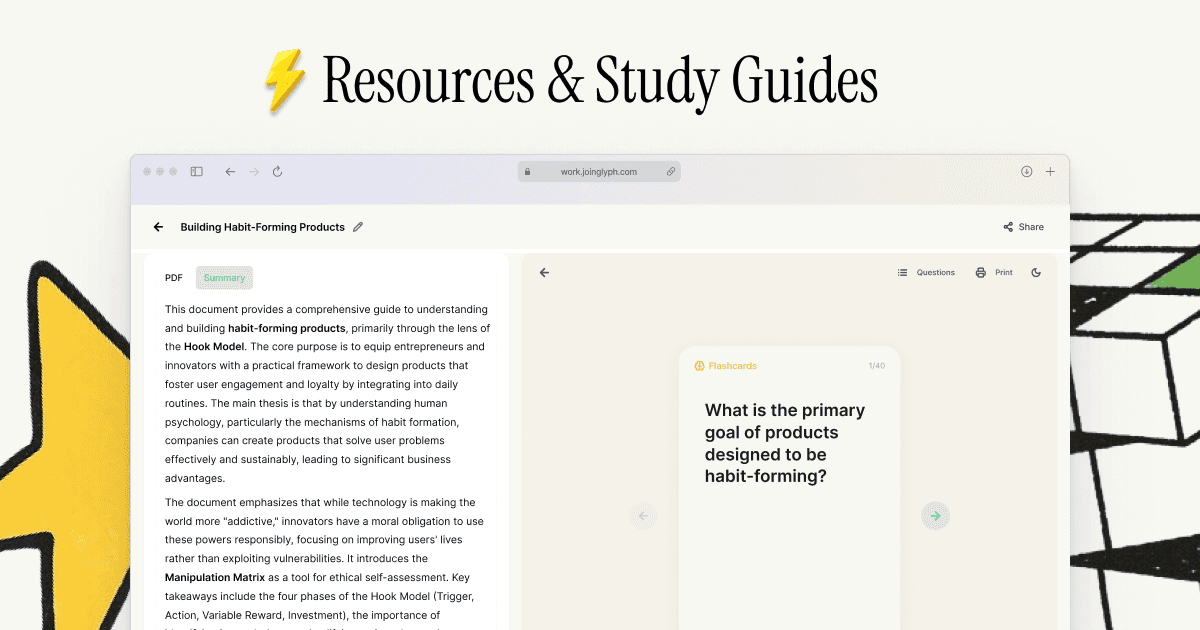
Generate first-principles summaries and structured cheatsheets.
Launch an AI Tutor that knows your specific context and teaches you based on your learning signals.
Start building your AI learning brain today.
Pick two prompts from the list above and start deconstructing your hardest subject. If you want to skip the prompt engineering and have an AI that already knows your syllabus, try Duetoday.