ChatGPT Prompts for Feynman Technique Studying
Many students struggle to move beyond rote memorization, often realizing too late that they don’t actually understand the core concepts of their coursework. These Feynman Technique prompts unlock a faster path to total subject mastery by forcing you to simplify, teach, and refine your knowledge until it sticks. Copy and paste the prompts below to transform your study sessions from passive reading into active learning.
Quick Answer: How to Master the Feynman Technique with ChatGPT
To get the best results, you should paste your specific lecture notes, textbook excerpts, or research papers into ChatGPT alongside the prompt. Tell the AI your current academic level and the specific goal (e.g., prep for a mid-term). The golden rule: Never ask ChatGPT to explain something in a vacuum; always provide your own source text so it identifies your specific knowledge gaps rather than giving generic internet summaries.
How to Use These Prompts Effectively
Step 1: Feed the Context: Paste your study material (slides, PDFs, or YouTube transcripts) first.
Step 2: Define the Persona: Tell ChatGPT to act as a mentor, a curious child, or a peer to adjust the complexity of the explanation.
Step 3: Identify the Gaps: Ask the AI to point out areas where your explanation is vague or overly technical.
Step 4: Automate the Workflow: Move these insights into an AI-powered workspace like Duetoday to create long-term retention schedules.
Core Feynman Technique Prompts
Bucket A: Understand & Simplify
1. The "Child-Level" Simple Explanation
Use this when you first encounter a dense topic and can't grasp the "big picture" logic.
"I am going to provide my notes on [TOPIC]. Based on these notes, explain this concept to me as if I am a 10-year-old. Avoid jargon and use a relatable analogy from everyday life. Then, ask me one question to see if I understood the core logic."
"I am going to provide my notes on [TOPIC]. Based on these notes, explain this concept to me as if I am a 10-year-old. Avoid jargon and use a relatable analogy from everyday life. Then, ask me one question to see if I understood the core logic."
"I am going to provide my notes on [TOPIC]. Based on these notes, explain this concept to me as if I am a 10-year-old. Avoid jargon and use a relatable analogy from everyday life. Then, ask me one question to see if I understood the core logic."
A good answer provides a clear analogy that makes the abstract feel concrete without losing the fundamental truth of the topic.
2. The Analogy Architect
Perfect for bridge-building between what you know and what you are currently learning.
"Translate the attached material into a mental model or analogy that links [NEW TOPIC] to something I already understand, like [FAVORITE HOBBY/TOPIC]. Explain why the comparison works and where it fails to be accurate."
"Translate the attached material into a mental model or analogy that links [NEW TOPIC] to something I already understand, like [FAVORITE HOBBY/TOPIC]. Explain why the comparison works and where it fails to be accurate."
"Translate the attached material into a mental model or analogy that links [NEW TOPIC] to something I already understand, like [FAVORITE HOBBY/TOPIC]. Explain why the comparison works and where it fails to be accurate."
A successful output creates a "memory hook" that makes the new information impossible to forget.
3. The Jargon-to-English Translator
Use this to strip away academic fluff that hides a lack of true understanding.
"Scan these notes and identify the top 5 technical terms. Explain each term using plain, non-academic language. If I cannot explain these terms simply, I don't know them. Challenge me to rewrite one paragraph of my notes without using these terms."
"Scan these notes and identify the top 5 technical terms. Explain each term using plain, non-academic language. If I cannot explain these terms simply, I don't know them. Challenge me to rewrite one paragraph of my notes without using these terms."
"Scan these notes and identify the top 5 technical terms. Explain each term using plain, non-academic language. If I cannot explain these terms simply, I don't know them. Challenge me to rewrite one paragraph of my notes without using these terms."
The result should be a version of your notes that anyone on the street could understand.
Bucket B: Identify Gaps & Remember
4. The Socratic Gap-Finder
Use this to find the "holes" in your knowledge that usually show up during exams.
"I will explain [TOPIC] to you in my own words below. Act as a critical mentor and point out exactly where my explanation is weak, where I am assuming facts I haven't explained, and what specific parts of the source text I missed."
"I will explain [TOPIC] to you in my own words below. Act as a critical mentor and point out exactly where my explanation is weak, where I am assuming facts I haven't explained, and what specific parts of the source text I missed."
"I will explain [TOPIC] to you in my own words below. Act as a critical mentor and point out exactly where my explanation is weak, where I am assuming facts I haven't explained, and what specific parts of the source text I missed."
This prompts an interactive dialogue where the AI pushes you to be more precise until your understanding is airtight.
5. The Feedback Loop
Great for active recall and checking if you've actually mastered the material.
"Based on the source text, ask me 3 'Why' questions and 2 'How' questions that require a deep understanding of the mechanics. Grade my responses on a scale of 1-10 based on how well I applied the Feynman Technique (simplicity and clarity)."
"Based on the source text, ask me 3 'Why' questions and 2 'How' questions that require a deep understanding of the mechanics. Grade my responses on a scale of 1-10 based on how well I applied the Feynman Technique (simplicity and clarity)."
"Based on the source text, ask me 3 'Why' questions and 2 'How' questions that require a deep understanding of the mechanics. Grade my responses on a scale of 1-10 based on how well I applied the Feynman Technique (simplicity and clarity)."
A good response will highlight the specific sentence where your logic broke down.
Bucket C: Practice & Master
6. The "Teach to Learn" Simulation
This simulates the core of Feynman’s fourth step: the final review.
"I want to teach you [TOPIC]. Act as a student who is confused. Whenever I give an explanation, ask a follow-up question that forces me to go deeper. Continue this until I have covered every major point in the attached lecture notes."
"I want to teach you [TOPIC]. Act as a student who is confused. Whenever I give an explanation, ask a follow-up question that forces me to go deeper. Continue this until I have covered every major point in the attached lecture notes."
"I want to teach you [TOPIC]. Act as a student who is confused. Whenever I give an explanation, ask a follow-up question that forces me to go deeper. Continue this until I have covered every major point in the attached lecture notes."
The output is a dynamic conversation that forces you to retrieve information repeatedly.
7. The Knowledge Map Generator
Visualizing the connections between concepts is key to the Feynman method.
"Summarize the key concepts of [TOPIC] into a structured outline. Then, for each point, provide a 'Common Misconception' that a beginner might have and explain why it is wrong using the Feynman method."
"Summarize the key concepts of [TOPIC] into a structured outline. Then, for each point, provide a 'Common Misconception' that a beginner might have and explain why it is wrong using the Feynman method."
"Summarize the key concepts of [TOPIC] into a structured outline. Then, for each point, provide a 'Common Misconception' that a beginner might have and explain why it is wrong using the Feynman method."
This protects you against common exam traps by clarifying what the concept *isn't*.
8. The Spaced Repetition Planner
Turn your Feynman explanations into a long-term study schedule.
"Create a 2-week study schedule for [TOPIC] using spaced repetition. Include specific dates to re-explain the concept using the Feynman Technique and suggest 3 different 'personas' to explain it to each time to keep it fresh."
"Create a 2-week study schedule for [TOPIC] using spaced repetition. Include specific dates to re-explain the concept using the Feynman Technique and suggest 3 different 'personas' to explain it to each time to keep it fresh."
"Create a 2-week study schedule for [TOPIC] using spaced repetition. Include specific dates to re-explain the concept using the Feynman Technique and suggest 3 different 'personas' to explain it to each time to keep it fresh."
This ensures the simplified knowledge moves from short-term to long-term memory.
Common Mistakes to Avoid
Passive Prompting: Asking "Explain this to me" is passive. Use "Challenge me to explain this" for better results.
Neglecting Sources: Letting the AI use its general database often leads to hallucinations. Always pin it to your specific syllabus.
Stopping at Summary: Simplification is only half of the Feynman Technique; the other half is identifying what you *missed*.
Automate the Feynman Technique with Duetoday
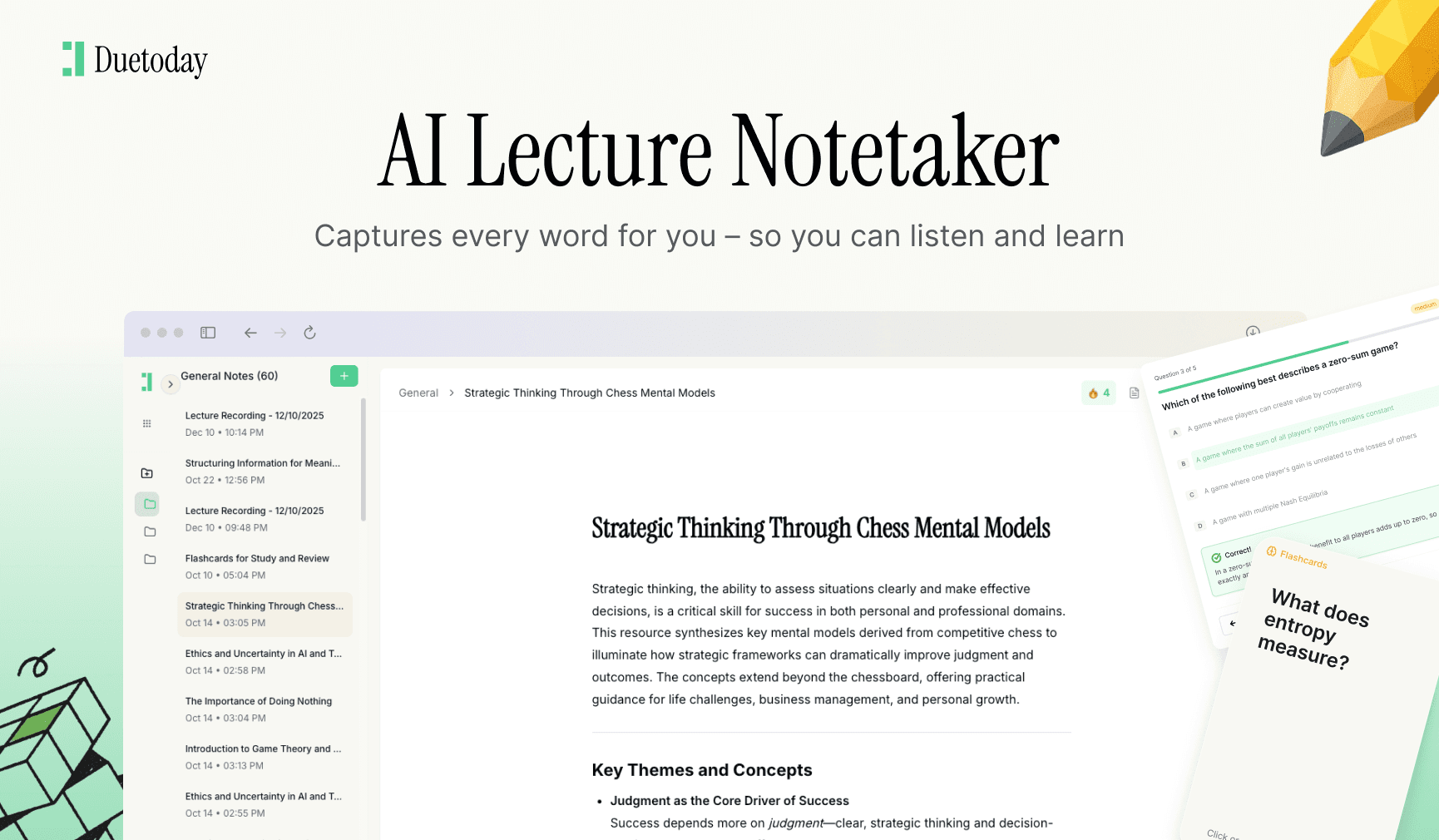
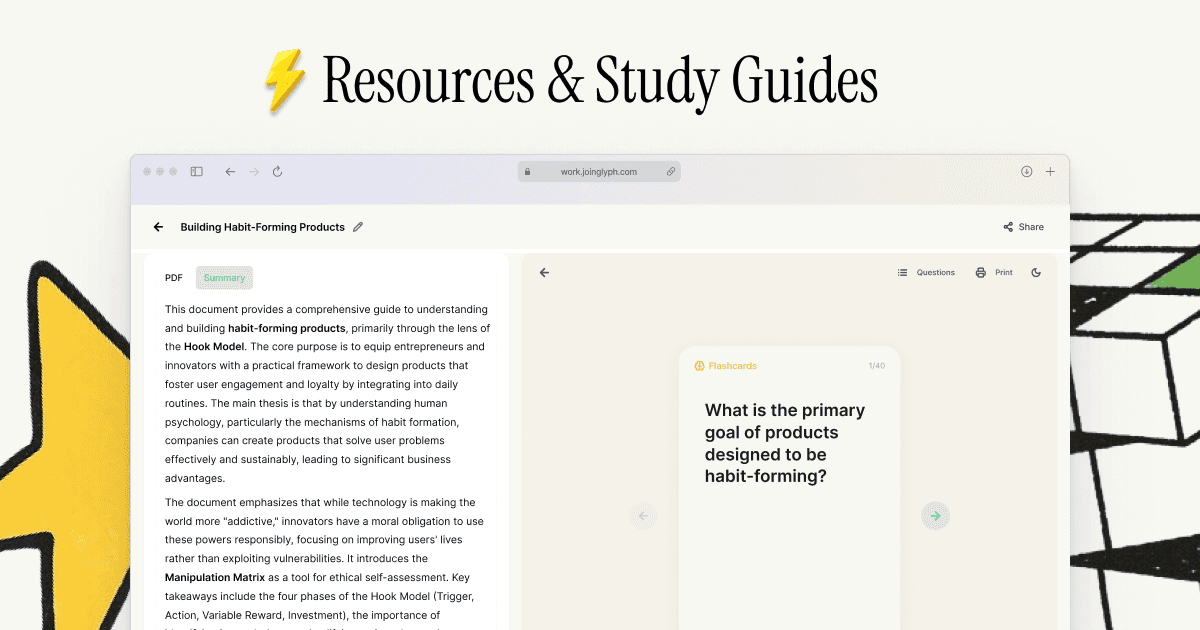
If you want this entire process automated, Duetoday is your retention-first AI workspace. Instead of manually crafting prompts, just upload your materials. Duetoday connects your lectures, PDFs, and Notion notes into a single AI Brain that generates practice questions and active recall prompts automatically. Step away from the chat box and into a system that actually helps you remember everything you learn.
Pick two prompts from the list above and start your study session today. If you want it done automatically, Duetoday can build your entire learning brain in seconds.