
>

>

ChatGPT prompts for Creating Study Guides: Fast and Simple.

ChatGPT prompts for Creating Study Guides [Free Guide]

Master your exams with these ChatGPT prompts for creating study guides. Learn how to transform notes into structured review sheets and practice tests instantly.

Use Study AI Free
ChatGPT Prompts for Creating Study Guides

Students often struggle to find the time to organize messy lecture notes, textbook chapters, and slides into a cohesive structure before an exam. These ChatGPT prompts unlock a faster way to synthesize complex information, identify key themes, and create active recall materials that actually help you retain knowledge. Copy and paste the prompts below to turn your raw data into a high-grade roadmap.

The Quick Start Guide

To get the most out of these prompts, follow this simple framework:

  • What to paste: Your lecture transcripts, PDF text, or personal notes.

  • What to replace: Change brackets like [Topic] or [Education Level] to your specific needs.

  • The Golden Rule: Always provide your own source text. If you let ChatGPT browse the web generally, it may include information your professor never covered.

How to Use These Prompts Effectively

Creating a study guide isn't just about summarizing; it’s about organization and retrieval. Follow these steps:

  • Step 1: Input Source Material: Start by pasting your specific notes or textbook excerpts into the chat.

  • Step 2: Define Constraints: Specify the format you want (e.g., bulleted list, table, or Q&A) and the difficulty level.

  • Step 3: Refine and Query: Ask the AI to identify gaps in your notes or to explain the hardest concept in three different ways.

  • Step 4: Finalize for Retention: Move these outputs into a system like Duetoday to ensure you actually review them using spaced repetition.

Bucket A: Understand & Structure

The Comprehensive Outline Prompt

Use this when you have a massive pile of notes and don't know where to start organizing.

I am going to provide my notes for [Topic]. Create a comprehensive study guide outline that categorizes the information into logical modules. Highlight key definitions in bold and list 3 essential takeaways for each section. [Paste Notes Here]

A good answer will provide a hierarchical structure that makes a 50-page transcript feel like a 2-page map.

The Concept Relater

Use this to bridge the gap between different chapters or complex theories.

Based on the attached text, create a 'Concept Connection' chart. Explain how [Concept A] relates to [Concept B] and identify any overlapping principles. Focus on how these might be compared in an essay question

A good answer explains the 'why' behind the relationships, rather than just defining the terms in isolation.

The Simplified Logic Chain

Use this for technical subjects where the sequence of steps is vital for understanding.

Break down the process of [Topic/Process] into a step-by-step logic chain. Use simple analogies for each step so a beginner can understand the workflow. [Paste Text Here]

A good answer removes jargon and uses a clear, chronological flow to explain a difficult system.
Bucket B: Remember & Retain

The Flashcard Generator

Use this to prep for vocabulary-heavy exams or memorization-based subjects.

From the provided material, extract a list of the 15 most important terms and dates. Format them as a 'Term: Definition' list that is ready to be converted into flashcards. [Paste Text Here]

A good answer is concise, with one clear fact or definition per line for easy memorization.

The Spaced Repetition Planner

Use this to turn your study guide into a long-term retention schedule.

I have an exam on [Date]. Based on the complexity of the study guide created above, generate a 7-day study schedule using spaced repetition. Tell me which sections to review each day

A good answer calculates high-intensity sessions for new topics and quick reviews for older ones.

Bucket C: Practice & Test

The Socratic Tutor Mode

Use this to simulate a live oral exam or a tutoring session.

I want you to act as a tutor. Using my notes, ask me one question at a time about [Topic]. Wait for my answer. After I answer, give me feedback and ask the next question to deepen my understanding. [Paste Notes Here]

A good answer challenges you to explain concepts in your own words rather than just reciting facts.

The 'Teach It Back' Drill

Use this to identify gaps in your knowledge by explaining it to the AI.

I will explain [Concept] to you. Based on the source material I provided earlier, tell me what I missed, what I got wrong, and how I can make my explanation more accurate for an exam

A good answer provides constructive criticism and bridges the gap between your current knowledge and the source material.

The Practice Exam Generator

Use this to simulate the actual pressure of an exam environment.

Generate a practice quiz based on these notes. Include 5 multiple choice, 3 true/false, and 1 essay question. Do not provide the answers until I ask for them. [Paste Text Here]

A good answer mimics the formatting of real academic assessments and covers the most critical points of the source text.

Common Mistakes to Avoid

  • Asking without providing source text: This leads to hallucinations where the AI uses general knowledge that may differ from your course material.

  • Not defining difficulty: An AP Biology study guide looks very different from a PhD-level guide; specify your level.

  • Ignoring citations: Always double-check facts, especially dates and specific numbers, as AI can occasionally swap them.

  • Only summarizing: A summary is passive. Ensure your prompts include requests for practice questions or 'teach-back' drills to ensure active recall.

Ready to Build Your Brain?

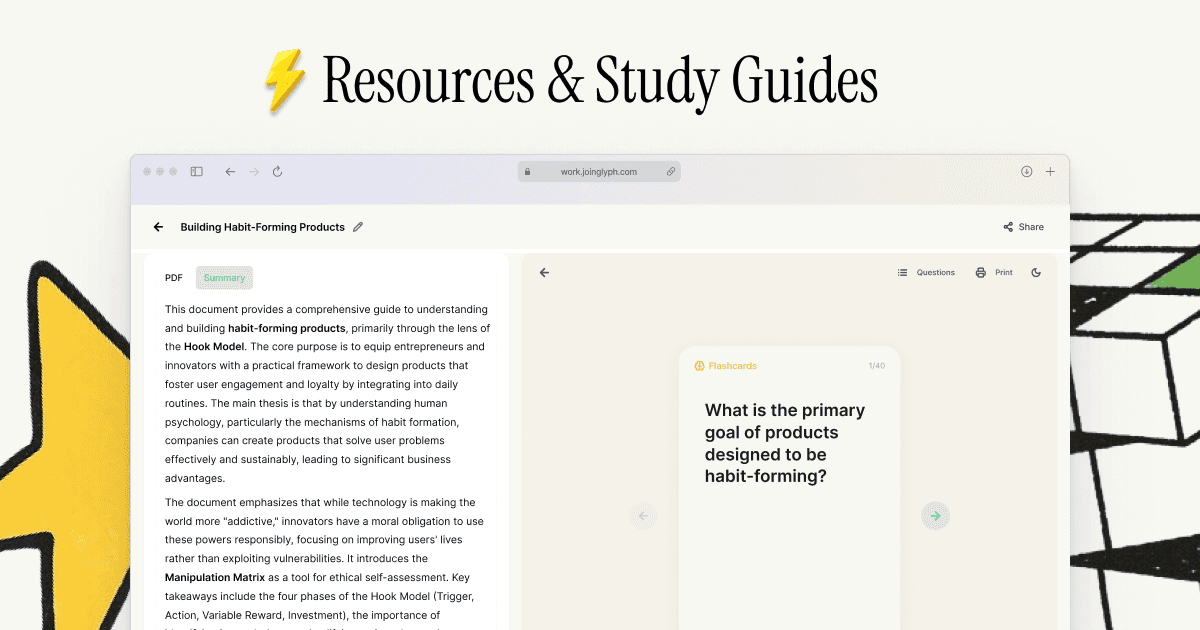
Using these prompts will significantly cut down your prep time. If you want to take it a step further, Duetoday can automate this entire process. Simply upload your PDFs or YouTube links, and let our AI Brain generate your study guides and flashcards in one click. Pick two prompts above and start today!

Duetoday is an AI-powered learning OS that turns your study materials into personalised, bite-sized study guides, cheat sheets, and active learning flows.

More Chatgpt Prompts
GET STARTED

Most Powerful Study Tool
for Students and Educators

Try Out Free. No Credit Card Required.
