
Chatgpt prompts for Creating Mnemonics [Free Guide]
Discover the best ChatGPT prompts for creating mnemonics. Learn how to turn complex facts into memorable acronyms and stories for better retention.
Use Study AI Free
ChatGPT Prompts for Creating Mnemonics
Students often struggle to memorize dense lists of information, complex sequences, or technical terminology that just won't stick through rote repetition. These ChatGPT prompts unlock creative memory hacks, transforming dry data into vivid stories, catchy acronyms, and mental imagery that boost long-term retention. Use the copy/paste prompts below to build your own custom memory palace in seconds.
Quick Answer: The Best Way to Build Mnemonics
To get the highest quality mnemonics from ChatGPT, you must provide the specific list of items you need to remember and define the desired style (e.g., a funny sentence, an acronym, or a rhyming verse). Always paste your source material directly into the chat to prevent the AI from hallucinating incorrect facts. For example, tell ChatGPT: 'Create a mnemonic for these 5 steps of mitosis for a college-level biology student.' The golden rule is to rely on your provided text so the output remains academically accurate while being creatively sticky.
How to Use These Prompts Effectively
Step 1: Paste your material: Provide the specific terms, dates, or phrases from your lecture notes or textbook.
Step 2: Set constraints: Specify the level of complexity (medical student vs. middle school) and the format (acronym, peg system, or story).
Step 3: Ask for a 'Vividness Check': Ask the AI to make the mnemonic more bizarre or emotional, as weird associations are easier to remember.
Step 4: Convert into Spaced Repetition: Once you have your mnemonic, move it into a system like Duetoday to ensure you review it right before you forget.
Bucket A: Understand & Simplify
The Simple Acronym Creator
Use this when you have a list of items where the order doesn't matter but you need to remember all components.
"I am studying [Topic]. Based on the following list: [List of Items], create three different easy-to-remember acronyms. Explain why each one works and suggest a visual image to associate with the acronym."
A good answer provides short, punchy words where each letter clearly maps to a key term from your list.
The Narrative Chain Method
Use this for processes or sequences where the order is vital to understanding the concept.
"Turn this sequence of events into a short, bizarre, and funny story: [Paste Sequence]. Each step must logically link to the next using vivid sensory details. Keep it under 100 words."
A good answer creates a 'mental movie' where the ending of one action triggers the memory of the next step.
The First-Letter Sentence (Acrostic)
Use this for memorizing hard-to-spell sequences or scientific classifications.
"Create a catchy acrostic sentence for these terms: [Terms]. The sentence should be funny or weird so it sticks in my mind. Ensure the first letter of each word matches the sequence provided."
A good answer produces a grammatically simple sentence that is much easier to recall than the raw data.
Bucket B: Practice & Recall
The 'Teach It Back' Mnemonic Drill
Use this to test if your mnemonic actually helps you understand the underlying material.
"I have created this mnemonic: [Mnemonic] to remember [Topic]. Act as a tutor and ask me to explain the concept behind each part of the mnemonic one by one. Correct me if I miss any details from my notes: [Paste Notes]."
A good answer forces you to retrieve the information, not just recite the acronym.
The Visual Peg System Generator
Use this for long lists (10+ items) that need to be memorized in specific order.
"I need to remember these 10 items using the Number-Rhyme system (1-Sun, 2-Shoe, etc.). Map these items to the pegs: [List of Items]. Create a vivid, interactive mental image for each pair."
A good answer provides 10 distinct, high-energy associations that link your data to the numbers 1-10.
The Rhyme & Rhythm Architect
Use this for formulas or definitions that need to be memorized word-for-word.
"Convert this definition/formula into a short, rhythmic nursery rhyme or a rap lyric: [Paste Formula/Definition]. It must maintain the exact order of operations or keywords."
A good answer uses meter and rhyme to make the information 'earworm' its way into your memory.
Bucket C: Advanced Retention
The Error-Log Mnemonic
Use this when you keep getting the same specific fact wrong in practice tests.
"I keep confusing [Concept A] with [Concept B]. Based on these notes: [Paste Notes], create a mnemonic that specifically highlights the difference between the two so I never swap them again."
A good answer creates a 'contrast mnemonic' that pins down the specific point of confusion.
Spaced Repetition Schedule Creator
Use this to plan when to review your new mnemonics for permanent storage.
"I just learned these three mnemonics for my exam on [Date]. Create a spaced repetition review schedule for me starting today, following the 1-3-7-30 day rule. Format it as a checklist."
A good answer provides a clear timeline that prevents the 'forgetting curve' from wiping out your hard work.
Common Mistakes to Avoid
Asking without source text: ChatGPT may hallucinate a mnemonic for the 'wrong' version of a theory if you don't provide your specific class notes.
Over-complicating: If the mnemonic is harder to remember than the original fact, it's a bad mnemonic. Keep it simple.
No Retrieval Practice: Simply reading a mnemonic isn't enough; you must practice 'unfolding' it back into the full information.
Ignoring context: Don't let the AI use slang or cultural references you don't understand; ask it to use themes you are familiar with (e.g., 'use Star Wars themes').
Supercharge Your Memory with Duetoday
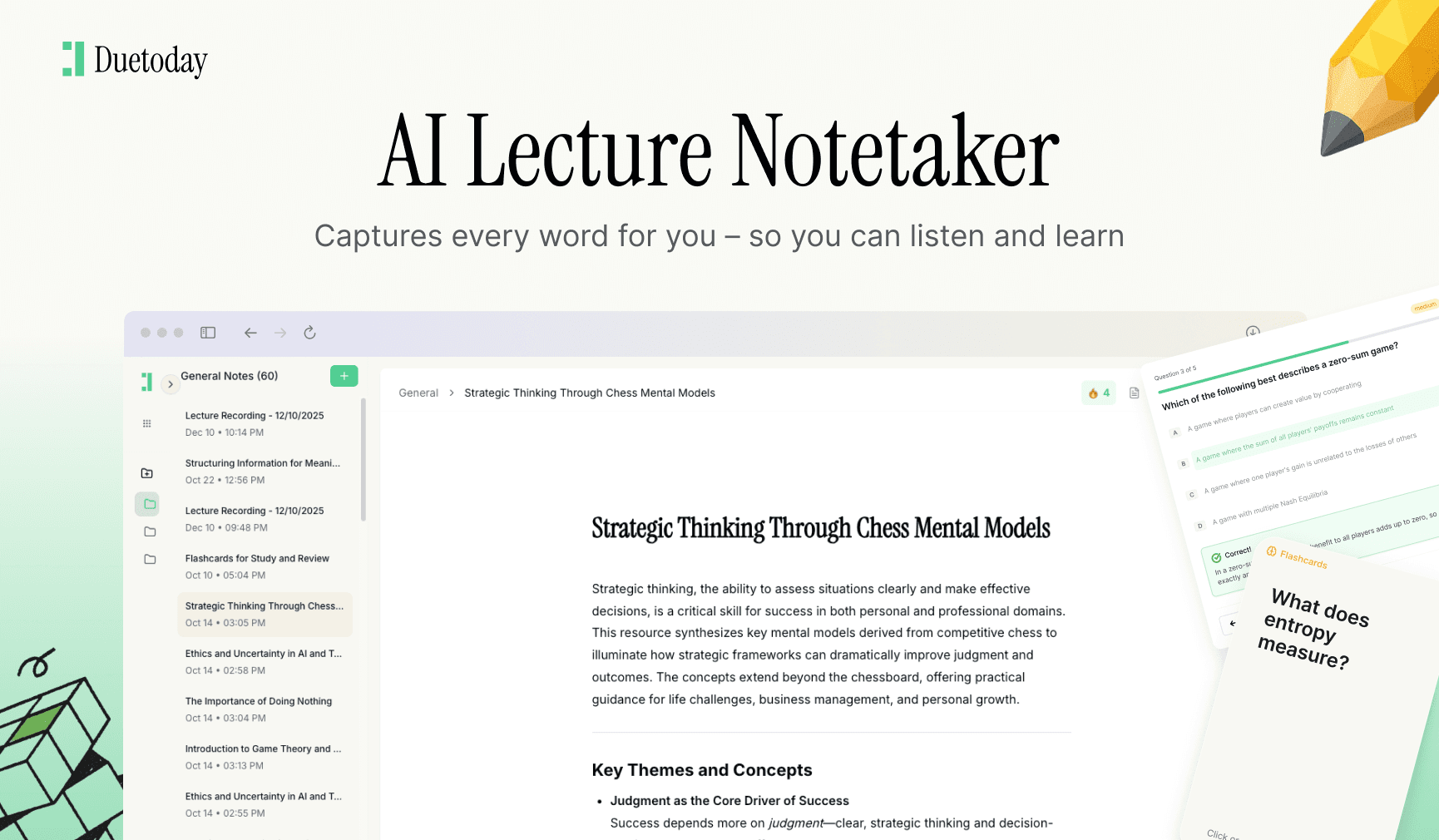
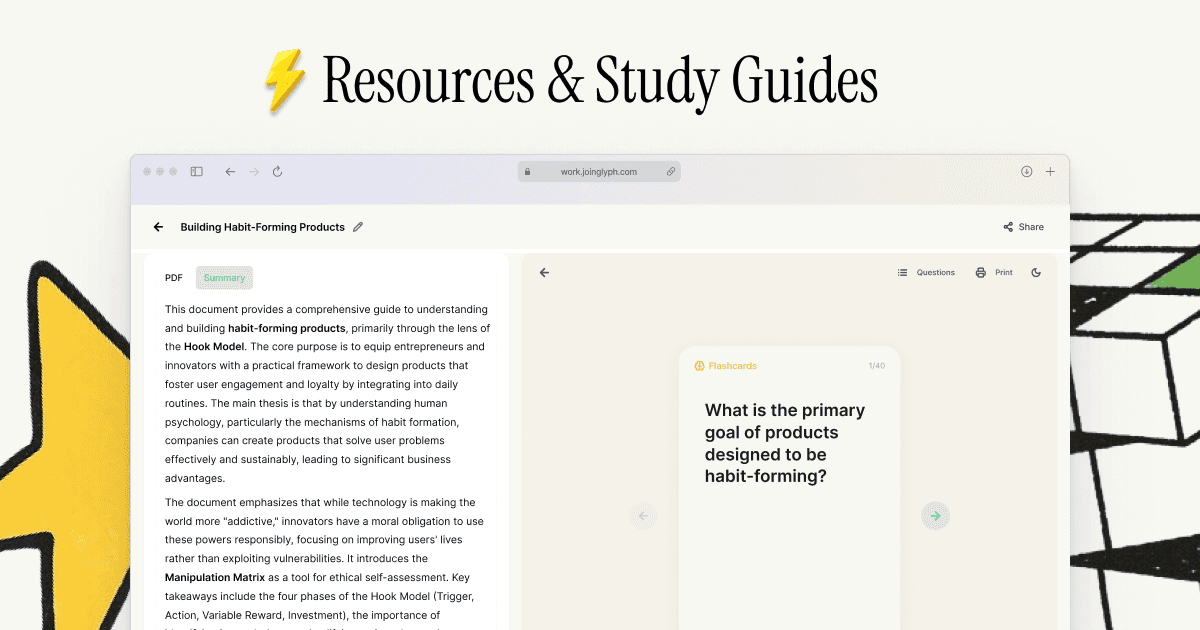
If you want to move beyond manual prompting, Duetoday can automate your entire study workflow. Simply upload your lecture recordings, PDFs, or Notion notes, and our AI Brain will automatically generate structured notes, flashcards, and mnemonics tailored to your specific materials. No more jumping between tools—just one unified workspace for instant recall and long-term retention.
Pick two prompts from this list and start building your memory assets today. Want it done automatically? Try Duetoday.

Duetoday is an AI-powered learning OS that turns your study materials into personalised, bite-sized study guides, cheat sheets, and active learning flows.
More Chatgpt Prompts
GET STARTED
Most Powerful Study Tool
for Students and Educators
Try Out Free. No Credit Card Required.
