
Chatgpt prompts for creating mental models [Free Guide]
Master complex subjects using ChatGPT prompts for creating mental models. Learn how to visualize, connect, and retain difficult concepts faster with our guide.
Use Study AI Free
ChatGPT Prompts for Creating Mental Models
Most students and lifelong learners struggle to move beyond rote memorization into true, deep understanding of how systems actually work. These prompts unlock a higher level of cognition by forcing ChatGPT to bridge the gap between abstract theory and functional reality, leading to 10x faster retention and better problem-solving skills. Simply copy and paste the prompts below to start building your mental library.
Quick Guide: How to Get the Best Results
To create an effective mental model, paste your core study material or a specific concept into ChatGPT and specify your current knowledge level. Always use the Source Material Rule: Provide the actual text from your lectures or PDFs rather than asking ChatGPT to guess, which ensures the mental model is accurate to your specific curriculum or project requirements.
How to Use These Prompts Effectively
To turn ChatGPT into a mental model architect, follow this repeatable four-step system:
Step 1: Feed the Context: Paste your research paper, lecture transcript, or textbook chapter first.
Step 2: Set Constraints: Define the framework you want (e.g., First Principles, Pareto Principle, or Systems Thinking).
Step 3: Audit the Output: Ask the AI to point out the "limitations" of the model it just created to ensure you aren't oversimplifying.
Step 4: Bridge to Reality: Convert the model into a practical analogy or a Spaced Repetition schedule to lock it into long-term memory.
Bucket A: Understand & Deconstruct
The First Principles Breakdown
Use this when a concept feels too bulky or complex to wrap your head around.
A good answer identifies the 3-5 non-negotiable elements that make the concept work.
The Feynman Technique Mirror
Use this to ensure you haven't just memorized jargon without understanding the 'why'.
A good answer uses a relatable metaphor (like comparing a cell to a factory) that maintains scientific accuracy.
Systems Thinking Interconnection
Use this to see how a specific topic fits into a larger ecosystem.
A good answer creates a circular flow or a web of dependencies rather than a linear list.
Bucket B: Remember & Retain
The Analogy Architect
Use this to create a 'memory hook' for abstract data points.
A good answer provides a 'mental image' that you can recall instantly during an exam.
The 80/20 Rule Extraction
Use this when you are short on time and need to focus on what actually matters.
A good answer highlights the 'structural' concepts that support all the minor details.
Visual Mind-Map Outlining
Use this to prepare for drawing or charting the concept yourself.
A good answer serves as a perfect blueprint for a physical study poster or digital canvas.
Bucket C: Practice & Stress-Test
The Socratic Tutor
Use this to test the robustness of your mental model through dialogue.
A good answer feels like a conversation that forces you to think through the logic yourself.
The 'Inversion' Error Log
Use this to spot gaps in your understanding by looking at what *doesn't* work.
A good answer helps you build 'defensive' knowledge to avoid common traps.
Common Mistakes When Building Mental Models with AI
Asking without source text: AI is a generalist; your exam is specific. Always paste your slides.
Ignoring the 'limits' of analogies: No analogy is perfect. If you don't ask where the analogy fails, you might learn wrong information.
Passive reading: Looking at a mental model isn't learning. You must use the 'Socratic' prompt to actively engage.
Over-complicating: If the mental model is harder to remember than the facts, it’s a bad model. Ask the AI to 'simplify further.'
Start Building Your Learning Brain
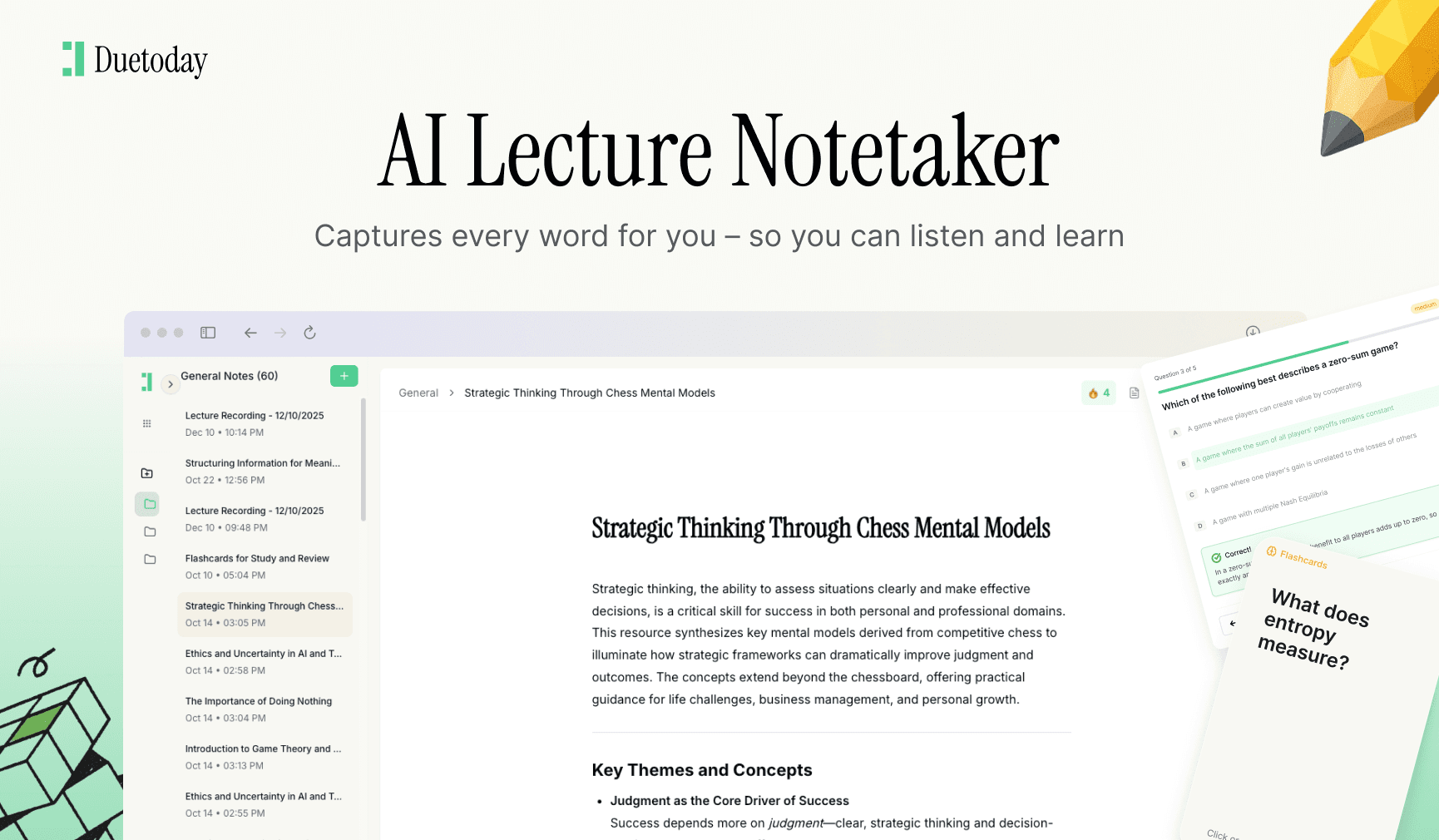
Pick two concepts you’re currently struggling with and run them through the First Principles and Analogy prompts. You’ll be surprised how quickly the fog clears. If you want this entire workflow—from PDF upload to mental model generation—to happen automatically, try Duetoday today side-by-side with your study materials.

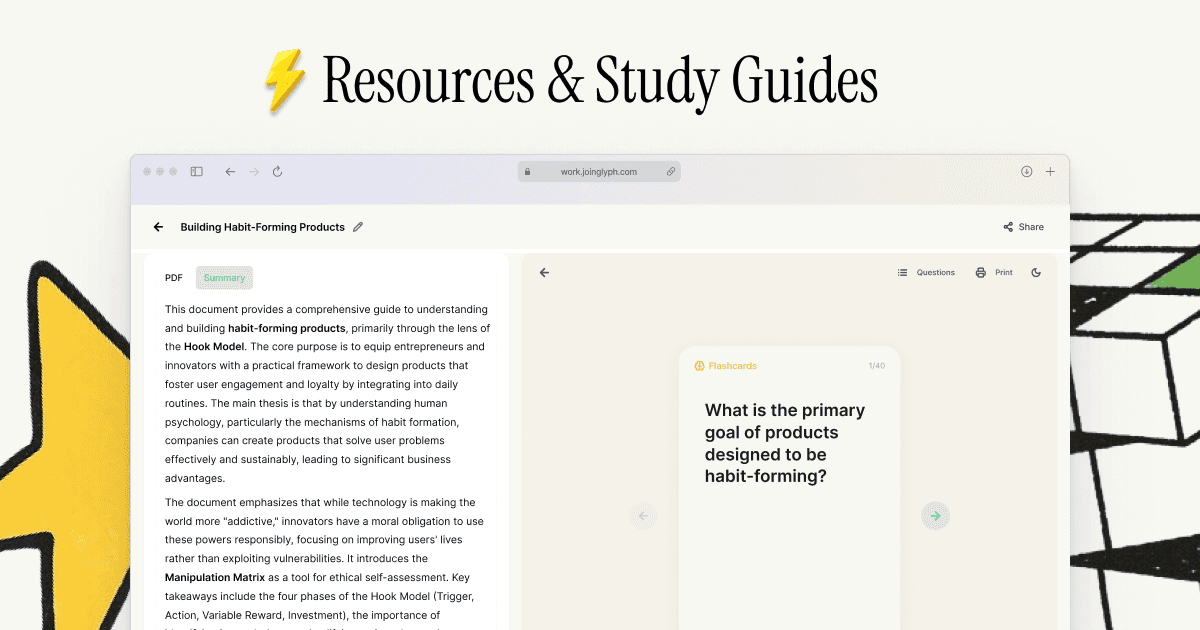
Duetoday is an AI-powered learning OS that turns your study materials into personalised, bite-sized study guides, cheat sheets, and active learning flows.
More Chatgpt Prompts
GET STARTED
Most Powerful Study Tool
for Students and Educators
Try Out Free. No Credit Card Required.
