
Chatgpt prompts for creating flashcards [Free Guide]
Master your exams with our expert ChatGPT prompts for creating flashcards from a chapter. Learn how to transform dense text into active recall tools instantly.
Use Study AI Free
ChatGPT Prompts for Creating Flashcards From a Chapter
Many students struggle to extract the most important information from a dense textbook chapter without ending up with hundreds of low-quality cards. These prompts unlock a faster way to identify core concepts and transform them into high-yield flashcards that improve long-term retention and exam performance. Simply copy and paste the prompts below to turn your reading material into a powerful study deck.
The Quick Start Guide
To get the best results, copy the text from your chapter (or a specific section) and paste it into ChatGPT alongside one of the prompts below. Always specify the complexity level (e.g., Undergraduate Biology) and the format (e.g., Front: Question / Back: Answer). The golden rule for AI flashcards is to always provide the source text—never let the AI guess the facts from its own training data, as it may include information your professor hasn't covered.
How to Use These Prompts
Step 1: Paste your chapter text or lecture notes directly into the chat.
Step 2: Set your constraints, such as the number of cards or the specific focus (e.g., definitions, processes, or dates).
Step 3: Review the output for accuracy and ask the AI to simplify any complex cards.
Step 4: Export the cards into your favorite study tool or convert them into a spaced repetition schedule for maximum memory.
Bucket A: Understand & Simplify
1. The Concept Summarizer
Use this when you have a long chapter and need to narrow down the 'must-know' concepts before making cards.
A good answer will provide a numbered list of core ideas without fluff, acting as a blueprint for your deck.
2. The 'Explain Like I'm 5' Flashcards
Perfect for difficult technical chapters where the textbook language is too dense to memorize.
This ensures you actually understand the underlying logic rather than just memorizing jargon.
3. Socratic Tutor Mapping
Use this to find the gaps in your knowledge before you even start the rote memorization phase.
This helps you create 'Big Picture' cards that connect different parts of the chapter together.
Bucket B: Remember & Retain
4. The Cloze Deletion Generator
Ideal for memorizing specific definitions or formulas where exact wording matters.
This format is excellent for building speed and accuracy during active recall sessions.
5. Spaced Repetition Organizer
Use this to turn a massive chapter into a manageable long-term study plan.
A good answer provides a clear calendar layout that prevents last-minute cramming.
6. The Mnemonic Maker
When you have a list of items or steps to memorize that just won't stick.
This adds a creative layer to your study deck, making abstract lists much easier to recall.
Bucket C: Practice & Master
7. Exam-Style Question Set
Use this to simulate the actual test environment once you've finished the chapter.
This forces active retrieval, which is significantly more effective than passive reading or highlighting.
8. The 'Teach it Back' Drill
The ultimate test of mastery. Use this to ensure you haven't just memorized words, but understood the system.
A good response will be constructive, highlighting exactly where you need to go back and reread the text.
Common Mistakes to Avoid
No Source Text: Never ask the AI to 'make cards for Chapter 5 of the Campbell Biology book'—it might use an old edition or hallucinate facts. Paste the actual text.
Volume Over Quality: Creating 200 cards for one chapter is overwhelming. Aim for 20-30 high-impact cards.
Vague Instructions: If you don't specify the 'Front' and 'Back' layout, the AI might give you a long essay instead of cards.
Ignoring Retrieval: Using AI to summarize is great, but don't forget to actually quiz yourself on the output.
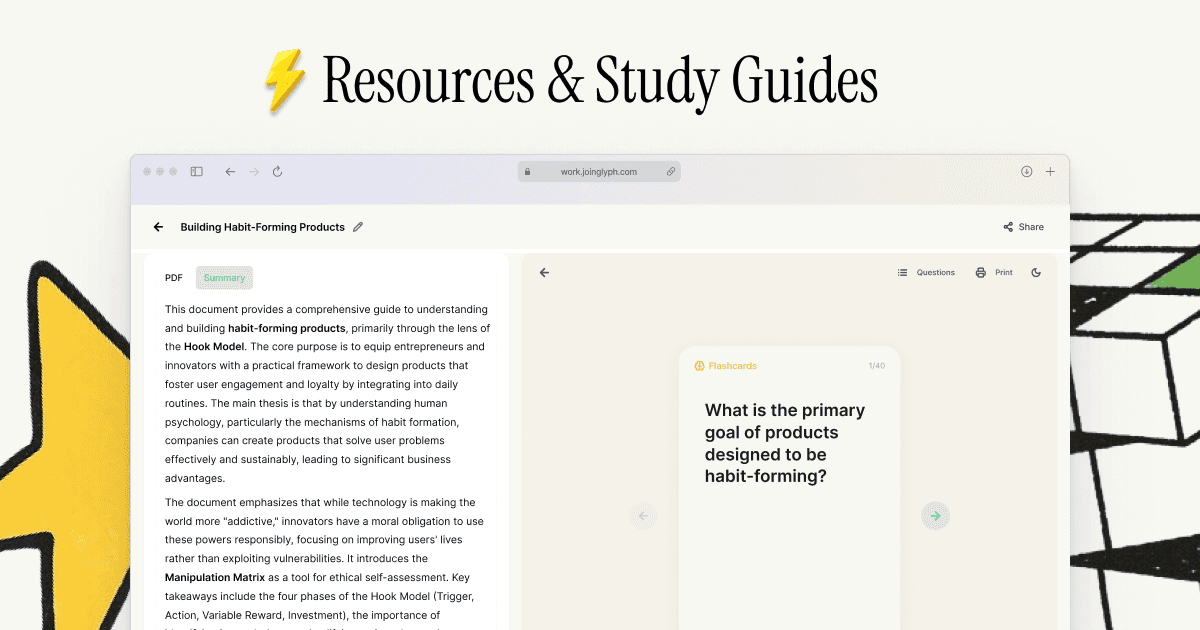
Pick two prompts from the list above and start transforming your study routine today. If you want a more streamlined experience where your PDFs and lectures are automatically converted into retention tools, Duetoday can handle the heavy lifting for you.

Duetoday is an AI-powered learning OS that turns your study materials into personalised, bite-sized study guides, cheat sheets, and active learning flows.
More Chatgpt Prompts
GET STARTED
Most Powerful Study Tool
for Students and Educators
Try Out Free. No Credit Card Required.
