
ChatGPT prompts for Creating Anki Cards [Free Guide]
Master ChatGPT prompts for creating Anki cards. Turn lectures, PDFs, and notes into high-quality flashcards for long-term retention.
Use Study AI Free
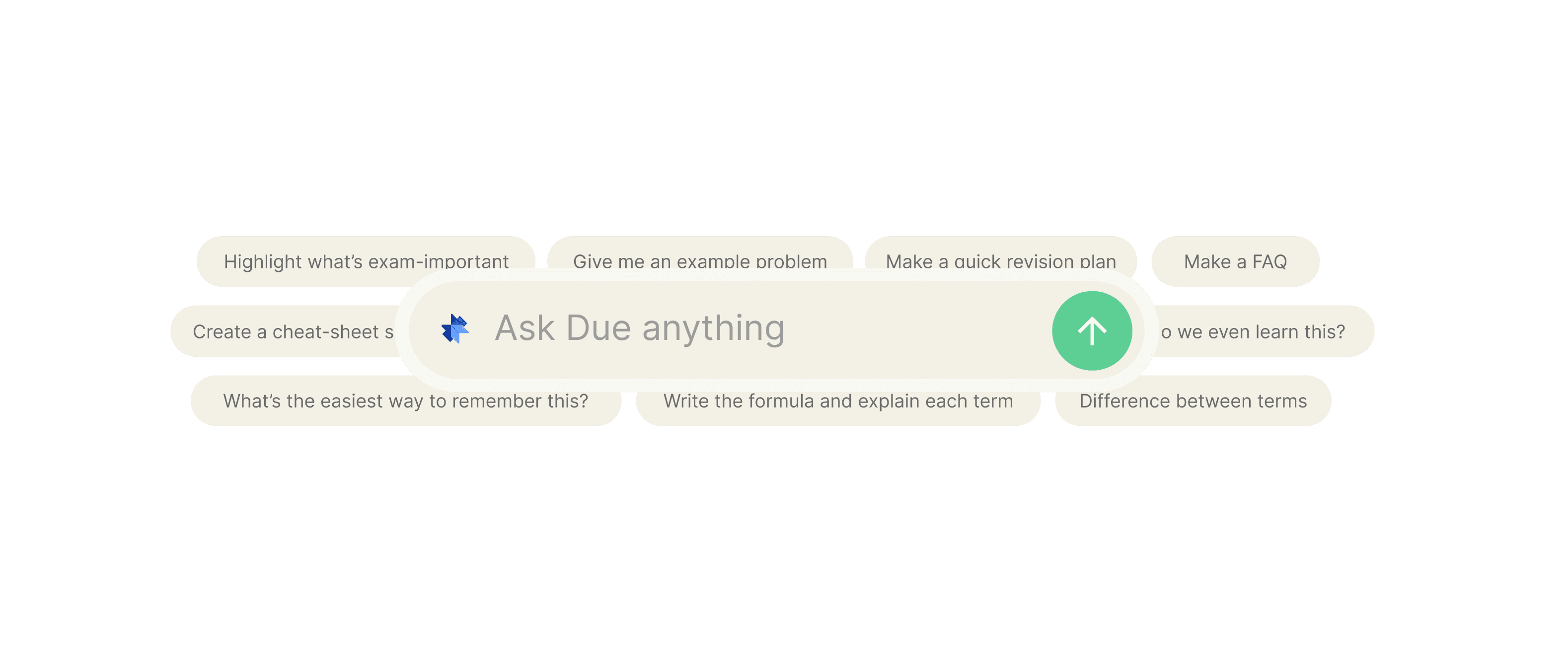
ChatGPT Prompts for Creating Anki Cards
Students often struggle with the 'bottleneck' of Anki: spending more time manually formatting cards than actually studying them. These ChatGPT prompts unlock a faster way to turn dense academic material into high-quality, atomized flashcards designed for maximum long-term retention. Use the copy/paste prompts below to automate your deck creation and get back to learning.
The Quick Answer: How to Create Anki Cards with AI
To get the best results, copy your source text (lecture notes, PDF snippets, or book chapters) and paste it into ChatGPT alongside a specific formatting instruction. The gold standard is to ask for a 'CSV format' or 'Tab-separated values' so you can import the file directly into Anki without manual entry. Always tell ChatGPT to follow the 'Minimum Information Principle'—ensuring each card only asks one specific question to prevent cognitive overload.
How to Use These Prompts Effectively
Step 1: Provide the Source: Paste your raw materials (lecture slides, Notion notes, or YouTube transcripts) first.
Step 2: Define the Format: Specify that you want Front/Back notation or Cloze deletions.
Step 3: Set Constraints: Limit the number of cards or set the difficulty level to ensure the AI doesn't create 'fluff' cards.
Step 4: Import to Anki: Copy the text into a .txt or .csv file and use Anki’s 'Import File' feature to populate your deck instantly.
Bucket A: Understand & Structure
1. The Concept Atomizer
Use this when you have a complex paragraph and need it broken down into simple, digestible facts.
A good answer looks like a series of short Q&A pairs where the 'Front' is a specific question and the 'Back' is a 1-3 word answer.
2. The Socratic Card Builder
Use this to create cards that test your understanding of 'why' things happen, rather than just 'what' they are.
A good answer focuses on causal relationships and mechanisms rather than simple vocabulary definitions.
3. Concept Comparison Cards
Perfect for subjects like biology or law where you need to distinguish between two similar concepts.
A good answer provides cards that prevent 'interference' by clarifying the boundaries between similar terms.
Bucket B: Remember & Practice
4. The Cloze Deletion Generator
Use this for memorizing definitions or specific sentences verbatim using the 'fill-in-the-blank' method.
A good answer will have the most important technical keywords hidden behind brackets for you to guess.
5. The Spaced Repetition Scheduler
Use this if you have an exam date and need a plan for when to introduce new cards.
A good answer provides a clear timeline, prioritizing high-yield topics first.
6. The 'Teach it Back' Drill
Use this to test if your cards are actually effective for your brain's logic.
A good answer removes jargon and uses 'Plain English' to speed up your review sessions.
Common Mistakes to Avoid
Asking without Source Text: Never ask ChatGPT to 'make cards for Biology' without giving it your specific class notes; it will include irrelevant details.
Ignoring the 'Single Fact' Rule: Don't let the AI put 5 bullet points on the back of one card; you will fail to recall them all consistently.
Forgetting to Fact-Check: AI can occasionally hallucinate technical dates. Quickly scan your CSV before importing.
Conclusion
Building a massive Anki deck doesn't have to be a chore. By using these structured prompts, you can bridge the gap between 'reading' and 'remembering' in seconds. Pick two prompts—like the Concept Atomizer or the Cloze Generator—and start transforming your notes today. If you want to skip the manual prompting and have an AI that already knows your syllabus, try Duetoday for a seamless study experience.

Duetoday is an AI-powered learning OS that turns your study materials into personalised, bite-sized study guides, cheat sheets, and active learning flows.
More Chatgpt Prompts
GET STARTED
Most Powerful Study Tool
for Students and Educators
Try Out Free. No Credit Card Required.
