ChatGPT Prompts for Creating a “Zero to Passing” Plan
Many students find themselves staring at a mountain of material just weeks before an exam, feeling overwhelmed and unsure where to start. These prompts unlock a structured, high-intensity roadmap that prioritizes high-yield topics to ensure you reach a passing grade or better in record time. Simply copy and paste the prompts below to turn your academic chaos into a focused execution strategy.
Quick Answer: The Best Way to Use This Page
To get a 10/10 plan, paste your syllabus or lecture list into ChatGPT and ask it to identify "high-yield" topics first. Always replace [Topic], [Level], and [Exam Date] with your specific details. The #1 Rule: Provide your own notes or textbook TOC so ChatGPT doesn't hallucinate irrelevant content.
How to Use These Prompts
Follow this repeatable system to build your passing plan:
Step 1: Paste your source material (syllabus, slides, or messy notes) into the chat.
Step 2: Set constraints such as your current grade level, the exam format (MCQ or Essay), and your time limit (e.g., "I have 48 hours").
Step 3: Ask for the output and perform a self-check by requesting a practice quiz on the most difficult section.
Step 4: Convert the plan into a spaced repetition schedule to ensure the information sticks.
Bucket A: Understand (Priority Setting)
The Pareto Study Planner
Use this when you have almost no time and need to know what actually matters for the grade.
"I have an exam on [Subject] in [Number] days. Based on the following syllabus: [Paste Syllabus], apply the Pareto Principle (80/20 rule) to identify the 20% of topics that will likely account for 80% of the exam marks. Create a study priority list from 'Critical' to 'Optional'."
"I have an exam on [Subject] in [Number] days. Based on the following syllabus: [Paste Syllabus], apply the Pareto Principle (80/20 rule) to identify the 20% of topics that will likely account for 80% of the exam marks. Create a study priority list from 'Critical' to 'Optional'."
"I have an exam on [Subject] in [Number] days. Based on the following syllabus: [Paste Syllabus], apply the Pareto Principle (80/20 rule) to identify the 20% of topics that will likely account for 80% of the exam marks. Create a study priority list from 'Critical' to 'Optional'."
A good answer looks like a ranked list of topics with justifications for why they are high-yield.
The 'Explain Like I'm Five' Baseline
Use this to get a bird's-eye view of a complex subject before diving into the details.
"Explain the core logic of [Topic] as if I am a beginner with no prior knowledge. Use a simple analogy and tell me the three most important things I must understand to pass an introductory exam on this."
"Explain the core logic of [Topic] as if I am a beginner with no prior knowledge. Use a simple analogy and tell me the three most important things I must understand to pass an introductory exam on this."
"Explain the core logic of [Topic] as if I am a beginner with no prior knowledge. Use a simple analogy and tell me the three most important things I must understand to pass an introductory exam on this."
A good answer provides a clear mental model and simple terminology without jargon.
The Concept Connector
Use this to understand how different chapters in your course relate to each other.
"Here is a list of chapters for my upcoming exam: [List Chapters]. Explain how these concepts are interconnected. Create a 'knowledge map' description that shows how Chapter 1 leads into the others so I can see the big picture."
"Here is a list of chapters for my upcoming exam: [List Chapters]. Explain how these concepts are interconnected. Create a 'knowledge map' description that shows how Chapter 1 leads into the others so I can see the big picture."
"Here is a list of chapters for my upcoming exam: [List Chapters]. Explain how these concepts are interconnected. Create a 'knowledge map' description that shows how Chapter 1 leads into the others so I can see the big picture."
A good answer helps you see the course as a single story rather than isolated facts.
Bucket B: Remember (Retained Learning)
The Spaced Repetition Architect
Use this to turn a list of topics into a calendar-based retention plan.
"Create a study schedule for the next [Number] days leading up to my [Subject] exam. Incorporate spaced repetition intervals for these topics: [List Topics]. Tell me exactly what to review each morning and each evening."
"Create a study schedule for the next [Number] days leading up to my [Subject] exam. Incorporate spaced repetition intervals for these topics: [List Topics]. Tell me exactly what to review each morning and each evening."
"Create a study schedule for the next [Number] days leading up to my [Subject] exam. Incorporate spaced repetition intervals for these topics: [List Topics]. Tell me exactly what to review each morning and each evening."
A good answer is a day-by-day table that balances new learning with active review.
The Meaningful Mnemonic Maker
Use this for hard-to-remember lists, formulas, or chronological events.
"I am struggling to memorize [List of Items/Steps]. Create 3 different mnemonics for these, ranging from funny to professional, and explain the logic behind each one to help it stick in my long-term memory."
"I am struggling to memorize [List of Items/Steps]. Create 3 different mnemonics for these, ranging from funny to professional, and explain the logic behind each one to help it stick in my long-term memory."
"I am struggling to memorize [List of Items/Steps]. Create 3 different mnemonics for these, ranging from funny to professional, and explain the logic behind each one to help it stick in my long-term memory."
A good answer provides catchy, easy-to-remember phrases tied directly to your material.
Bucket C: Practice (Exam Simulation)
The Socratic Tutor Mode
Use this to test your depth of understanding by being interviewed by the AI.
"I want you to act as a Socratic tutor. Based on this text [Paste Text], ask me one challenging question at a time to test my understanding. After I answer, provide feedback and ask the next question. Do not give me the answers upfront."
"I want you to act as a Socratic tutor. Based on this text [Paste Text], ask me one challenging question at a time to test my understanding. After I answer, provide feedback and ask the next question. Do not give me the answers upfront."
"I want you to act as a Socratic tutor. Based on this text [Paste Text], ask me one challenging question at a time to test my understanding. After I answer, provide feedback and ask the next question. Do not give me the answers upfront."
A good answer is a back-and-forth dialogue that exposes your specific knowledge gaps.
The Practice Exam Generator
Use this to simulate the actual pressure of the exam day.
"Based on the provided notes, generate a 10-question practice exam. Include 5 multiple-choice questions and 5 short-answer questions. Provide the answer key separately at the bottom so I can grade myself after completion."
"Based on the provided notes, generate a 10-question practice exam. Include 5 multiple-choice questions and 5 short-answer questions. Provide the answer key separately at the bottom so I can grade myself after completion."
"Based on the provided notes, generate a 10-question practice exam. Include 5 multiple-choice questions and 5 short-answer questions. Provide the answer key separately at the bottom so I can grade myself after completion."
A good answer mimics the tone and difficulty of real academic assessments.
The Error-Log Analyst
Use this after a practice session to ensure you don't repeat the same mistakes.
"I got these questions wrong: [Paste Questions/My Answers]. Analyze why my logic was flawed, explain the correct concept simply, and give me a similar 'parallel' question to solve right now to prove I've learned it."
"I got these questions wrong: [Paste Questions/My Answers]. Analyze why my logic was flawed, explain the correct concept simply, and give me a similar 'parallel' question to solve right now to prove I've learned it."
"I got these questions wrong: [Paste Questions/My Answers]. Analyze why my logic was flawed, explain the correct concept simply, and give me a similar 'parallel' question to solve right now to prove I've learned it."
A good answer provides a 'root cause analysis' of your mistake and immediate practice to fix it.
Common Mistakes to Avoid
Asking without source text: ChatGPT will guess based on general internet data rather than your specific professor's curriculum.
Ignoring the level: Always specify if you are in High School, Undergrad, or Grad school to get the right depth.
No retrieval practice: Don't just ask for summaries; ensure you include prompts that force you to recall information.
If you want this automated...
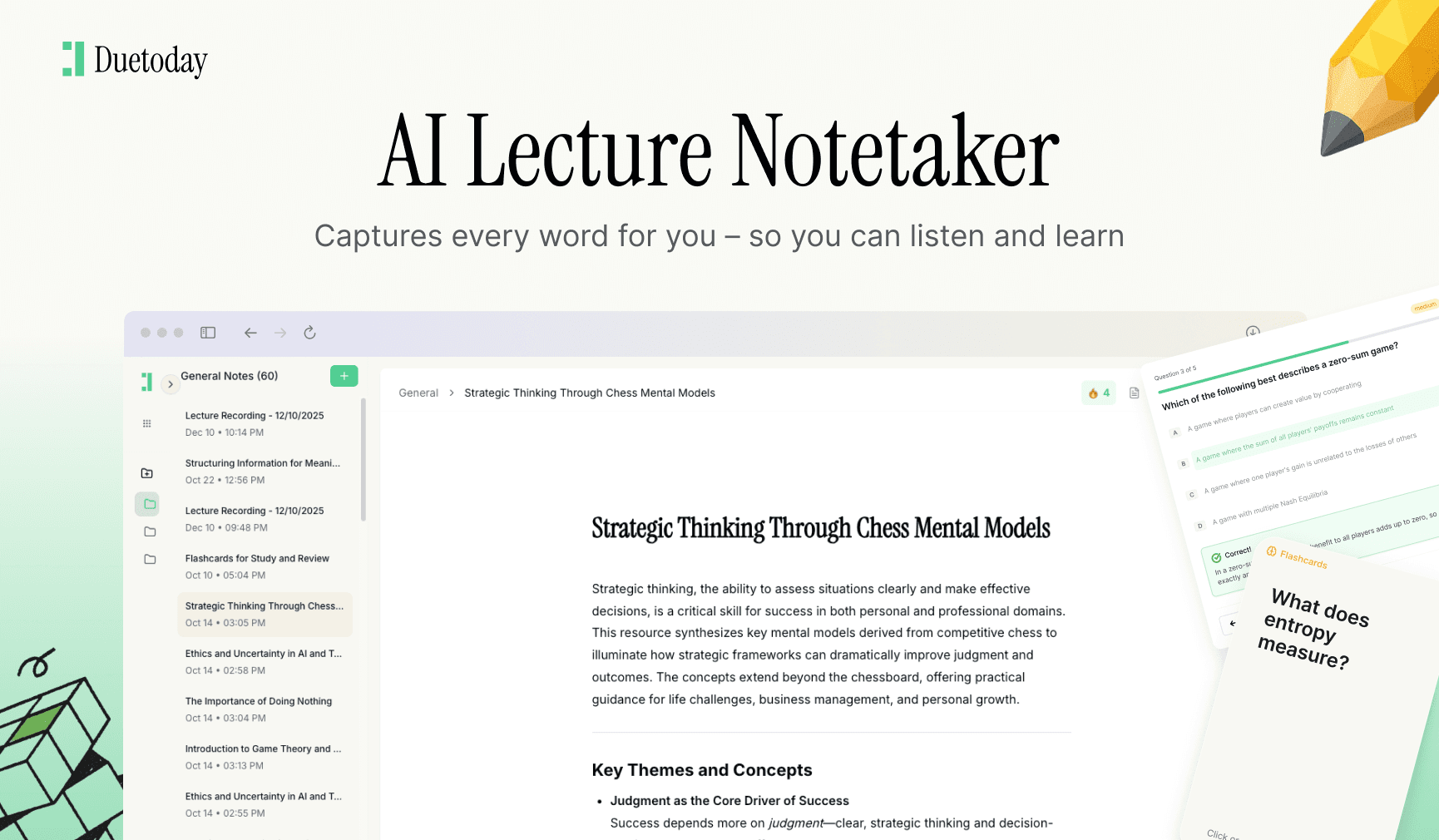
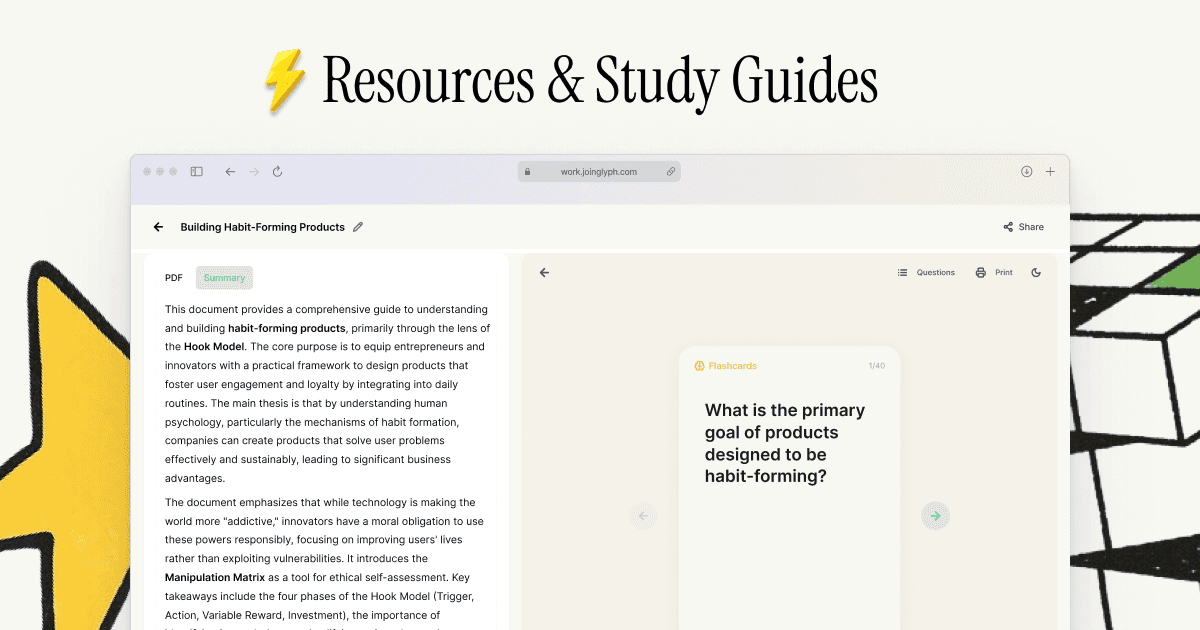
Manually prompting AI can be a chore. Duetoday simplifies your entire study workflow in three steps:
Upload everything: Lectures, PDFs, and YouTube links go into one AI Brain.
Instant Generation: Get flashcards, quizzes, and structured notes automatically.
Retention Focus: Use built-in study modes and your Google Calendar to stay on track.
Start Your Zero-to-Passing Plan with Duetoday AI
Pick two prompts from the list above and start your session right now. If you want the process handled for you from start to finish, try Duetoday for a more connected learning experience.