
>

>

ChatGPT prompts for chapter summaries to master any book quickly.

Chatgpt prompts for chapter summaries [Free Guide]

Master complex books with these ChatGPT prompts for chapter summaries. Learn how to extract key themes, retain more information, and create study guides.

Use Study AI Free
ChatGPT Prompts for Chapter Summaries

Students and lifelong learners often struggle to digest long, dense chapters without losing the forest for the trees, leading to wasted hours and poor retention. These purpose-built prompts unlock the ability to condense complex text into clear, actionable summaries that emphasize key themes and structural logic. Simply copy and paste the prompts below to transform your reading material into high-quality study assets.

Quick Answer: The Best Way to Summarize

To get the most out of ChatGPT, don't just ask it to 'summarize.' Instead, provide the specific text of the chapter and define your goal (e.g., preparing for an exam or writing a review). The golden rule is: Always provide the source text. ChatGPT works best as a processing tool, not a search engine; feeding it your actual notes or PDF text prevents it from hallucinating details that aren't there.

How to Use These Prompts

  • Step 1: Paste your material: Copy the text from your PDF, e-book, or lecture notes into the chat.

  • Step 2: Set constraints: Specify the academic level (e.g., Undergraduate) and the desired format (e.g., bullet points).

  • Step 3: Ask for output + self-check: Request the summary and immediately follow up by asking ChatGPT to quiz you on the content.

  • Step 4: Convert into retention material: Turn the summary into flashcards or a spaced repetition schedule to ensure the knowledge sticks.

Bucket A: Understand the Core Concepts

1. The 'Big Picture' Structural Summary

Use this when you need to understand how a chapter is organized before diving into the details.

Analyze the following chapter text. Provide a high-level summary that outlines the main argument, the 3-5 supporting sections, and how they connect to the overall thesis of the book. [Insert Text]

A good answer will provide a logical flow showing how one idea leads to the next.

2. Concept-to-Example Breakdown

Ideal for STEM or social science chapters where abstract theories are paired with specific case studies.

Extract every major concept introduced in this chapter. For each concept, provide a 1-sentence definition and the specific example used in the text to illustrate it. [Insert Text]

A good answer helps you ground theory in reality without unnecessary fluff.

3. The Simple-First Summary

Use this for extremely dense or jargon-heavy chapters that feel overwhelming.

Summarize the attached chapter as if you are explaining it to a high school senior. Avoid jargon where possible, and use an analogy to explain the most difficult concept. [Insert Text]

A good answer provides foundational clarity so you can move on to advanced study.
Bucket B: Remember and Retrieve

4. The Key Terms Glossary

Use this to isolate the vocabulary you must know for a test or professional application.

Identify all bolded terms, specialized vocabulary, and key figures mentioned in this chapter. Create a table with the term in the left column and a concise definition in the context of this chapter in the right. [Insert Text]

A good answer creates a ready-made cheat sheet for quick review sessions.

5. The Spaced Repetition Blueprint

Use this to plan your long-term retention of the chapter's material.

Based on this chapter summary, create a 4-week study schedule following spaced repetition principles (Day 1, 3, 7, 14, 28). For each session, suggest one specific question I should answer to test my memory. [Insert Text]

A good answer gives you an actionable plan to move information to long-term memory.

Bucket C: Practice and Test

6. The Socratic Tutor Mode

Use this to engage in active recall rather than passive reading.

I am going to paste a chapter summary. I want you to act as a Socratic tutor. Don't give me the answers. Instead, ask me 3 challenging questions that require me to synthesize the information in the text. [Insert Text]

A good answer forces you to think critically instead of just skimming.

7. Potential Exam Question Generator

Use this to predict what your professor or examiner might ask.

Review the following chapter text and generate 5 multiple-choice questions and 2 short-answer essay prompts. Include an answer key at the very bottom. [Insert Text]

A good answer mimics the difficulty level of a university-level assessment.

8. The 'Teach it Back' Drill

Use this to find gaps in your own understanding of the summary.

I will summarize what I learned from this chapter. Your job is to point out any factual errors, missed key points, or logical gaps based on the text provided below. [Insert Text]

A good answer acts as a safety net for your self-directed learning.

Common Mistakes to Avoid

  • Summarizing without source text: Never ask for a summary of a 'popular' book without providing the text; ChatGPT may rely on outdated or generic data.

  • Ignoring the 'Formatting' instruction: If you don't ask for bullets or tables, you'll get a wall of text that is hard to study from.

  • Passive consumption: Reading a summary is not enough. You must use the 'Practice' prompts to ensure you actually understand the material.

Conclusion

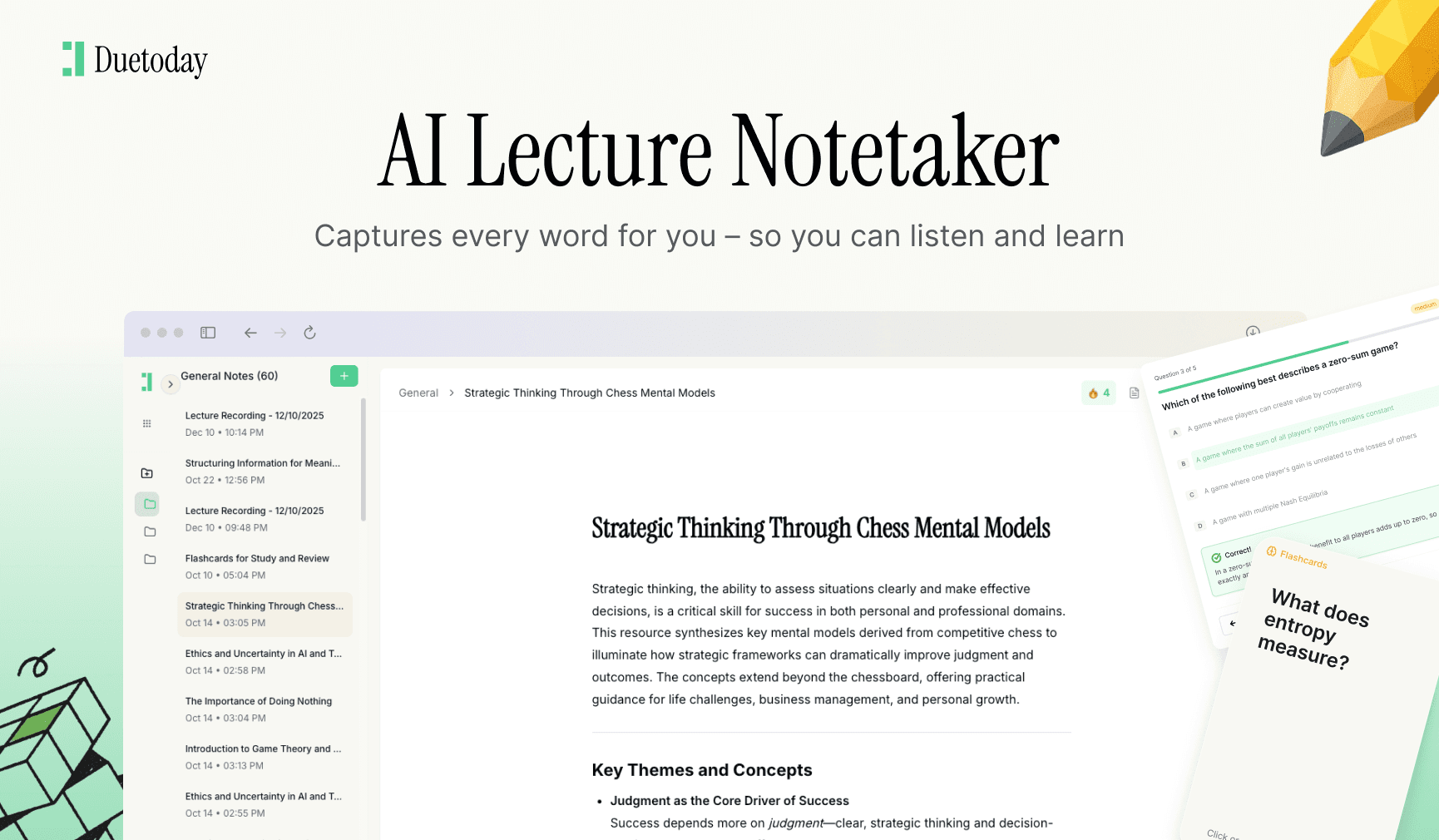
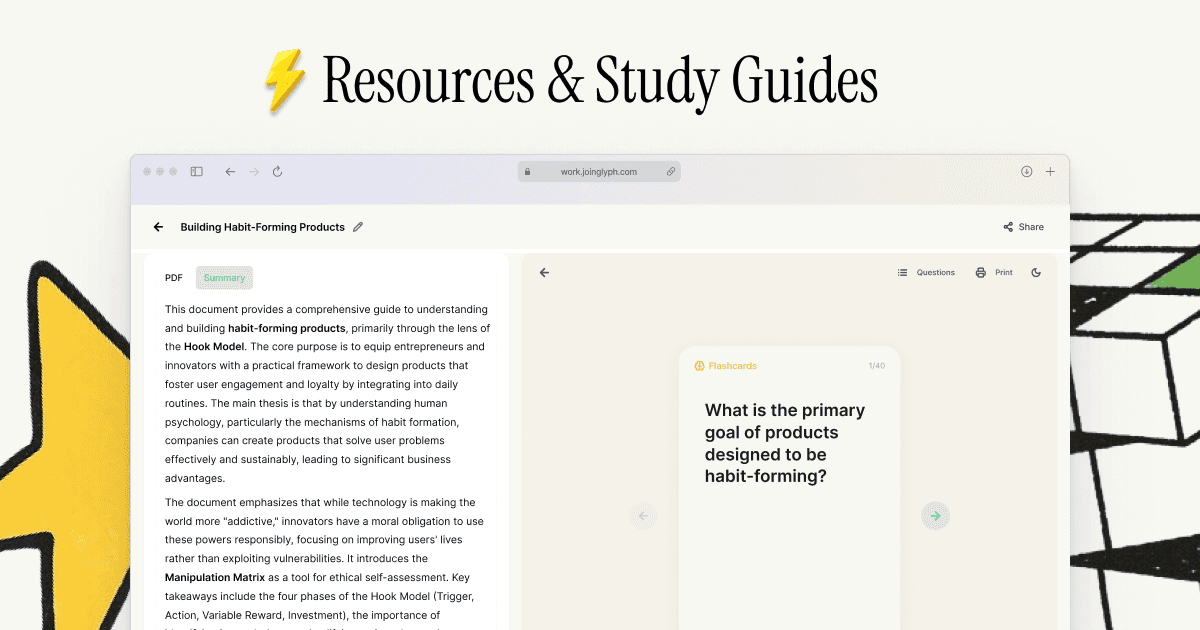
Pick two of the prompts above and start with your next reading assignment. Whether you need a simple breakdown or a rigorous practice test, these prompts turn ChatGPT into a powerful study ally. If you want to automate this entire process—connecting your PDFs, YouTube lectures, and Notion notes into a single AI brain—give Duetoday a try.

Duetoday is an AI-powered learning OS that turns your study materials into personalised, bite-sized study guides, cheat sheets, and active learning flows.

More Chatgpt Prompts
GET STARTED

Most Powerful Study Tool
for Students and Educators

Try Out Free. No Credit Card Required.
